These instructions apply to the Honda Civic Mk11 (FE/FL) 2022-Present.
For other models, please choose your vehicle here.
The Honda Civic Mk11 (FE/FL, 2022–present) uses a Deflation Warning System that watches the wheels and learns a reference. After you inflate or change a tyre you calibrate it from the dashboard menu so it knows the new pressures are correct. Here’s how.
The amber tyre symbol means the current pressures no longer match the reference the car has stored. It is a warning rather than a fault: on a healthy car it usually appears because a tyre has slowly lost air, the weather has turned cold, or the wheels have recently been off. Once the pressures are right and you have calibrated, it clears and stays clear.
How the Civic’s System Works
The Deflation Warning System doesn’t read a pressure figure from each wheel; instead it learns your correct pressures as a reference and then watches for a tyre that behaves as if it is losing air. That is why the fix is “inflate and calibrate” rather than just topping up — the calibration step writes the current pressures into memory as the new baseline. Because it is a learned reference, calibrating while a tyre is soft teaches the wrong target, so the pressures must be right before you start.
Getting Ready
- Set the pressures with the tyres cold — after standing or a very short drive. Warm tyres read high and calibrate a false value.
- Use the figures on the driver’s door-pillar label, matched front and rear to your load.
- Make sure the car is stationary, ignition on, gear selector in P before you open the menu.
- Even a few psi low across the set is enough to keep the light on, so check all four with a gauge.
Set the Pressures First
Inflate all four tyres cold to the figure on the driver’s door-pillar label, then calibrate.
How to Calibrate the Civic Mk11 TPMS
- With the car stationary, turn the ignition ON and put the gear selector in P.
- On the multifunction display, select ‘HOME’.
- Open the ‘Vehicle settings’ menu.
- Select ‘Deflation Warning System’, then ‘Calibrate’.
- Confirm — the system stores the current pressures as the reference. It finishes learning over a short drive.
If the Light Stays On
- Re-check every tyre — one low corner keeps the warning on.
- Always calibrate after inflating or a wheel change — the system needs the new baseline.
- Calibrate with correct, even pressures — calibrating on a soft tyre teaches the wrong reference.
- Give it a short drive — calibration finishes on the move, so allow a few minutes of steady driving before deciding it hasn’t worked.
- Look for a slow puncture — if a corner keeps dropping over a day or two, suspect a nail or a leaking valve; the light will keep returning until it’s repaired.
- Still on with everything correct? A stored fault may be involved — look up the code on autodtcs.com.
What Happens Next
Once you confirm the calibration with the pressures correct, the warning clears and the car finishes learning the new baseline over the first few minutes of driving. From then on it judges every tyre against that fresh reference, so the light only returns if a tyre genuinely drops again. A warning that comes straight back after calibrating is a useful hint of a slow leak worth inspecting.
Frequently Asked Questions
How do I reset the tyre pressure light on a Honda Civic?
Set the pressures, then on the display go to Home → Vehicle settings → Deflation Warning System → Calibrate. Do it with the car stationary, ignition on and the selector in P, then drive for a few minutes so the system can finish learning the new reference.
Do I need a tool?
No — the Civic calibrates from its own menu; no garage equipment needed.
Why does the light come on in cold weather?
Pressures drop as temperature falls. Top up to the label figure and re-calibrate. A tyre set correctly in mild weather can read low on a cold morning, so this is normal seasonal behaviour rather than a puncture — unless the same corner keeps needing air.
It came on after a wheel change — why?
The reference moved. Run Calibrate so the new pressures become the baseline. The same applies after a puncture repair, a tyre rotation, or fitting a different set of wheels — the system has to relearn what “correct” is.
Does the Civic show individual tyre pressures?
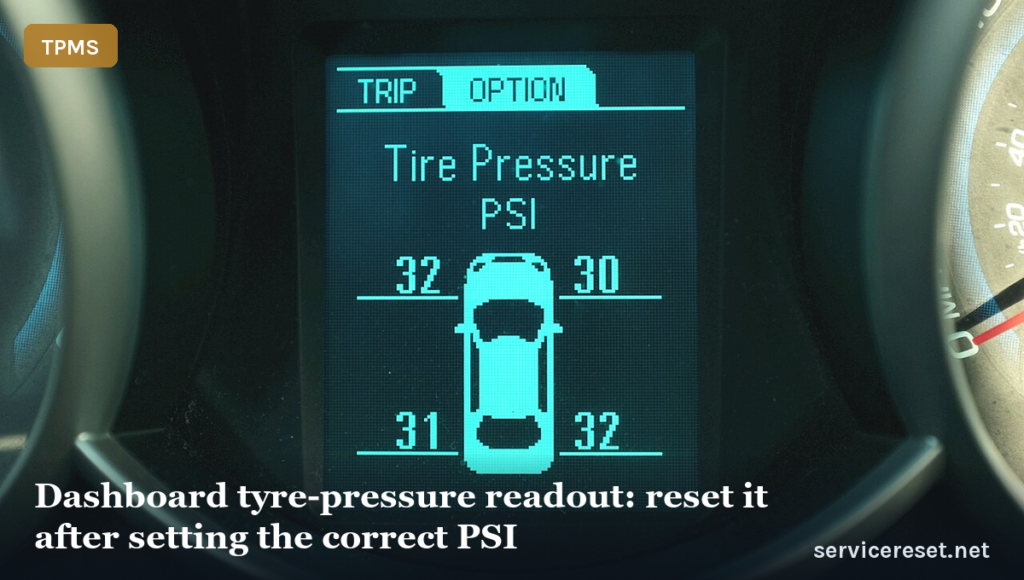
The Deflation Warning System is a monitoring type that learns a reference and flags a tyre losing air, rather than displaying a live psi figure for each corner. That is why the reset is a Calibrate step from the menu rather than something that clears on its own. Always check the pressures with your own gauge.
If a fault code is stored, look it up on autodtcs.com. To clear a maintenance reminder, see our Civic Mk11 service reset.
Independent guide — not affiliated with Honda. Always follow your official service manual and safety precautions. Read our full disclaimer.