These instructions apply to the SsangYong Tivoli Mk1 2015-2022.
For other models, please choose your vehicle here.
When the remote for a SsangYong Tivoli (2015–2022) starts working only from arm’s length, responds on the second or third press, or goes dead altogether, the culprit is nearly always the little coin cell inside it. Depending on trim and market, your Tivoli came with one of two keys — a three-button folding “flip” remote (the common one, shared with the Korando and Musso) or a smart keyless fob with a pull-out emergency blade. Both run on the same cheap battery but open in completely different ways. Here is what to buy, how to open each key without cracking the case, and why cutting a brand-new key is the one part of this job you can’t do at home.
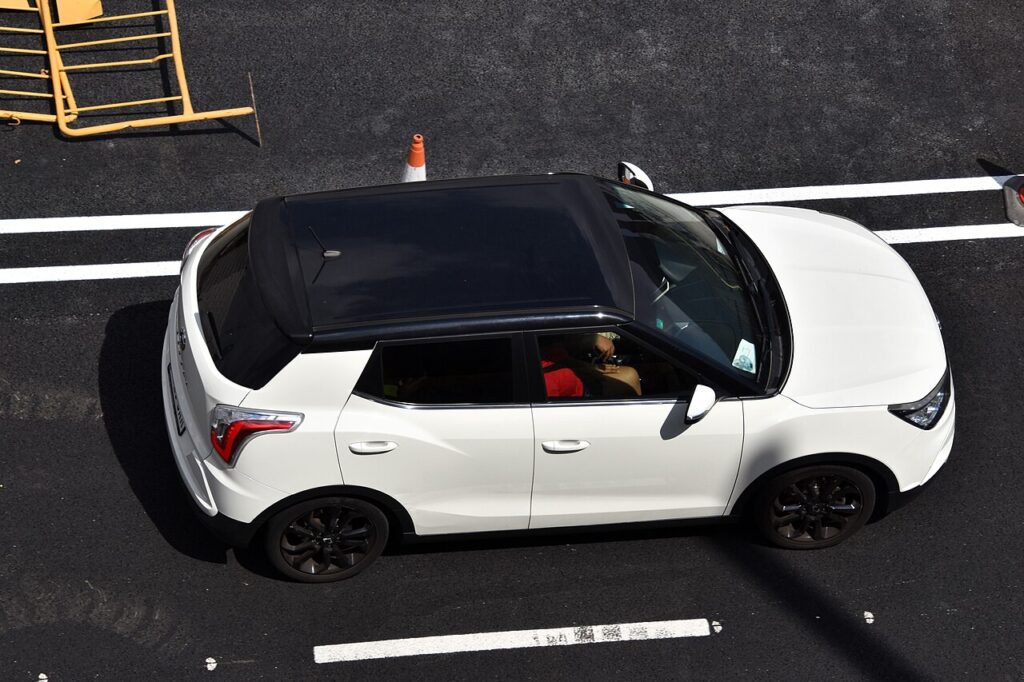
How to Tell the Fob Battery Is Dying
- Shrinking range. You have to stand right next to the Tivoli, or almost touch the door handle with the key, before it locks or unlocks. This gradual loss of range is the classic first sign.
- Second- and third-press operation. The car responds eventually but not on the first button push — a weak cell that can’t sustain the transmitter’s brief current draw.
- Cold-morning dropouts. A near-flat lithium cell loses voltage in the cold, so a key that is fine at midday may refuse to work first thing on a frosty morning.
- Keyless fob not detected. On smart-key Tivolis, the car may stop recognising the fob for passive entry or push-button start, forcing you to touch the fob to the start button — a documented low-battery behaviour on keyless SsangYongs.
A CR2032 in a Tivoli remote typically lasts two to four years. If yours is around that age and showing any of the above, fit a fresh cell before you start suspecting the receiver or the immobiliser.
The Battery You Need
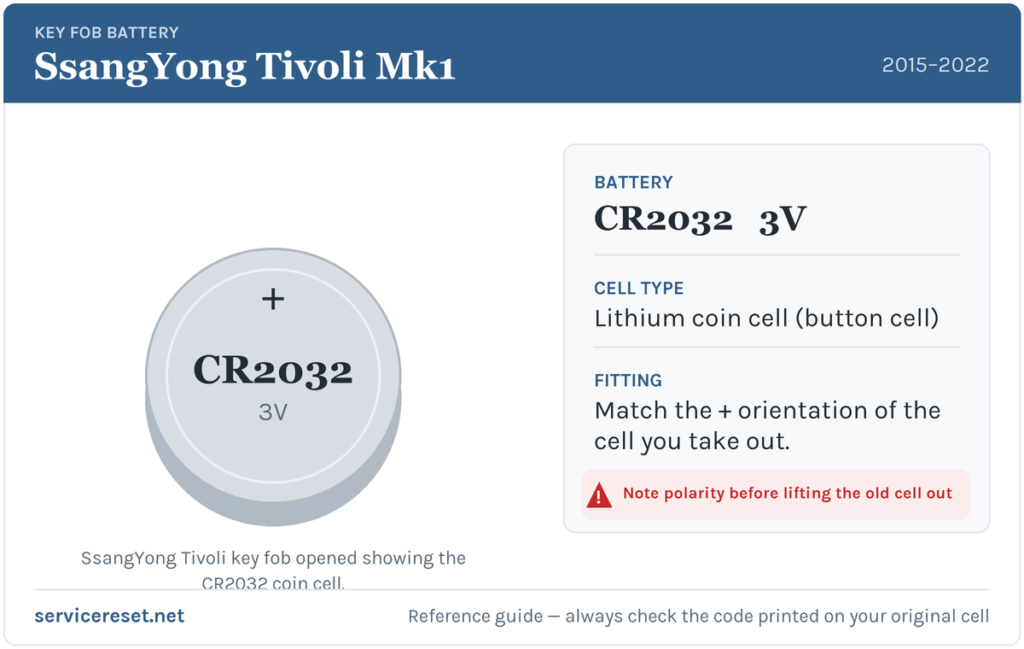
Both the flip remote and the smart fob take a single CR2032 3-volt lithium coin cell. That is the most common key-fob battery made, sold in any supermarket, hardware shop or petrol station. A CR2025 is a slightly thinner drop-in alternative that also fits and works, though the marginally-thicker CR2032 is the correct spec and holds a little more charge. Fit a good-quality branded cell — bargain-bin coin cells often sag under load and give poor range even when brand new.
Method 1 — Three-Button Folding “Flip” Remote
This is the switchblade-style key whose metal blade folds out of the fob body at the press of a button. It is the standard Tivoli key and is identical to the one used on the Korando and Musso.
- Fold the metal blade closed so the fob is easier to grip.
- Find the seam that runs around the edge of the plastic case. Insert a small flat-blade screwdriver into the slot on the side and gently lever the two halves apart — the back cover pops off. There is no screw on this key.
- Before removing the old cell, press the remote buttons a few times to bleed off any residual charge, then lift the flat battery out.
- Fit the new CR2032 with the positive (+) side facing up, the same way the old one sat. Match what you removed if in any doubt.
- Line up the cover and press the halves firmly together until the seam clicks shut all the way round, then test every button.
Method 2 — Smart Keyless Fob
If your Tivoli has push-button start and passive entry, you may have the smart fob instead. It has no external screw either; it opens using the emergency blade it carries inside.
- Release the emergency blade: slide the small catch and pull the mechanical key blade straight out of the fob body.
- Insert the tip of that blade (or a thin flat plastic tool) into the small lever slot the blade leaves behind, and twist to split the two halves of the housing apart.
- Note the way the old cell sits, discharge the fob by pressing its buttons, then ease the flat battery out.
- Seat the new CR2032 the same way round as the one you took out, click the case halves back together, and slide the emergency blade home until it latches.
⚠️ Copy the orientation you removed. A coin cell fitted the wrong way round will not power the key, and if it bridges the contacts it can slowly discharge — so always match the polarity of the old cell rather than guessing.
Did It Work?
Stand back a few metres and lock, then unlock, the Tivoli. Full range should return straight away and every button should respond on the first press. On a smart-key car, passive entry and push-button start should behave normally again; if the fob was only just readable before, it may take one or two uses for the car to settle back to detecting it at a distance.
If a Fresh Cell Doesn’t Fix It
- Re-check polarity and seating. The cell must sit flat under its clip with the correct face up and firm contact on both terminals — a cell that has popped slightly loose is the most common “new battery, still dead” cause.
- Clean the contacts. A film of finger grease or light corrosion on the metal terminals is enough to cause dropouts; wipe them with a dry cloth or cotton bud, and try another cell in case the “new” one was shelf-flat.
- Rule out the car. If the Tivoli itself is slow to wake or the central locking is erratic, a tired 12-volt vehicle battery can mimic key faults; have the car battery checked.
New Key or Spare — Why It’s a Dealer Job
Changing the coin cell leaves the fob’s existing coding untouched, so no reprogramming is needed and the key works the moment the case clicks shut. Cutting or coding a new key is different: the Tivoli’s remotes run on the 433 MHz immobiliser system, so a blank fob has to be paired to the car with dealer-level diagnostic equipment and the blade cut to the car’s key code. That makes a lost key or an extra spare a job for a SsangYong dealer or an auto-locksmith — so keep the battery in your spare fresh too, and never end up down to a single working remote.
Frequently Asked Questions
What battery does a SsangYong Tivoli key fob take?
A single CR2032 3-volt lithium coin cell. A slightly thinner CR2025 will fit as a stand-in, but the CR2032 is the correct size and lasts a little longer. The same cell suits both the flip remote and the smart keyless fob.
How do I open the Tivoli flip key?
There is no screw. Fold the blade away, slide a small flat-blade screwdriver into the seam on the side of the case, and gently lever the back cover off. The smart fob instead splits open using the emergency blade’s tip in the internal lever slot.
Which way up does the battery go?
On the flip remote the CR2032 sits positive (+) side up. On either key the safe rule is to fit the new cell exactly the way the old one came out — an upside-down cell simply won’t power the key.
Do I need to reprogram the key after changing the battery?
No. A battery swap doesn’t affect the fob’s stored coding, so it works immediately. Only a brand-new or replacement key needs programming to the car.
How long should a Tivoli key battery last?
Usually two to four years. A smart fob left sitting near the car wakes and drains faster than a flip remote you only press when you approach, so keyless keys can be at the shorter end of that range.
Can I still drive the Tivoli if the fob battery is completely dead?
Yes. Use the mechanical blade hidden in the fob to unlock the driver’s door manually. On smart-key models the car is designed to still start with a flat fob — typically by holding the key against the start button — so a dead cell won’t strand you.
If your Tivoli’s remote stopped working suddenly rather than fading — especially right after the car battery was disconnected — a stored fault or a lost pairing is more likely than a flat cell; you can look up what any related warning code means on autodtcs.com.
Independent guide — not affiliated with SsangYong. Always follow your official service manual and safety precautions. Read our full disclaimer.