These instructions apply to the Porsche Cayenne Mk3 (9YA) 2018-Present.
For other models, please choose your vehicle here.
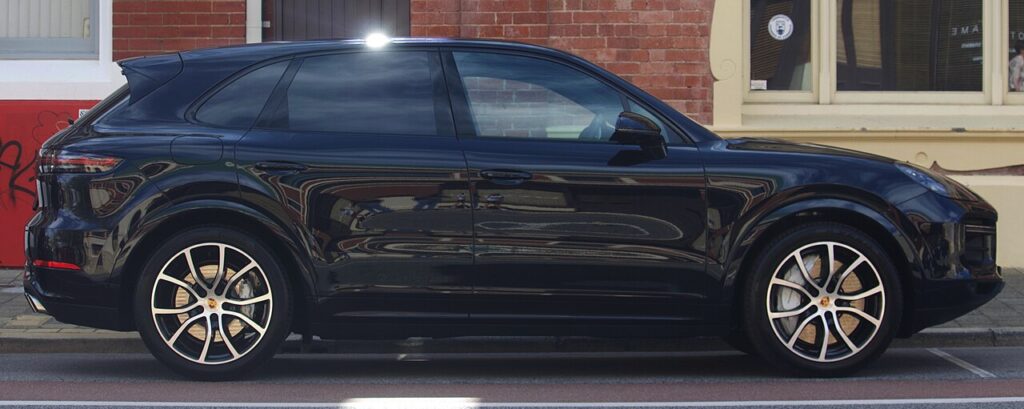
The Porsche Cayenne (9YA/9YB, 2018–Present) has a fully electronic parking brake, but it is built around a drum-in-hat design: small parking-brake shoes clamp inside the rear rotor’s top hat, driven by electric actuators, while the service braking is done by separate calipers. Knowing which part the EPB actually holds is the key to changing the rear pads safely — and to knowing when you really need service (installation) mode.
What service mode is and why the third-gen Cayenne needs it
Because the EPB drives shoes inside the rotor hat — not the caliper pistons — a straight rear pad change usually does not require service mode. The caliper pistons are pushed back the conventional way once the caliper is off the disc. You need to command the EPB into installation position when you have to remove the rear rotor: for a disc renewal, or to replace the parking-brake shoes, the actuators must wind clear of the hat first. There is no accelerator-and-switch owner routine for this on the 9YA — it is done with PIWIS or a capable scan tool through the parking-brake module.
Retracting the rear brakes on the Cayenne
Park level, chock the fronts and connect a battery charger; the EPB control unit will abort on low voltage.
- Pad-only change. Release the EPB, raise the car, remove the rear wheels and caliper. Press the caliper piston(s) back evenly with a pad spreader, fit the new pads and refit the caliper. No tool needed.
- Rotor or parking-brake shoe change. Connect PIWIS (or iCarsoft POR, Foxwell, Autel), open the parking-brake system and select Move to installation / service position. The actuators retract the shoes so the rotor lifts off.
Never force the EPB actuator or shoes back by hand
Never lever, hammer or clamp the parking-brake shoes to free a stuck rotor, and never back-drive the actuator while it is powered. Retract the EPB electronically in installation position only. If a rear rotor will not come off, the parking brake is still applied — stop and run the routine. The only thing you compress by hand is the service-caliper piston, and only after the caliper is off the disc.
Exit, calibration and bed-in
After rotor or shoe work, use the tool to leave installation position and run the parking-brake adjustment / grind-in and calibration so the shoe air gap is set correctly — the brakes must be below 50 °C. If your Cayenne has PCCB ceramic discs (Turbo and option cars), no grind-in of the service pads is needed, but treat the ceramic rotors gently — they chip and the calipers are very expensive. Finish by bedding the pads in: several firm slowdowns from around 40 mph with cooling between, then check the parking brake holds on a slope.
Frequently Asked Questions
Do I have to use service mode to change rear pads? No — on the Cayenne the EPB holds drum shoes, not the caliper pistons, so a pad-only swap needs no service mode. You only need it to pull the rotor or service the shoes.
Can I retract the EPB from the dash menu? No. There is no owner installation-position function in the PCM; you need PIWIS or a capable OBD tool on the parking-brake module.
The EPB is stuck in service position — now what? Reconnect a tool and command it back out. Cycling the ignition or the switch will not release it.
Is the hybrid (E-Hybrid) any different? The EPB drum-in-hat principle is the same; just be sure the 12 V system stays charged during the work.
Why did the actuator routine fail partway? Low 12 V supply, almost always. Keep a charger connected and retry.
If a brake or EPB code is stored after the job, look it up on our sister site autodtcs.com.
Independent guide — not affiliated with Porsche. Always follow your official service manual and safety precautions. Read our full disclaimer.