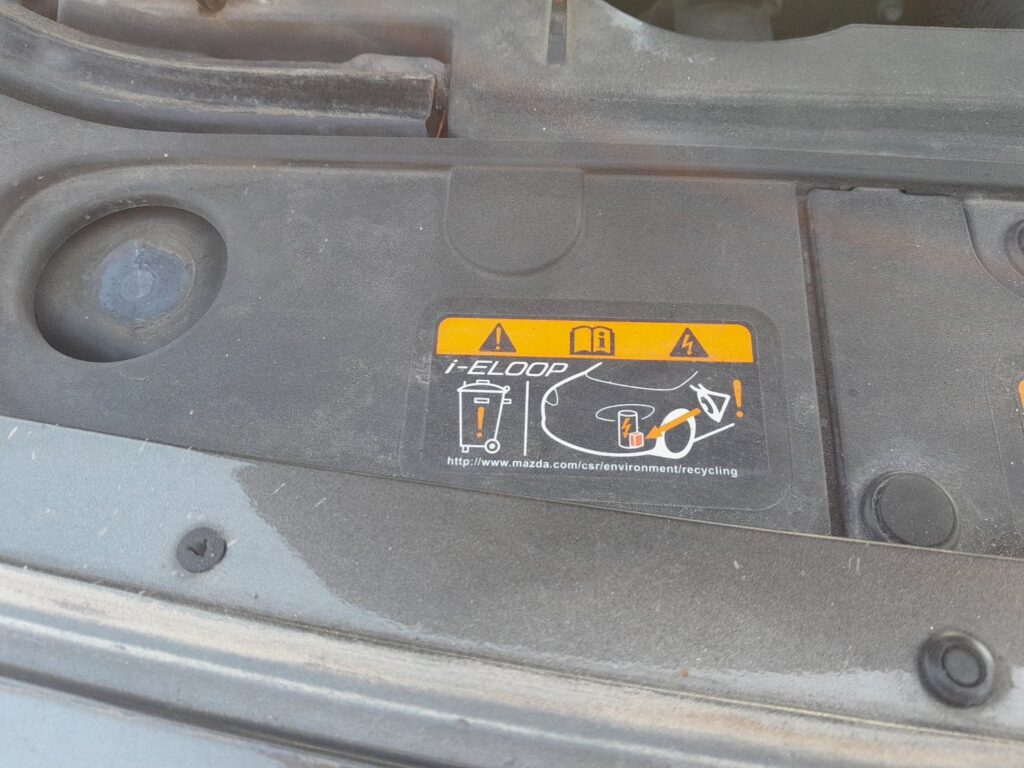
If you have opened the bonnet of a Mazda 6, CX-5 or Mazda 3 from the last decade and spotted a small orange i-ELOOP label, you have found one of Mazda’s cleverest fuel-saving tricks. i-ELOOP — short for “intelligent Energy Loop” — is Mazda’s brake-energy regeneration system, and unlike a hybrid it does the job with a capacitor instead of a heavy battery.
What i-ELOOP actually is
i-ELOOP recovers the energy your car would otherwise waste as heat every time you lift off or brake, turns it into electricity, and stores it to run the car’s electrical systems. It is not a hybrid drive — it never turns the wheels. Its only job is to take the work of generating electricity off the engine, and that is what saves fuel.
How it works
Three parts do the work:
- A variable-voltage alternator (12–25 V). During steady cruising and acceleration it stays largely idle. The instant you lift off the throttle or brake, it ramps up and generates hard — using the car’s momentum rather than fuel.
- An Electric Double-Layer Capacitor (EDLC). The recovered electricity is stored in a low-resistance supercapacitor mounted at the front of the engine bay. A capacitor can absorb and release energy far faster than a battery, which is exactly what the brief bursts of braking demand.
- A DC-DC converter. This steps the capacitor’s roughly 25 V down to the 12 V your lights, climate blower, wipers and audio actually use, and tops up the normal 12 V battery.
Because the electrics can run from the stored charge, the alternator can stop dragging on the engine while you accelerate and cruise — and that reduced load is where the fuel saving comes from.
Why a capacitor instead of a battery?
Braking energy arrives in short, intense bursts. A capacitor can be charged and drained in seconds, tolerates being cycled hard millions of times without wearing out, works in the cold, and is light and compact. A conventional battery would charge too slowly to catch each deceleration and would degrade quickly under that kind of use.
How much fuel does it save?
Mazda quoted up to around 10% in stop-start city driving, where you brake and accelerate constantly. On a steady motorway run the benefit is much smaller, because there is little braking energy to harvest. Either way it is effectively free economy once the system is fitted — there is nothing for the driver to do.
Do you need to maintain or reset it?
No. i-ELOOP needs no owner maintenance and there is nothing to reset — it manages itself. The capacitor safely self-discharges after the car is switched off. If the system ever develops a fault you may see a warning message, and the capacitor is a replaceable part, but in day-to-day ownership you can simply forget it is there.
The label under the bonnet
The orange sticker — like the one on this Mazda 6 — is a safety and recycling notice, not a service instruction. Because the capacitor can hold an electrical charge, it must not be short-circuited or thrown into general waste; at end of life it has to be recycled properly. That is all the label is telling you.
FAQ
Is i-ELOOP the same as i-stop?
No. i-stop is Mazda’s stop/start system, which switches the engine off at a standstill. i-ELOOP is energy recovery. They complement each other — the stored charge can help power an i-stop restart — but they are separate systems.
Can I switch i-ELOOP off?
No. It is factory-fitted and works automatically; there is no driver on/off switch, and there is no benefit to disabling it.
Does disconnecting the 12V battery affect i-ELOOP?
No lasting effect — the system resumes on its own once power is restored. If you are working on the electrical system, see our step-by-step guide to disconnecting and reconnecting the Mazda 6 12V battery. If a charging-system warning light appears afterwards, a scan tool will read the stored fault code — you can look up what it means at autodtcs.com.
