These instructions apply to the Hyundai i30 Mk3 (PD) 2017-Present.
For other models, please choose your vehicle here.
If an amber AdBlue (urea / diesel exhaust fluid) warning has appeared in your Hyundai i30 Mk3 (PD, 2017–present) diesel, the tank just needs topping up — a job you can do yourself in a couple of minutes. The AdBlue tank on the i30 diesel holds about 12 liters, and you top it up through a blue-capped filler. This guide shows whether your car uses AdBlue, where it goes, and how to add it.
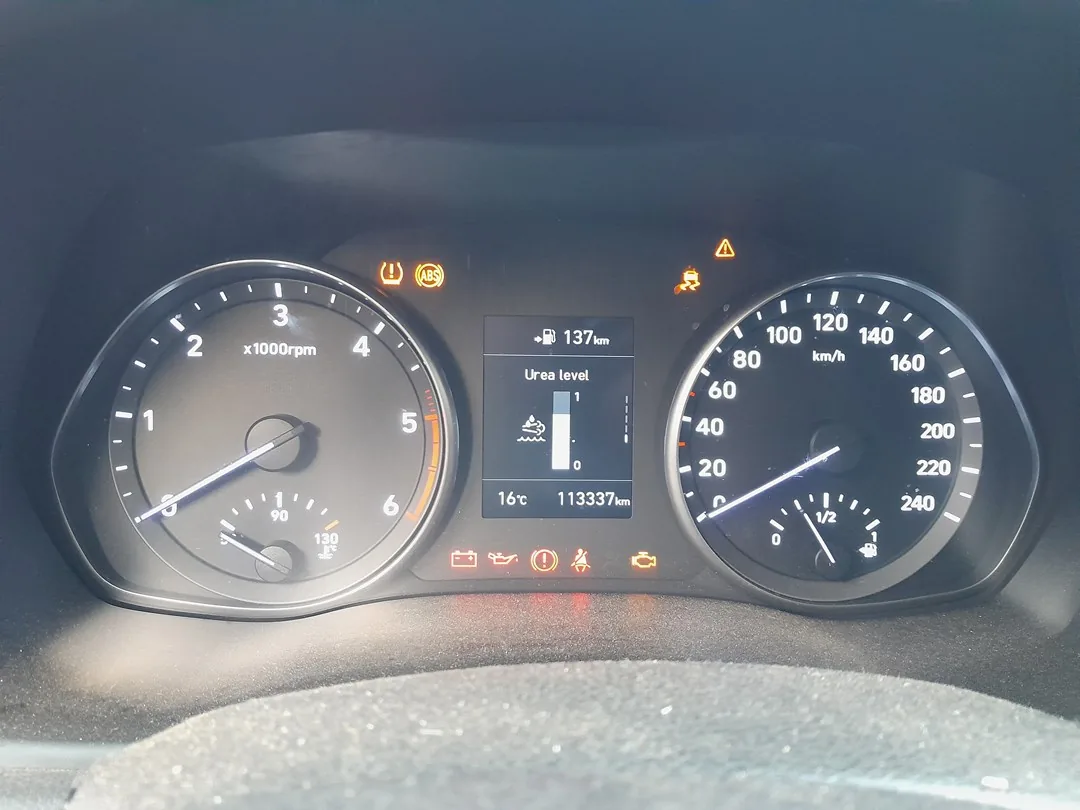
Does Your i30 Diesel Use AdBlue?
Not every i30 1.6 CRDi does. Hyundai met Euro 6 two ways: earlier diesels used a lean-NOx trap (LNT) and need no AdBlue, while the later SCR diesels inject AdBlue into the exhaust and do.
The easy test: if you ever see a Urea / AdBlue message in the cluster, or there’s a small blue cap next to the diesel filler, your car uses it. No blue cap and no urea warning means it doesn’t.
Where the AdBlue Goes
On the i30 diesel the AdBlue filler is the smaller blue-capped neck right next to the diesel fuel filler, under the same fuel flap — the owner’s manual shows it there. Open the flap and you’ll see the large black diesel neck with the blue AdBlue cap beside it. AdBlue and diesel go into completely separate tanks, so never pour AdBlue into the diesel neck (or diesel into the AdBlue neck).

How to Top Up the AdBlue
- Buy AdBlue / DEF certified to ISO 22241 (any brand meeting that standard is fine) — a bottle with a no-spill spout, or the pour hose supplied with it, makes it far easier.
- Turn the ignition off, open the fuel flap and turn the blue AdBlue cap counterclockwise to remove it.
- Pour in slowly until the level reaches the mark on the filler / the tank is full. AdBlue crystallizes into a white residue on paint and trim, so wipe any spills with water straight away.
- Don’t overfill — leave some room; a brim-full tank can expand and crack the reservoir if it freezes. Never mix AdBlue with water or additives.
- Turn the cap clockwise until it’s properly closed, and shut the flap.
The tank holds roughly 12 liters, so a full top-up from near-empty lasts a long time.
Clearing the Warning
You don’t need a tool or a dealer reset — after a top-up the car re-reads the level itself. The warning comes in stages: it first shows “Low Urea” when less than about 5.4 liters remain, then a more urgent “Refill Urea”, and finally “Refill Urea tank or vehicle will not start” with a remaining-distance countdown in km.
Top up before that last stage: if the tank runs out, emissions law means the engine will not restart once you switch it off. If you do hit the no-start lockout, add enough AdBlue, turn the ignition on, wait a couple of minutes for the system to register the fluid, then start — it should run normally and the warning clears itself.
Frequently Asked Questions
How much AdBlue does the Hyundai i30 take?
The tank holds roughly 12 liters. A full top-up from near-empty typically lasts several thousand kilometers depending on driving.
Can I top up AdBlue at any time?
Yes. You can add AdBlue whenever you like, even before a warning appears — there’s no need to wait until it’s empty, and no reset is required afterwards.
Where do I buy AdBlue?
Fuel stations, motor factors and most supermarkets sell it in bottles; many forecourts also have an AdBlue pump. Any product marked ISO 22241 (or “AUS 32”) is the correct fluid.
My i30 says “AdBlue: engine will not restart” — what now?
The tank has run out. Add at least a few liters of AdBlue, then turn the ignition on and wait a minute or two so the system registers the fluid before starting; it should then start normally.
If a fault code is stored alongside the AdBlue warning (for example an SCR or NOx-sensor code), look it up on autodtcs.com.
Independent guide — not affiliated with Hyundai. Always follow your official service manual and safety precautions. Read our full disclaimer.