These instructions apply to the Nissan Pulsar Mk1 (C13) 2014-2018.
For other models, please choose your vehicle here.
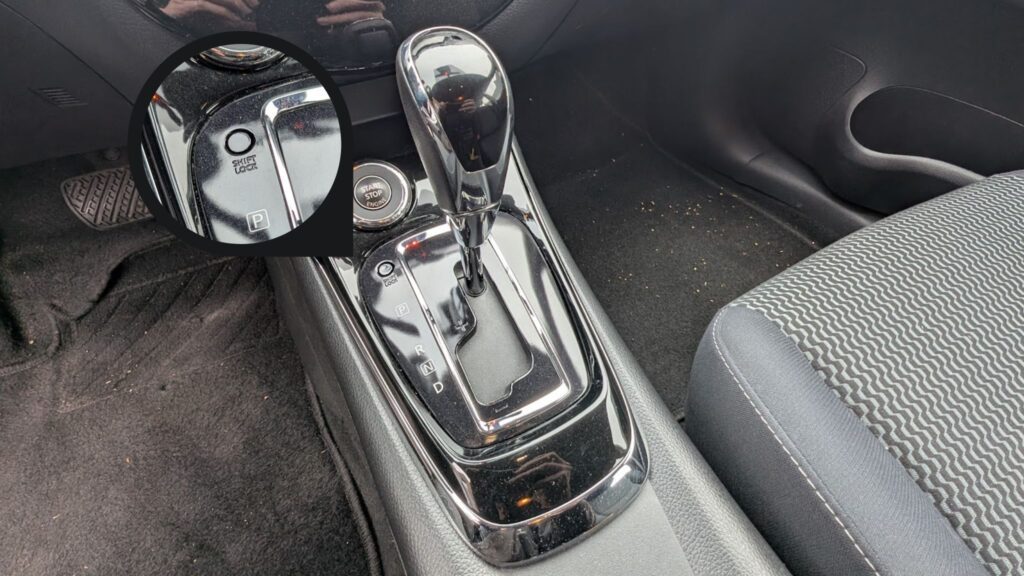
The Jatco RE0F11A continuously variable transmission, fitted to a range of Nissan, Renault, and Mitsubishi cars from 2010 onwards, uses an electronically-controlled shift-lock to prevent the gear lever moving out of Park (P) without the brake pedal pressed and the ignition on. When the 12-volt battery is flat — or after certain electrical faults — the shift-lock won’t release electrically, which leaves the car stuck in P and unable to be pushed or towed. Nissan provides a manual mechanical override accessed through a slot next to the gear lever. This guide walks through the procedure for cars fitted with the RE0F11A: typically the Nissan Pulsar, Note, Juke, Sentra, Tiida, plus the Renault Clio Mk4 with the Energy CVT variant.

Before you start
The shift-lock override moves the lever from P to N (Neutral), so the car can be pushed or towed, not from P to D — you cannot drive away using this procedure. After the override is used, the lever stays in N until you reverse the procedure or until the electrical fault that caused the lock-up is resolved and a normal P-to-other-gear shift is made.
- Apply the parking brake first. The shift-lock override removes the only thing holding the car stationary on a slope. Even on level ground, block the wheels with chocks before starting — the override-and-roll combination is the most common DIY mistake on this procedure.
- This is an emergency procedure. If you find yourself needing it, the underlying problem is either a flat 12V battery, a brake-light switch fault, a shift-lock solenoid fault, or a wider electrical fault. Don’t use the override repeatedly without diagnosing the root cause; have the transmission’s electrical control inspected.
- Identify your shift-lock release slot. The slot location varies by host vehicle:
- Nissan Pulsar: small rectangular cap on the left side of the gear lever surround
- Nissan Note: similar — left side of the lever surround
- Nissan Juke: behind the lever, accessed by lifting a small panel
- Renault Clio Mk4 with Energy CVT: small flap on the centre console near the lever base
The cap is usually a small rectangular plastic cover that pries off with a flat screwdriver or a fingernail.
- Have a flat-blade screwdriver ready — small to medium size, about 3–5 mm wide. A coin will not work; the slot requires a flat tip with enough length to depress the internal release lever.
Tools required
- Small flat-blade screwdriver (about 3–5 mm wide)
- Wheel chocks or a stable improvised stop (a brick will do)
- Optional: torch / flashlight if working in low light — the slot can be hard to see
Safety note
The shift-lock release removes the transmission’s only mechanical stop on rolling. Before proceeding:
- Apply the handbrake firmly. Some affected cars (especially the Pulsar) have an electric parking brake that may not engage if the 12V battery is fully flat — verify the rear wheels are locked before proceeding.
- Chock the wheels. Place a wheel chock or brick against a downhill-facing tyre. If you don’t have chocks, position the car at the bottom of the steepest part of the slope or on level ground.
- Don’t perform this procedure on a steep slope without a stable stop. The car can roll once N is selected; the EPB on this generation Pulsar is rated for 12% gradient holding, not steeper.
Emergency release procedure
- Switch the ignition OFF (or, on push-button-start cars, ensure the power button is fully off — the dashboard is dark).
- Apply the parking brake fully. On cars with the electric parking brake, pull and hold the EPB switch upwards for 2 seconds.
- Chock the wheels if there’s any chance of rolling.
- Pry off the small cap covering the shift-lock release slot next to the gear lever. Use a flat screwdriver under one edge; the cap usually comes off with light pressure.
- Insert the flat screwdriver into the slot and press down. You should feel a click or a slight detent as the internal release lever depresses.
- While holding the screwdriver down, press and hold the standard shift-lock release button on the gear lever (the small button on the side of the lever knob — present on all cars with this CVT).
- Move the gear lever from P into N (Neutral). The lever should now move freely; if it doesn’t, the screwdriver isn’t depressing the internal lever far enough — try again with slightly more pressure.
- Remove the screwdriver. The lever stays in N.
- The car can now be pushed or towed.
After the override — what happens next
Once the lever is in N, the car can be moved. To return the lever to P, you’ll need to address the underlying electrical fault first:
- If the cause was a flat 12V battery, jump-start the car (or fit a fresh battery) and the shift-lock should release normally.
- If the cause was a brake-light switch fault, the shift-lock won’t release until the switch is replaced — even after a successful jump-start. Replace the switch (typically £15, 10 minutes to fit).
- If the cause was a CVT-system electrical fault (shift-lock solenoid, transmission control unit, or wiring), the car needs scan-tool diagnosis. Read the TCM with Consult-III or an aftermarket Nissan-aware scan tool.
How to verify the release worked
- The gear lever moves freely from P to N when the screwdriver is held in the slot.
- The car can be pushed or towed once in N (with the parking brake released).
- There is no resistance from the transmission itself — if the wheels won’t turn even with N selected and the parking brake released, the issue is mechanical (seized output shaft, parking pawl jammed against the ring gear) rather than electrical, and the car needs recovery rather than DIY override.
Troubleshooting
The screwdriver goes into the slot but the lever doesn’t release. The screwdriver isn’t long enough or isn’t pressing hard enough. The internal release lever sits about 10–15 mm below the slot surface; a short screwdriver won’t reach. Use a longer flat-blade or a wooden chopstick to extend reach if needed.
The lever moves from P to N but won’t go back to P after the fault is fixed. The shift-lock release procedure can leave the mechanical interlock in a “released” state until the next normal P selection. Try shifting from N to D, then back to N, then back to P. If still no luck, the override has caught the interlock plate against the housing — needs the transmission casing dropped briefly to free it.
The lever moves into N but the car still won’t push. The transmission’s mechanical parking pawl (a tooth that engages a slot on the output shaft) is still engaged. This is rare but happens if the car was forced into P while still rolling. The fix is to roll the car forward 5 cm (with the override active) — usually the pawl pops free.
The shift-lock cap won’t come off. On some host vehicles (notably the Note and the Juke), the cap is clipped from above and pries off from one specific edge. Try each edge in turn; one will give. Don’t force from the centre — that can break the surround moulding.
I performed the procedure and now the dashboard shows “Shift lock fault”. Normal — the TCM has logged that the override was used. The fault clears once the next normal P-to-D shift completes (after the electrical issue is fixed). If it persists for more than a week of normal driving, scan with Consult or Nissan-aware aftermarket tool.
Frequently asked questions
Which cars use the RE0F11A CVT?
Nissan Pulsar C13 (2014–2018), Note E12 (2013–2017), Juke F15 facelift (2014–2019), Sentra B17 (2013–2019), Tiida C13 (2015–2020 in select markets), Renault Clio IV Energy CVT (very low-volume), Mitsubishi Lancer with 2.0 CVT (US market). All use the same shift-lock mechanism and the same override procedure described above.
Is this procedure dangerous?
Only if you skip the parking-brake / wheel-chock step. The override itself is a Nissan-engineered legitimate procedure documented in the owner’s manual — there’s nothing improvised about it. The risk is purely about the car rolling once N is selected without the brakes engaged.
What is the most common reason to need this override?
A flat 12V battery. The shift-lock requires battery power to release electrically; if the battery is fully dead, you can’t even put the car into N to push it onto a flatbed. This procedure exists specifically for that situation.
Will I damage the transmission by using the override?
No. The mechanical override is part of the transmission’s designed operation. Repeated use without diagnosing the root cause is what creates problems — the underlying electrical fault may worsen if ignored.
Why does the gear lever have its own button if there’s also a slot?
The lever button is the normal shift-lock release — used during every shift from P to any other position when the brake is pressed. The slot is the emergency mechanical release that bypasses the electrical interlock entirely. They serve different purposes: button = normal shift, slot = no-power emergency.
My car has the JF015E CVT, not the RE0F11A — does this procedure apply?
The Jatco JF015E (used in some early Note and Pulsar variants and many other small Nissan / Suzuki cars) uses the same shift-lock architecture and the same emergency-release slot procedure. The location of the slot differs slightly between host vehicles but the mechanism is identical.
If the shift-lock fault persists after your battery is restored or after the brake-light switch is replaced, scan the TCM for diagnostic trouble codes. For CVT-related DTCs and what they mean, see autodtcs.com.
Independent guide — not affiliated with Nissan. Always follow your official service manual and safety precautions. Read our full disclaimer.