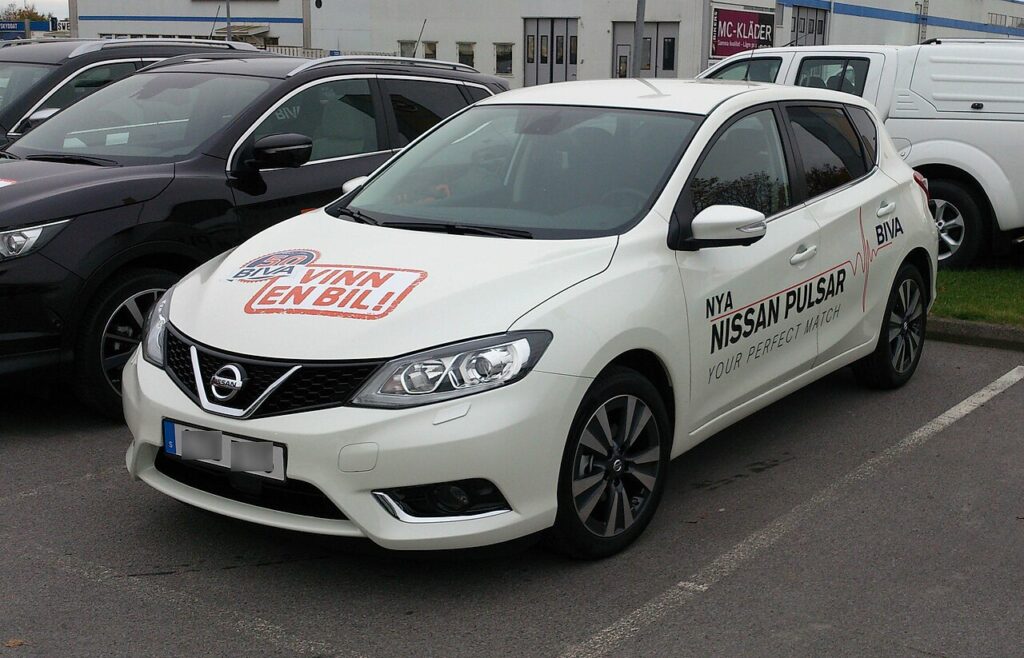
These instructions apply to the Nissan Pulsar Mk1 (C13) 2014-2018.
For other models, please choose your vehicle here.
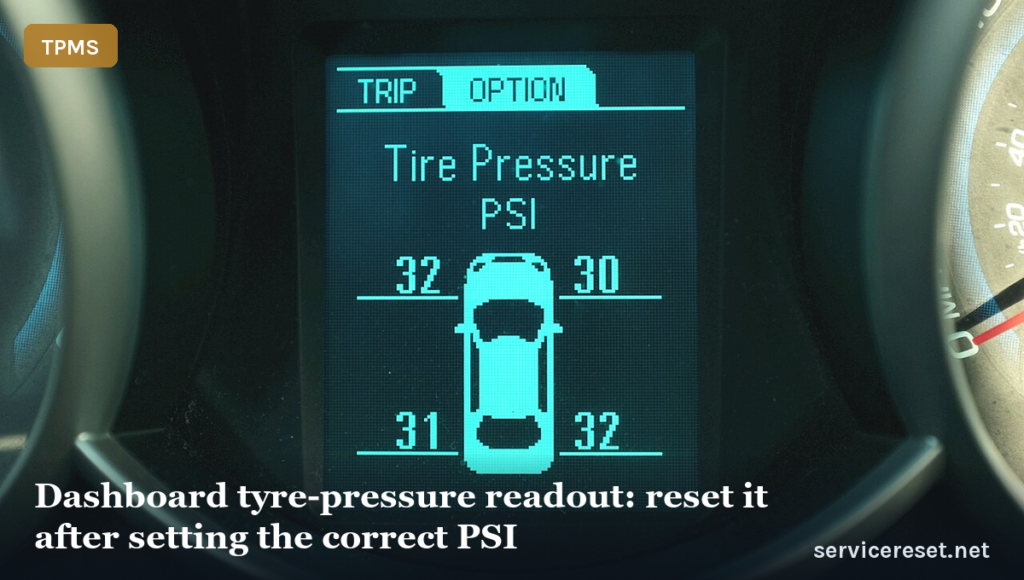
The Nissan Pulsar C13/C12/B17 (2014–2018) uses a tyre-pressure monitoring system (TPMS) that watches the pressure in all four tyres and warns you on the cluster when one drops below the safe threshold. After any tyre work — a top-up, a swap to winter wheels, a rotation, or a new set of rubber — the system needs to be re-initialised against the new pressures so it has a fresh baseline to monitor.
When a TPMS Reset Is Required
- After checking and adjusting tyre pressures (even a top-up of just one tyre).
- After replacing one or more tyres or wheels.
- After rotating tyres front-to-rear or side-to-side.
- After a seasonal swap from summer to winter wheels (or vice versa).
- After a battery disconnect if the warning light comes on incorrectly.
Preparation
- Inflate all four tyres to the placard pressure listed on the driver’s door jamb sticker (this is the cold pressure — set it before the car is driven, or after the car has been parked for at least three hours).
- Park on a level surface with the engine off.
- Turn the ignition to ON (do not start the engine).
- Make sure the steering wheel multifunction controls are in their normal position — some Pulsars have replacement non-OEM wheels that don’t expose the ENTER scroll-wheel needed for the procedure.
Tools and Supplies
None for the reset itself. You may want a tyre-pressure gauge and a compressor if you’re setting pressures before the reset.
TPMS Reset — Step-by-Step
- Use the ENTER scroll-wheel on the steering wheel to navigate the cluster menu. Push up or down to move between options; press inward to confirm.
- Scroll to Settings and press ENTER to confirm.
- Scroll to Tyre Pressures and press ENTER.
- Choose Calibrate and confirm with ENTER.
- Scroll to Start and press ENTER again.
- The display will show “Resetting tyre pressure system” and may animate for a few seconds.
- Drive the vehicle for at least 2 minutes above 25 km/h (15 mph). Straight-line driving on a level road is ideal — the system stores readings while the wheels are spinning.
- The new tyre pressures are now the reference baseline.
Verify the Reset Worked
The amber low-pressure warning light should go out after the calibration drive. If your Pulsar’s cluster shows individual pressures in the trip computer, those values should also update to your freshly-set cold pressures (give or take a small amount as the tyres warm up).
Troubleshooting
- The warning light comes back on a few miles later. The reset was successful but at least one tyre is genuinely leaking. Re-check pressures cold and inspect each tyre for a slow puncture (often hard to see — a soap-water spray will bubble at the leak).
- “Tyre Pressures” option doesn’t appear in the menu. The base-trim Pulsar (without the colour info display) may not expose the calibrate menu — on those cars the system self-calibrates after 10 minutes of driving above 25 km/h, with no driver action needed. Just drive normally.
- Display shows a tyre icon with a question mark or “—”. One of the wheel-position sensors lost communication. Check that you haven’t installed a non-TPMS spare wheel; if the original wheels are on the car, a sensor battery may be dead (typical lifespan is 7–10 years).
- System won’t accept the calibration if pressures are too low. Add air to the placard value before retrying — the system rejects calibration if all four tyres are dramatically under pressure, as a safety measure.
Frequently Asked Questions
How long do I need to drive after the reset?
The Pulsar’s system stores readings during the first 2 minutes of driving above 25 km/h. In practice, drive normally for 5–10 minutes — by then the system has plenty of data and the warning light should be confirmed off.
Why check pressures cold instead of hot?
Tyre pressure rises as the rubber heats up — typically 3–6 psi between cold (parked overnight) and hot (after 30 minutes of motorway driving). The placard pressure on your door jamb is a cold figure. Setting pressures hot leaves you with under-inflated tyres once they cool, which is exactly what the TPMS is designed to warn against.
I switched to winter wheels with separate TPMS sensors — do I need to re-pair them?
The Pulsar’s TPMS is a direct system (each wheel has its own sensor that broadcasts to the car). On the C13/C12/B17, the car auto-learns sensor IDs after about 10 minutes of driving — no pairing tool needed for OEM-spec sensors. If you fitted aftermarket sensors, check that they’re programmed to Nissan’s protocol; some generic sensors need a TPMS programmer first.
Does this work the same on the Pulsar GTI?
The procedure is the same. The GTI uses the same direct TPMS hardware as the standard Pulsar — the difference is performance tuning, not the monitoring system.
Independent guide — not affiliated with Nissan. Always follow your official service manual and safety precautions. Read our full disclaimer.