These instructions apply to the Peugeot 1007 Mk1 (A0) 2005-2011.
For other models, please choose your vehicle here.
Disconnecting the 12 V battery on the Peugeot 1007 (2005–2011) is a job most owners can do on the driveway. You’ll want to do it when the battery is due for renewal, before any electrical or bodywork repair, ahead of laying the car up for the winter, or to give a sulking body-control module a clean restart after a flat. The 1007 is fairly electronics-heavy for its size — the powered sliding doors alone rely on the battery staying happy — so the important part is working in the right order and giving the car a moment to relearn afterwards. Done properly, nothing is damaged and everything comes back within a short drive.
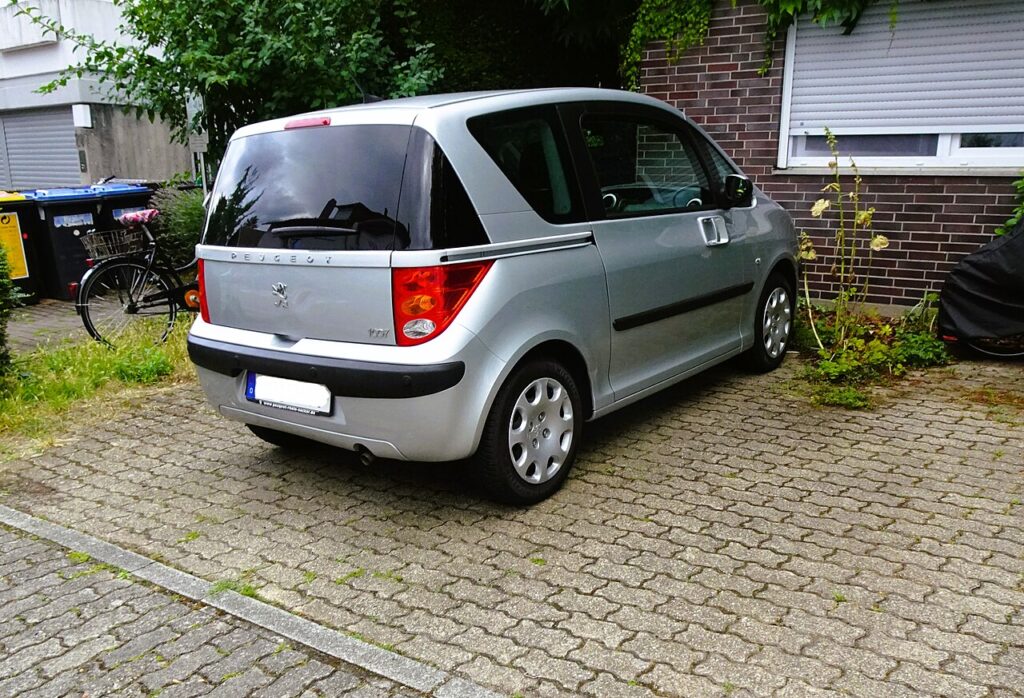
Where the 12 V Battery Is
On the 1007 the battery sits in the engine bay, towards the front under a protective cover. Lift the cover off to expose the two terminals. Identify them before you touch anything: the negative (−) post carries the black earth lead and usually the smaller clamp, while the positive (+) post carries the red lead under a plastic flap. Getting these clear in your mind now saves fumbling with a spanner later.
First, a Few Checks
- Park on level ground, switch the ignition fully OFF and take the key out of the car.
- Close the boot and make sure the electric sliding doors are shut — you don’t want them mid-travel when the power drops.
- Switch off the lights, heater blower, radio and every other consumer.
- If your stereo uses a security code, dig it out now so you can key it back in afterwards.
- Wait a couple of minutes for the control units to power down, then have a 10 mm spanner or socket, gloves and eye protection to hand.
How to Disconnect the Battery
- Double-check everything electrical is off, then lift the terminal cover.
- Loosen the negative (−) terminal clamp first, ease it off the post and tuck the lead well out of the way so it can’t spring back.
- Loosen the positive (+) terminal clamp and lift it clear.
- If you’re taking the battery out, undo the hold-down bracket and lift it out squarely — it’s heavier than it looks, so keep it upright.
How to Reconnect the Battery
- Sit the battery back in its tray and secure the hold-down bracket so it can’t shift.
- Fit the positive (+) terminal first and tighten the clamp securely.
- Fit the negative (−) terminal last and tighten it.
- Refit the protective cover and give both clamps a final wiggle to confirm they’re tight.
What You’ll Need to Reset Afterwards
- Re-initialise the electric sliding doors — they can behave oddly until they’ve relearned their end stops.
- Reset the service indicator if it was showing before the disconnect.
- Reprogram the key remote if it no longer locks or unlocks the car.
- Reset the clock and re-enter your radio presets (and the security code if the stereo asks for one).
- A few warning lights may linger for a moment — most clear themselves once the car has been driven a short distance.
If a Warning Light Stays On or the Car Feels Off
- Recheck both clamps are genuinely tight — a loose earth is the usual cause of odd electrical gremlins.
- Take the car for a short drive so the modules can relearn; many lights extinguish on their own.
- Re-run the sliding-door initialisation if a door is stopping short or refusing to auto-close.
- If the car struggles to crank, the battery itself may simply be tired — have it and the charging system tested.
- Read any code that’s logged so you know whether it’s a genuine fault or just a disturbance from the power cut.
Frequently Asked Questions
Where is the battery on the Peugeot 1007?
It’s in the engine bay near the front, under a protective cover. Lift the cover to reach the positive (+) and negative (−) terminals. There’s no need to remove anything else on this car to get at the clamps.
Which terminal do I disconnect first?
Always the negative (−) first when disconnecting, and reconnect it last. Working earth-first means that if your spanner slips onto the bodywork there’s no live circuit to short, so you avoid sparks.
What will I need to reset afterwards?
Expect to reset the clock and radio presets, re-initialise the electric sliding doors, and possibly reset the service indicator. If the remote stops working, reprogram it. Most of this takes just a few minutes on the driveway.
Does a new battery need coding on the 1007?
No. The 1007 is from an era before battery-management registration, so a like-for-like 12 V battery fits without any coding. Just reconnect in the correct order and work through the reset list above.
Will disconnecting the battery clear fault codes or the service light?
Pulling the battery can clear some temporary codes, but it isn’t a proper reset — a genuine fault will simply return. Use the dedicated service indicator reset for the service light rather than relying on a disconnect.
Can I jump-start it instead of disconnecting?
If the car is only flat, a jump-start gets you going without touching the terminals. Disconnecting is for battery renewal, electrical work or storage. If a jump-start doesn’t hold, the battery is likely at the end of its life and worth replacing.
If a warning light stays on after the job, look the code up on autodtcs.com to see whether it’s a real fault or just a leftover from the power cut.
Independent guide — not affiliated with Peugeot. Always follow your official service manual and safety precautions. Read our full disclaimer.