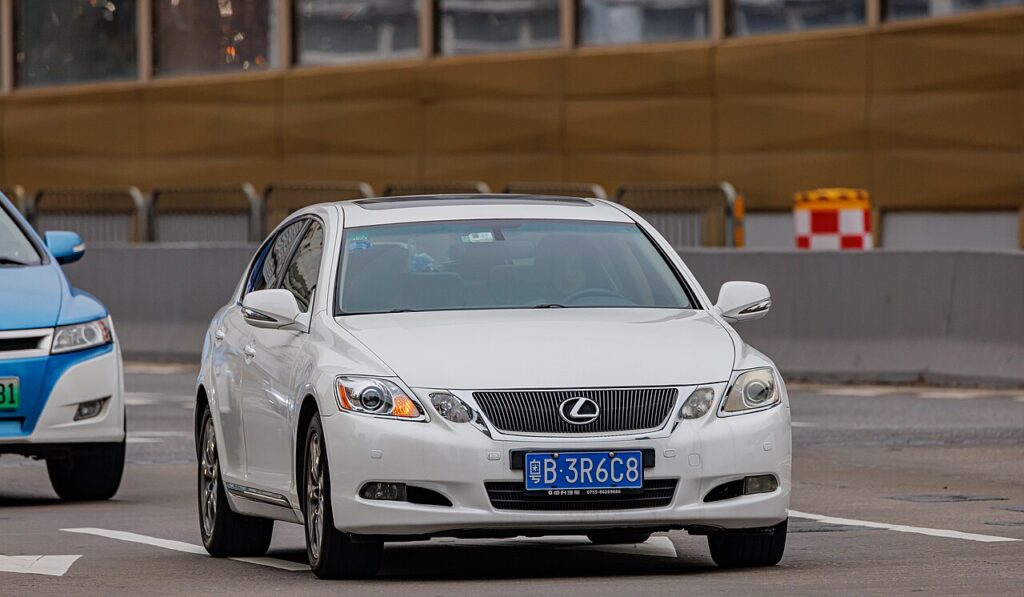
These instructions apply to the Lexus GS Mk3 (S190) 2005-2012.
For other models, please choose your vehicle here.
A Lexus GS (S190, 2005–2012) that only unlocks when the fob is almost touching the door handle, throws a key-battery warning in the multi-information display, or refuses the push-button start until you hold the fob against the start switch is nearly always suffering one simple fault: the coin cell inside the Smart Access key has gone flat. This third-generation GS — the GS 300, GS 350, GS 430 and the GS 450h hybrid — shipped with Lexus’s keyless smart key as standard, a slim fob carrying a hidden mechanical blade rather than a folding flip key. Here is the exact cell it takes, how to open the case without cracking it, and why a fresh battery is a five-minute driveway job while a brand-new key is not.
How to Tell the Fob Battery Is Dying
- Shrinking range. You have to stand right beside the car, or almost touch the fob to the handle, before it locks or unlocks. On a keyless car this is the first and clearest warning.
- A key-battery warning. The GS shows a low smart-key-battery message (a key symbol) in the multi-information display when the fob voltage drops.
- Push-button start gets fussy. If the car will not recognise the fob for a keyless start, hold the fob directly against the START/STOP switch — the system reads the key by short-range induction even with a dead cell. Needing that trick regularly means the battery is nearly gone.
- Cold-weather dropouts. A tired lithium cell sags in the cold, so buttons that work at midday fail on a frosty morning.
A coin cell in a GS smart key typically lasts two to four years. If yours is older than that and doing any of the above, fit a fresh cell before you suspect the antennas, the receiver or the immobiliser.
The Battery You Need
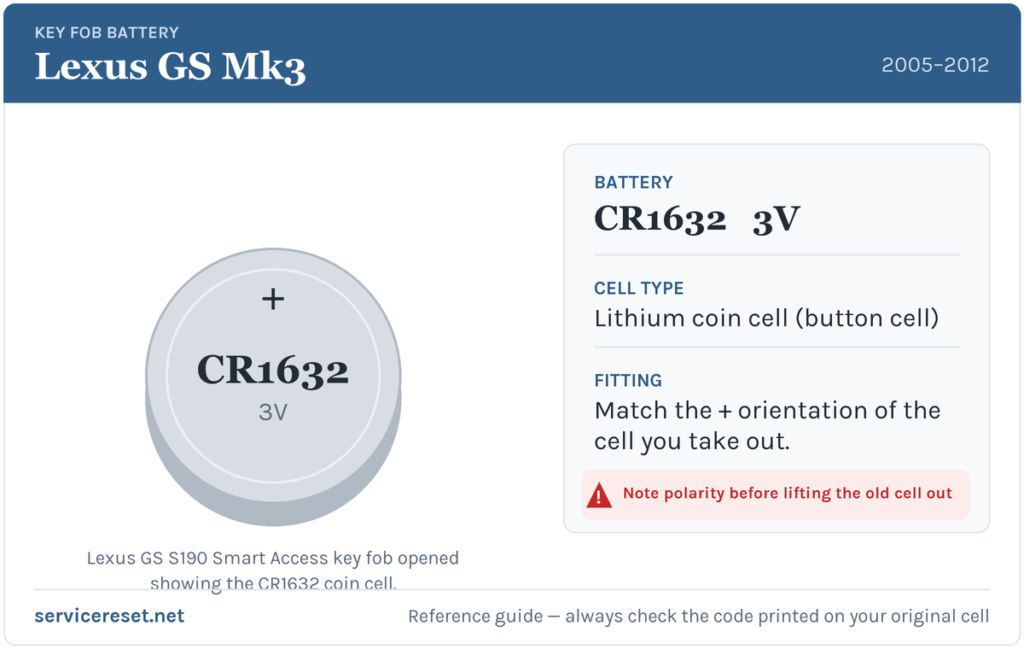
The S190 Smart Access fob (Lexus FCC families HYQ14AAB / HYQ14ACX / HYQ14AEM, fitted across GS 300, GS 350, GS 430 and GS 450h) uses a single CR1632 3-volt lithium coin cell. That is the wide-but-thin 16 mm cell — not the more common CR2032, which is too thick to seat in this fob and will stop the case closing. Buy a good branded lithium cell; bargain cells sag under the brief high current the transmitter draws and can give short range even when “new”.
One caution worth knowing: various Lexus fobs of this era use the equally thin CR1616 rather than the CR1632, and the two look almost identical apart from height (1.6 mm versus 3.2 mm). The GS S190 smart key is documented as CR1632, but the safest habit is always to read the code stamped on the cell you take out and match it exactly — never guess from a generic “fits Lexus” listing.
How to Replace the Smart Key Battery
- Release the mechanical key. Slide the small latch on the side of the fob and pull the hidden metal valet key straight out. The slot it leaves is your opening point.
- Split the case. Insert the tip of that valet key — or a thin flat-blade screwdriver wrapped in tape to avoid scratches — into the notch where the blade came out, and gently twist. The two halves of the shell separate along the seam. Work around the joint rather than forcing one spot.
- Reach the cell. Lift the back cover away. On this fob the coin cell sits in a holder on the circuit board; if a plastic module or the board itself covers it, ease that up carefully to expose the battery.
- Note the orientation, then swap. Look at which face of the old cell points up before you prise it out. Fit the new CR1632 the same way — on the GS smart key the positive (+) face sits upward toward the back cover — but always copy exactly what you removed. Handle the cell by its edge; skin oil on the flat faces harms the contact.
- Reassemble. Press the two halves back together until the seam clicks shut all the way round, then slide the mechanical valet key back into its slot until it latches.
⚠️ Get the polarity right. A coin cell fitted the wrong way round will not power the transmitter and can slowly discharge against the contacts, so double-check the plus face matches the cell you took out before you close the case.
Make Sure It Took
Stand back a few metres and lock, then unlock, the car with the buttons — full range should return at once. Test the keyless entry by touching the door handle with the fob in your pocket, and start the car normally with the push button. Any key-battery message in the display clears once the car reads a healthy fob, sometimes after one drive cycle rather than instantly.
If a Fresh Cell Doesn’t Fix It
- Re-check polarity and seating. A cell fitted upside down, or one not pressed fully under its clip, is the most common reason a “new” battery does nothing.
- Confirm the cell code. If you fitted a CR1616 where the fob wants a CR1632, the thinner cell may rattle and lose contact — check the marking against the one you removed.
- Wipe the contacts. A little corrosion or finger grease on the terminals causes dropouts; clean them with a dry cloth.
- Weak car battery. A tired 12-volt battery in the GS itself can mimic key faults by leaving the receiver slow to wake. If the whole car is sluggish to respond, that is worth ruling out separately.
New Key or Spare — Why It’s a Dealer Job
Changing the cell keeps the fob’s existing pairing, so nothing needs reprogramming and the key works the moment you close the case. Adding a spare or replacing a lost smart key is a very different matter: the GS uses a rolling-code immobiliser, blank Smart Access fobs must be ordered against the car’s VIN, and registering them requires a dealer or specialist auto-locksmith with the correct diagnostic access. Because Lexus of this era limits how many keys a car can hold, it pays to keep your spare fob’s battery fresh too — so you are never down to one working key while you wait on a new one.
Frequently Asked Questions
What battery does a Lexus GS (2005–2012) smart key take?
A single CR1632 3-volt lithium coin cell. It is the thin 16 mm type — do not substitute the thicker CR2032, which will not let the case close.
Could my fob actually use a CR1616 instead?
The GS S190 smart key is documented as CR1632, but several Lexus fobs of the period use the thinner CR1616, and the two are easy to confuse. Always read the code printed on the cell you remove and match it exactly.
Which way up does the battery go?
On the GS smart key the positive (+) face points up toward the back cover, but the reliable rule is to note the orientation of the old cell before you lift it out and fit the new one the same way.
Do I need to reprogram the key after changing the battery?
No. A battery swap does not affect the fob’s coding, so it works straight away. Only a brand-new key needs programming to the car.
Can I start the GS if the fob battery is completely dead?
Yes. Use the hidden mechanical blade to unlock the driver’s door, then hold the fob directly against the START/STOP button and press it — the car reads the key at close range even with a flat cell, so a dead battery will not strand you.
How long should a GS key battery last?
Usually two to four years. Leaving the fob sitting close to the car, so the keyless system keeps waking it, shortens that noticeably.
If your remote stopped working suddenly right after the car’s 12-volt battery was disconnected — rather than fading over weeks — the pairing or a stored fault is a likelier cause than the coin cell; you can look up what a logged code means on autodtcs.com.
Independent guide — not affiliated with Lexus. Always follow your official service manual and safety precautions. Read our full disclaimer.