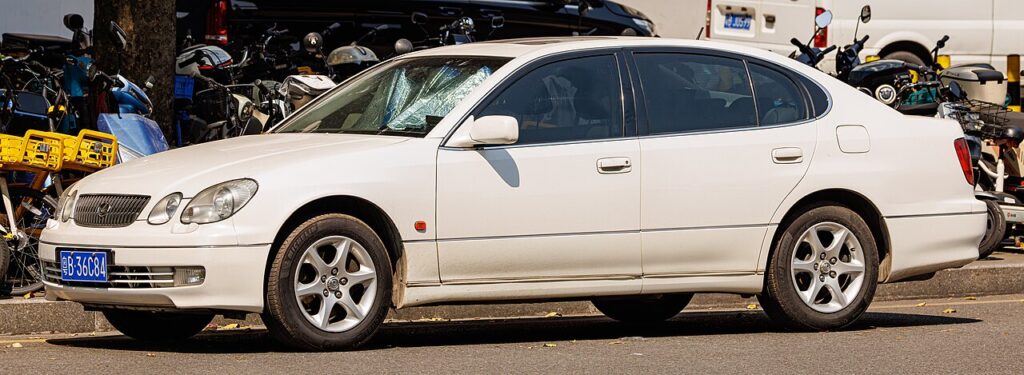
These instructions apply to the Lexus GS Mk2 (S160) 1997-2005.
For other models, please choose your vehicle here.
If the keyless remote for your Lexus GS (S160, 1997–2005) — the second-generation GS300, GS400 or GS430 — only locks the car from arm’s length, flashes weakly, or has stopped working altogether, the coin cell inside it has almost certainly gone flat. This is an older Lexus, so the setup is not the all-in-one smart key of modern cars: you carry a bladed metal ignition key (with a transponder chip for the immobiliser) and a separate keyless-entry remote fob for the door locks. The battery you are chasing lives in that separate remote, and it opens in a slightly fiddly two-stage way. Here is exactly what cell it takes, how to get inside without cracking the case, and why cutting a new key is the one part you cannot do at home.
How to Tell the Fob Battery Is Dying
- Shrinking range. You have to stand right next to the GS — instead of unlocking it from across the car park — before the doors respond. On a car this age that is the number-one sign of a tired cell.
- The remote’s LED goes dim or dark. The little indicator light on the fob should blink cleanly on every press. When it barely glows, or does nothing, the battery voltage has dropped too far to drive the transmitter.
- Buttons work only sometimes. Intermittent locking — fine one minute, dead the next, worse when it is cold — is a near-flat cell that can no longer supply the brief burst of current the transmitter needs.
- No dashboard warning. Unlike newer models, the S160 GS has no “key battery low” message in the cluster, so you have to read the symptoms above rather than wait for the car to tell you.
A coin cell in one of these remotes typically lasts two to four years. If yours is older than that and behaving like any of the above, fit a fresh battery before you start suspecting the receiver or the immobiliser.
The Battery You Need
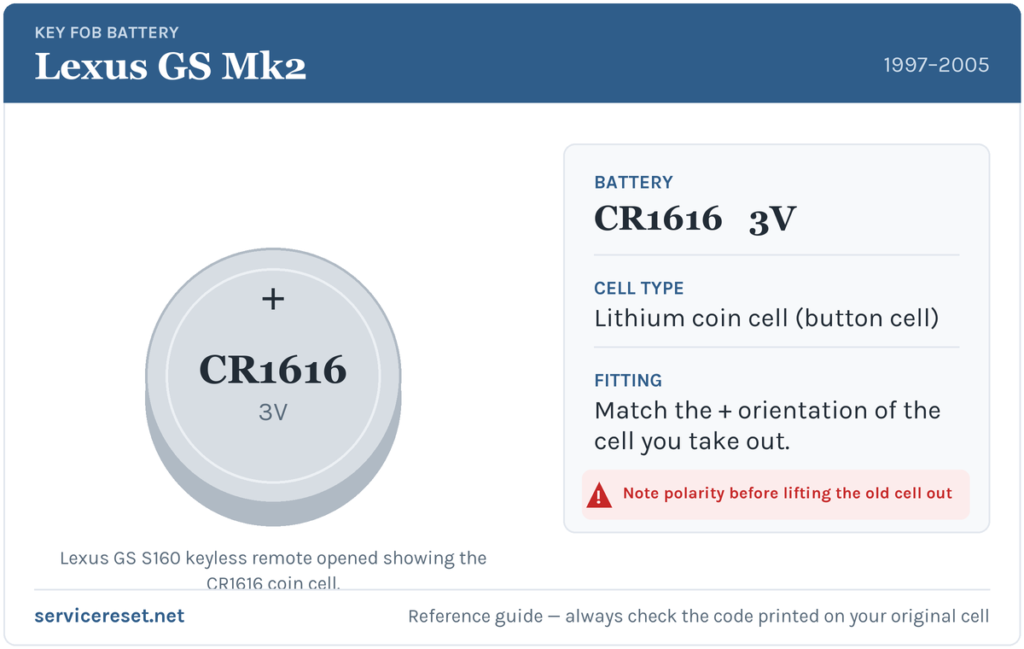
The GS S160 keyless remote takes a single CR1616 3-volt lithium coin cell — a thin 16 mm cell, not the fatter CR2032 used by most modern fobs, so do not assume the common one will fit. One caveat worth knowing: some owner literature for these years lists a CR2016 (same 16 mm diameter, twice the thickness), and individual remotes have turned up with either. The reliable move is to open the fob first and read the code printed on the cell you take out, then buy to match — the code is stamped on the old battery and often on the fob’s inner case too. Buy a good branded cell; cheap ones sag under load and can give short range even when new.
How to Open the Remote and Change the Cell
- Remove the retaining screw. Turn the fob over and undo the small cross-head (Phillips) screw on the back with a fine screwdriver. Keep it safe — it is tiny.
- Pry the case apart. The two halves also hook together on a lip, so the top will not simply lift off. Slip the tip of the screwdriver into the seam, twist gently, and at the same time push the top of the case away from the key — it releases with light pressure. Work slowly so you do not snap the plastic tabs.
- Lift out the electronics module. Inside the outer shell sits the circuit-board module. Ease it out; on many of these remotes the cell is not exposed yet.
- Undo the two inner screws. The module is closed by a small cover held with two more screws (often a different length from the first — keep them separate). Remove them and open the cover to reach the battery.
- Swap the cell the same way round. Note which face of the coin cell is showing before you lift it out, then fit the fresh CR1616 the identical way up. Handle it by the edges — finger grease on the flat faces can cause poor contact.
- Reassemble in reverse. Refit the inner cover and its two screws, seat the module back in the shell, clip the halves together, and drive the single back screw home — snug, not forced, as the housing is plastic.
⚠️ Match the original orientation. These fobs do not carry a printed polarity diagram, so the safe rule is simple: copy the way the cell you removed was sitting. A coin cell fitted upside down will not power the transmitter — if in doubt, the “+” marked face usually goes towards the side stamped with the battery code.
Confirm It Worked
Stand a few metres from the GS and press lock, then unlock. Full range should come straight back and the fob’s LED should blink brightly on each press. If the light is strong but the doors ignore it, re-open the fob and confirm the cell is seated firmly against both contacts before looking any further.
If a Fresh Cell Doesn’t Fix It
- Re-check seating and orientation. A cell that is the right way up but sitting proud of its clip is the most common reason a “new battery” changes nothing. Press it home under the retainer.
- Clean the contacts. On a twenty-plus-year-old remote the metal terminals can dull or corrode. Wipe them with a dry cloth or a little contact cleaner so the fresh cell makes a solid connection.
- Confirm the cell code. A too-thin CR2016 where a CR1616 belongs (or vice versa) may not touch both contacts. Re-read the code on the battery you removed and match it exactly.
- Rule out the transmitter. If the LED still will not light with a known-good cell, the remote’s electronics may have failed after two decades, and the fob itself will need replacing and pairing.
New Key or Spare — Why It’s a Dealer Job
Changing the coin cell keeps the remote’s existing code, so nothing needs reprogramming afterwards. A brand-new remote or a replacement ignition key is a different matter. The keyless fob has to be re-registered to the car’s receiver, and the bladed key carries a transponder that must be matched to the immobiliser — both need the correct equipment and the car’s details. On an S160 GS that means a Lexus dealer or an experienced auto-locksmith rather than a driveway job. The practical lesson: keep the battery in your spare remote fresh too, so you are never relying on a single working key.
Frequently Asked Questions
What battery does a Lexus GS (1997–2005) remote take?
A single CR1616 3-volt lithium coin cell. Some owner literature for these years lists a CR2016 instead, and remotes have turned up with either, so open the fob and match the code printed on the cell you remove.
Is the remote the same thing as my ignition key?
No. On this generation the keyless remote is a separate fob from the metal ignition key. The battery in this guide is for that remote — the ignition key is mechanical with a transponder chip and has no coin cell of its own.
Which way up does the cell go?
Fit it exactly the way the old one came out. There is no printed polarity label inside these fobs, so copying the original orientation is the reliable method; generally the “+” face sits towards the side marked with the battery code.
Do I need to reprogram the remote after changing the battery?
No. Swapping the cell does not erase the remote’s code, so it works as soon as the fresh battery is in. Only a new or replacement remote needs registering to the car.
How long should the remote battery last?
Usually two to four years. Frequent locking and unlocking, or a weak cell that has sat unused for a long time, will shorten that.
Can I still get into and start the GS if the remote is dead?
Yes. The remote only drives the door locks by radio — use the metal key blade to unlock the driver’s door and start the car as normal. A flat remote battery never leaves you stranded on this model.
If the locks or immobiliser started misbehaving at the same time as an electrical fault — rather than the remote simply fading — there may be a stored trouble code behind it; you can look up what it means on autodtcs.com.
Independent guide — not affiliated with Lexus. Always follow your official service manual and safety precautions. Read our full disclaimer.