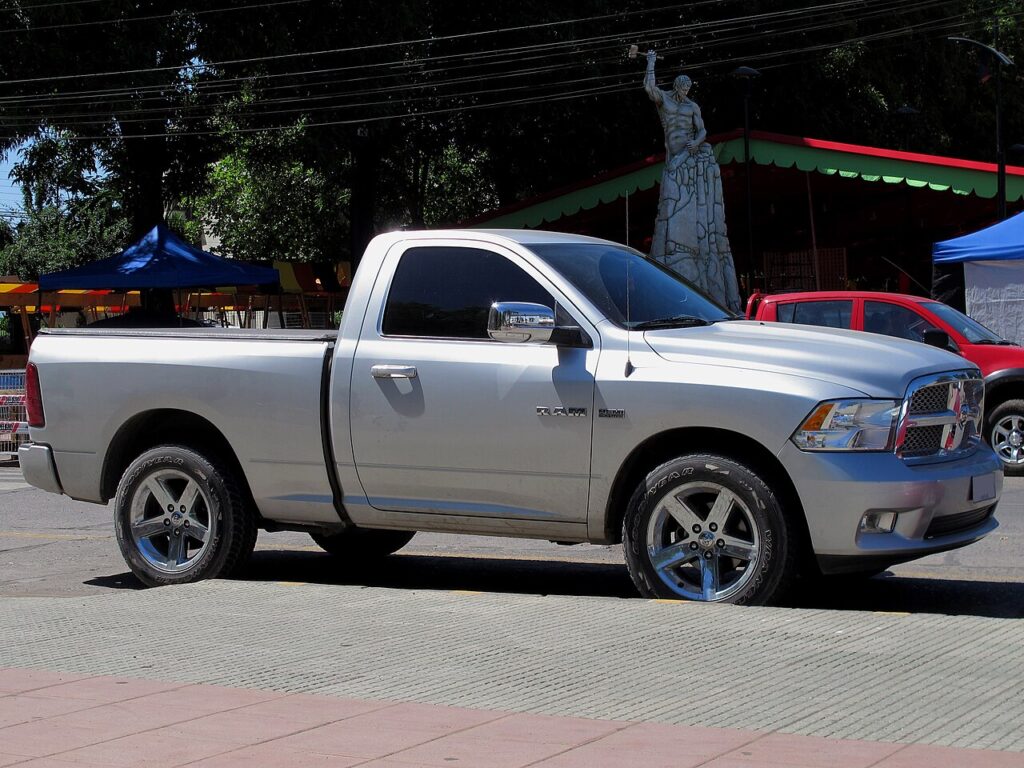
These instructions apply to the RAM 1500 Mk4 (DS) 2011-2019.
For other models, please choose your vehicle here.
If the tyre-pressure warning has come on in your RAM 1500 (DS, 2011–2019) after you’ve adjusted the pressures or changed a wheel, the system relearns by driving — there’s no button to press. Here’s how it works.
The amber horseshoe-and-exclamation symbol in the cluster is the tyre-pressure monitoring (TPMS) warning. On the 1500 it lights when a tyre reads below the pressure the truck expects — usually because the air has cooled, you’ve adjusted a pressure, or you’ve changed a wheel. It’s a heads-up, not a fault in the truck, and it clears once the pressures are right and the system has re-read them on a drive. A lamp that flashes at start-up and then stays solid is more likely a sensor issue than a low tyre.
How TPMS works on the 1500
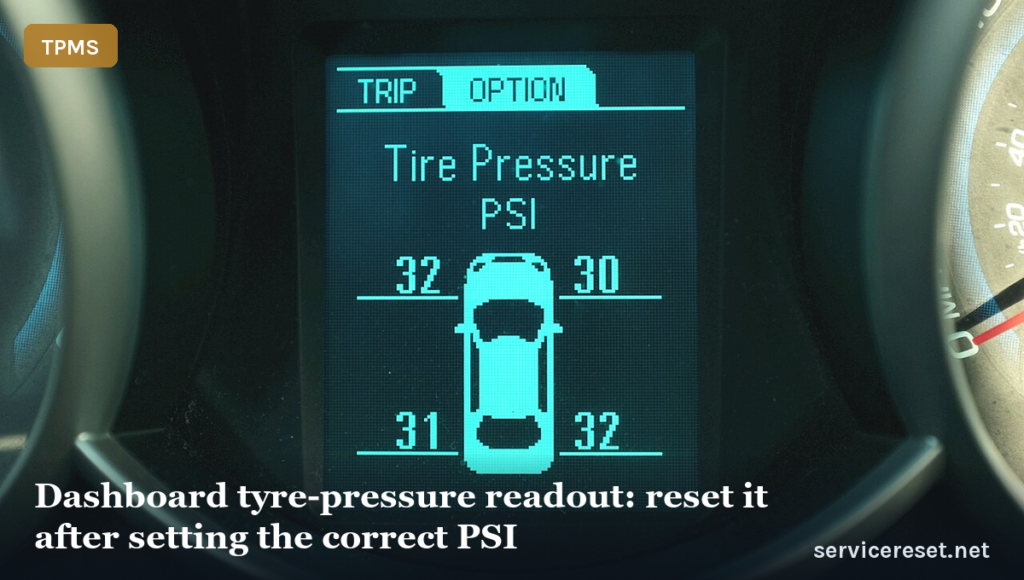
The 1500 uses a direct system: each wheel has a battery-powered sensor that reports its actual pressure, so the truck knows the real value at every corner rather than estimating it. There’s no menu button to press — after you correct the pressures the truck relearns them as you drive. One quirk of a work truck matters here: the door placard often lists a higher pressure for heavy payloads, so the “correct” figure depends on how you’re loaded.
Before You Start
- Check pressures cold — first thing, before the truck has been driven, so the readings are honest.
- Read the driver’s door placard and pick the figure for your load: the everyday number for a light truck, the higher payload number when carrying or towing.
- Set all four (and the spare, if it’s sensored) to that figure — one low corner keeps the light on.
- Park level and plan a continuous drive rather than a few short trips.
Completing the Procedure
- Park level and set all four tyres to the correct cold pressures (mind the higher loaded-payload pressures on the door placard).
- Stop the engine and wait about 20 minutes.
- Start up and drive for about 10 minutes at over 25 km/h (15 mph).
- The new pressures are stored and the warning clears.
Frequently Asked Questions
How do I reset the tyre pressure light on a RAM 1500?
Set all four pressures correctly, wait 20 minutes with the engine off, then drive about 10 minutes above 25 km/h.
If the Warning Stays On
- Recheck every tyre with a gauge. A single corner a few psi low will hold the light on even if the rest are spot-on.
- Set to the right load figure. Using the light-load pressure while running the payload number, or vice versa, can leave a tyre reading under the stored value.
- Give the relearn time. The wait with the engine off and then a continuous drive lets the system re-read all four — short hops around a yard may not be enough.
- Measure cold. Pressures set warm drop below spec once the tyres cool and re-trip the light.
- Cold morning? Pressure falls roughly 1–2 psi per 10°C drop, so a frosty start can set it off on its own — top up to spec.
- Fitted a spare or swapped a wheel? A wheel without a working sensor reads as low or missing until the sensored road wheel is back on.
- Correct pressures but still lit? A sensor with a flat internal battery can’t report and needs a workshop check rather than a reset.
What to Expect After
Once the pressures match the load and the drive is done, the warning goes out and stays off for the trip. If it comes back after a day or two, suspect a slow leak in one tyre and have it inspected — on a truck that regularly carries weight, a soft tyre wears fast and runs hot, so it’s worth chasing down rather than repeatedly topping up.
Is there a reset button?
No — the system relearns automatically as you drive.
Do I need a tool?
Not for a normal relearn; a tool is only needed when new pressure sensors are fitted.
Why does my pressure warning change with load?
The 1500 specifies higher pressures for heavy payloads — set to the figure that matches your load.
Do I need to set the spare’s pressure too?
If your spare carries a sensor, keep it inflated to the placard spare figure or it can trip the warning even while stowed. If it’s an unsensored spare it won’t report, but a temporary spare fitted to the road may show as low until the normal wheel is back on.
Can a cold morning trip the light on its own?
Yes. As temperatures drop, so does tyre pressure, so a tyre that was correct in warmer weather can read low overnight. Top it up to the placard figure while cold; if the light only shows on the coldest mornings and eases as the day warms, it’s temperature, not a puncture.
If the warning came on with other lights, decode the code on autodtcs.com.
Independent guide — not affiliated with RAM. Always follow your official service manual and safety precautions. Read our full disclaimer.