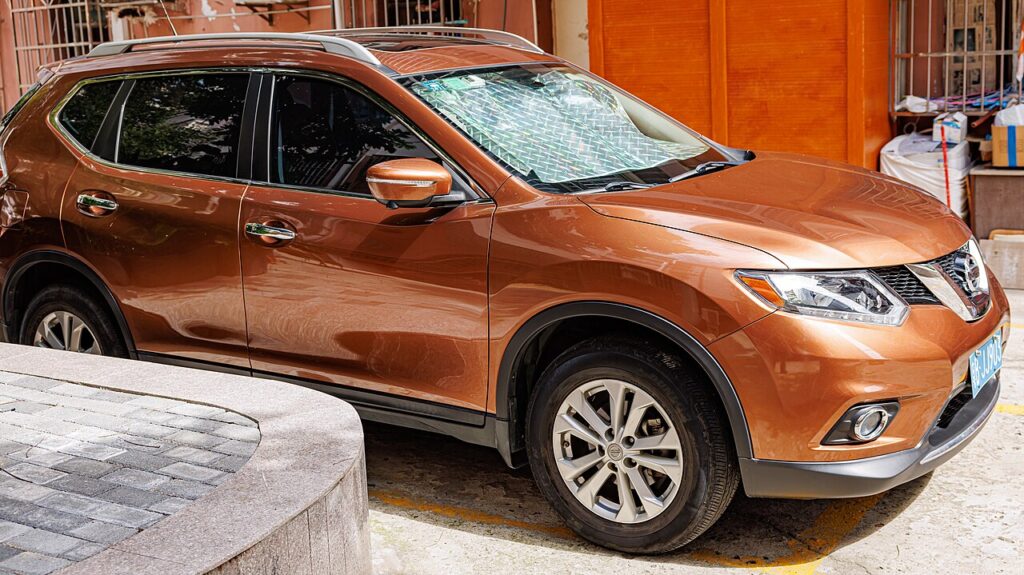
These instructions apply to the Nissan X-Trail Mk3 (T32) 2014-2022.
For other models, please choose your vehicle here.
This guide covers putting the electronic parking brake into service mode on the Nissan X-Trail (T32, 2014–2022) so the rear calipers open far enough to fit new pads. It applies to the EPB cars — those with the small P rocker switch on the centre console. Some base-trim T32s (and the closely related Rogue in certain markets) shipped with a conventional foot or pull-up park brake; if yours has a pedal or lever rather than a console switch, the rear pistons simply wind in by hand and none of the steps below are needed.
What service mode does and why you need it
On EPB-equipped T32s each rear caliper has its own electric motor that screws the piston out to clamp the disc when you park. That motor lives between the piston and the pad, so it winds the piston progressively further out as the friction material wears down. To get thicker new pads in, the motor must first pull the piston all the way back. Service mode — Nissan’s brake-pad-replacement routine — commands both rear motors to their fully retracted reference position, lets you swap the pads, then re-clamps the motors onto the new pads and recalibrates so the controller knows the new piston travel.
Retracting the rear calipers
- Park on the level, engine off, transmission in P, wheels chocked. Leave the ignition ON (engine off) so the EPB controller stays powered.
- Plug an EPB-capable scan tool into the OBD socket under the dash. The T32 works with Nissan CONSULT (M.U.T.-III SE) and with generic EPB tools that list the Nissan brake-service function.
- Select the brake controller (EHS / PKB) → Work Support → Start Brake Pad Replacement and confirm. Both rear motors whir as they wind the pistons fully back.
- When the tool shows the motors are open, remove the rear wheel, unbolt the caliper, and replace the pads.
- Fit the new pads, then run Finish Brake Pad Replacement and the initialisation/calibration step so the controller relearns the clamp position.
Never force the pistons back by hand
Do not wind or clamp a T32 rear piston back while the motor is still extended. The actuator is designed to be driven only by its motor; pushing it from the piston face strips the internal gear, bends the spindle, or forces dirty fluid back past the motor seals — any of which means a replacement caliper. If you have no scan tool, the only safe route is to retract the motor under its own power: unplug its connector and pulse it from a 12V source, reversing polarity to drive it inward. There are no sensors in the motor circuit, just the two motor leads — but never turn the ignition on with a motor disconnected or the EPB controller will log an open-circuit fault.
Exit service mode and bed in the new pads
After the finish and calibration steps, switch the ignition off and on, cycle the EPB switch (pull up to apply, press down to release), and confirm the dash brake symbols clear. Pump the brake pedal several times before you move so the pistons take up the gap. Bed the pads in with eight to ten firm-but-not-full stops from about 30–40 mph, leaving cooling time between each, and avoid hard prolonged braking for the first 200 miles so the friction material transfers evenly onto the discs.
Frequently Asked Questions
Does my X-Trail T32 have an electronic parking brake? Look for the console P switch. Higher trims have the EPB; some entry models used a foot or lever park brake, which winds in by hand instead.
Can I do the rear pads without a diagnostic tool? Only by powering each caliper motor back through its connector with a 12V supply. There is no dashboard sequence that opens the T32 calipers.
The brake light stayed on afterwards — why? Usually the calibration step was missed, or the ignition came on with a motor unplugged. Run the initialisation function and clear the stored codes.
Does the seven-seat T32 differ? No. Seating layout has no effect on the rear brakes; the EPB procedure is identical across five- and seven-seat cars.
Do the front brakes need service mode? No. The front calipers are ordinary hydraulic units with no motor, so you press those pistons back in the usual way.
If a parking-brake or ABS warning light stays lit after the job, scan for the stored fault codes and look them up at autodtcs.com before clearing.
Independent guide — not affiliated with Nissan. Always follow your official service manual and safety precautions. Read our full disclaimer.