These instructions apply to the Audi Q3 Mk2 (F3) 2018-Present.
For other models, please choose your vehicle here.
The Audi Q3 Mk2 (F3, 2018–present) stores a reference set of tyre pressures, so after you inflate or change a tyre you tell it the new values are correct. You do that through the MMI menu. It’s a normal step after any pressure change, not a sign of a fault — the car just needs a fresh baseline to compare against. Here’s how.

How the System Works on the Q3
The Q3 Mk2 uses an indirect monitor: instead of a pressure sensor inside each wheel, it watches the wheel-speed signals the ABS already produces. A tyre losing pressure has a slightly smaller rolling radius and turns marginally faster, and the system spots that difference against its stored baseline. That’s why there’s no live PSI readout and why you must store a new reference after any change — the car only knows “correct” is whatever you last told it to remember.
Set the Pressures First
Inflate all four tyres cold to the figure on the driver’s door-pillar label, then store the new reference.
Before You Begin
- Set pressures cold — parked several hours or driven under a mile — so the stored baseline is accurate.
- Use the door-pillar label figure; there’s often a separate value for a full load or higher speeds.
- Make sure all four corners are at spec before storing — an indirect system compares wheels against each other.
- Switch the ignition on so the MMI is awake; you can store while stationary.
How to Store the New Pressures
- Adjust the pressures, then switch the ignition on.
- On the MMI touchscreen open ‘Vehicle’ (or the car/assist menu).
- Select ‘Service & checks’ → ‘Tyre pressure monitoring’ (wording varies by software).
- Choose ‘Store tyre pressures’ / ‘SET’ and confirm. A message confirms the new reference is saved.
If the Light Stays On
- Re-check every tyre — the system compares wheels, so one low corner triggers it.
- Always re-store after inflating — the Q3’s indirect system needs the new baseline saved.
- Drive a short distance after storing — the system needs some steady running to learn the corrected rolling radii.
- After a wheel change or fitting winter wheels, store again once they’re on and set to spec.
- Cold snaps lower pressures overnight; top up to the label figure and re-store rather than assuming a sensor fault.
- If the light returns quickly with pressures confirmed correct, suspect a slow puncture on one corner and have it checked.
After the Reset
Once you’ve stored the reference and driven a short distance, the warning clears and the Q3 quietly monitors against the new baseline. Because the system is indirect, it won’t show you exact pressures — it just stays dark until it detects a corner drifting low again. If it lights after a cold night, that’s expected pressure loss; correct the pressures cold and store once more.
Frequently Asked Questions
How do I reset the tyre pressure light on an Audi Q3?
Set the pressures, then in the MMI go to Vehicle → Service & checks → Tyre pressure monitoring and store the new values.
Do I need a tool?
No — the Q3 stores the reference through its own menu; no garage equipment needed. Because the monitor is indirect and reads the ABS wheel-speed signals rather than in-wheel sensors, there’s nothing to program at a workshop for a routine reset after inflating or swapping wheels.
Why does the light come on in cold weather?
Pressures drop as temperature falls. Top up to the label figure and re-store the reference.
It came on after a wheel change — why?
You moved the reference. Re-run the store so the new pressures become the baseline.
Does the Q3 show me exact tyre pressures?
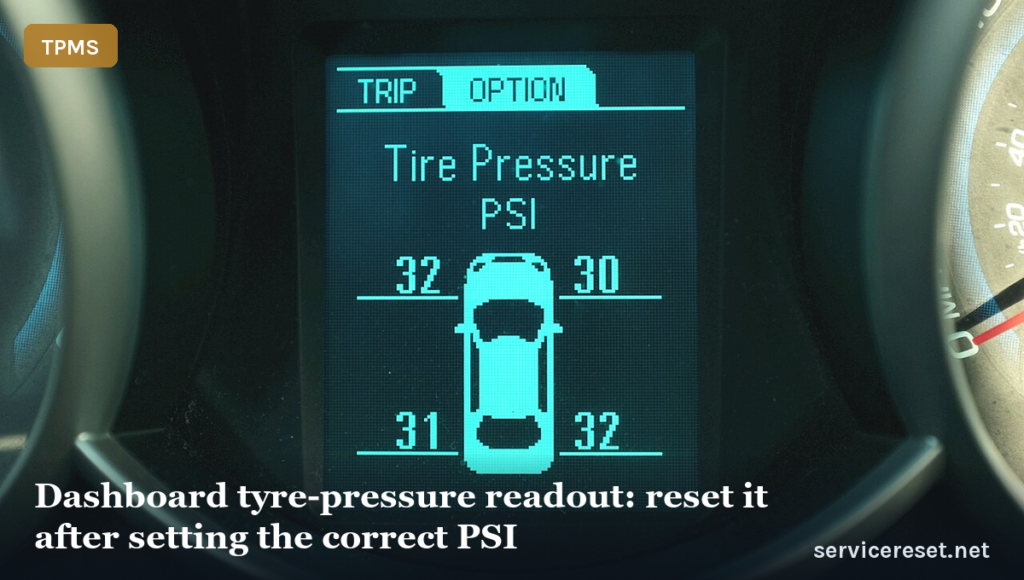
No — because it’s an indirect system it doesn’t read PSI per wheel, so there’s no live figure on screen. It only tells you when a tyre has drifted low relative to the stored baseline. Use a gauge to set pressures cold, then store them as the new reference.
Do I have to store the reference again if I only added air to one tyre?
Yes. Set all four to spec first, then store, so the whole set becomes the baseline. Adjusting a single corner without re-storing leaves the car comparing against old values and can trigger a false warning on your next drive.
If a fault code is stored, look it up on autodtcs.com. To clear a service reminder, see our Q3 Mk2 service reset.
Independent guide — not affiliated with Audi. Always follow your official service manual and safety precautions. Read our full disclaimer.