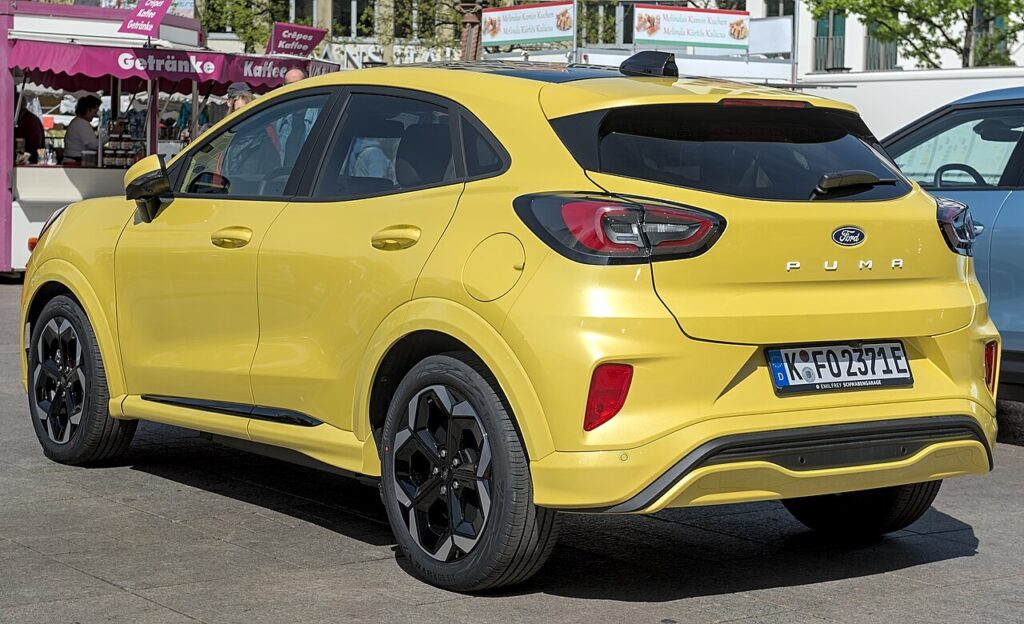
These instructions apply to the Ford Puma Mk2 (J2K) 2020-Present.
For other models, please choose your vehicle here.
The Ford Puma (2020–Present) shares its EPB architecture with the current Fiesta and Focus: a switch-operated electronic parking brake driving a small motor in each rear caliper. There is no handbrake cable to slacken and no piston to wind by hand — before a rear pad change you put the EPB into service (maintenance) mode and let it retract the pistons electronically.
What service mode is and why you need it
Each rear caliper’s piston is moved by a geared electric motor. While the system is live the motor holds the piston, so it can’t be compressed for new pads. Service mode winds both motors fully open and locks the EPB out so it can’t apply while you work. The message centre shows a maintenance-mode message and the amber brake lamp stays lit until you exit.
Entering EPB service mode on the Puma
Park on level ground and chock a front wheel. If your Puma has Auto Hold, switch it off first. Then:
- Set the ignition to ON with the engine off (don’t press the brake during start).
- Press and hold the accelerator pedal fully down.
- Keeping the accelerator down, push the EPB switch down to RELEASE and hold it.
- With both held, set the ignition OFF, then back ON within five seconds.
- Hold until the message centre reads Maintenance Mode and the EPB lamp lights, then release both.
The pistons are now retracted and the EPB is locked out for the job.
Never force the pistons back by hand
Never wind or force the EPB pistons back with a G-clamp, a wind-back tool or by hand. The piston is driven by an electric motor and gearset; pushing it back mechanically strips the gears or burns out the motor, and the only fix is a new caliper. In service mode the motor has already retracted the piston, so the new pads should go in with light hand pressure. If a piston still feels tight, the car probably never entered maintenance mode — check the dash message before doing anything else.
Exit and bed-in
After fitting the pads and refitting the wheels, exit with the reverse sequence: ignition ON, hold the accelerator, push the EPB switch UP to APPLY, cycle the ignition OFF then ON within five seconds, hold until the EPB performs a full apply-and-release, then release. This sets the correct pad-to-disc air gap. Re-enable Auto Hold if you use it, then bed the pads in on the road — several firm slow-downs from about 30 mph (50 km/h) with cooling gaps — and verify the parking brake holds on an incline.
Frequently Asked Questions
Do I need FORScan for the Puma rear pads? Usually not — the Puma honours the accelerator-and-switch sequence above, the same as the current Fiesta and Focus. A cheap OBD adapter (around $50) running FORScan, with its “Enter parking brake maintenance mode” function, is a reliable fallback if the manual entry won’t take.
Is the EPB on every Puma? Yes. The Puma launched with the electronic parking brake across the range, including the mild-hybrid (mHEV) versions, so every car uses this procedure.
The Puma won’t enter maintenance mode — why? Most often Auto Hold is still on, the accelerator wasn’t held fully, the switch was pulled up instead of pressed down, or the ignition cycle took too long. Turn Auto Hold off, stay on level ground in P, and repeat.
Do I have to twist the piston in? No — once retracted in service mode it compresses straight in; it is not a screw-in piston.
Why is the brake lamp still on afterwards? It clears when you complete the exit (apply) sequence and the EPB cycles. If it stays lit, repeat the exit steps or scan for a stored EPB code.
If a warning light or fault code shows up during the job, look it up on our sister site autodtcs.com.
Independent guide — not affiliated with Ford. Always follow your official service manual and safety precautions. Read our full disclaimer.