These instructions apply to the Hyundai Nexo Mk1 (FE) 2018-2023.
For other models, please choose your vehicle here.
The Hyundai Nexo (FE, 2018–2023) has two completely separate coolant systems, and mixing them up can be an expensive mistake. This guide explains the fuel-cell coolant, the motor/inverter coolant, and the brake fluid — what you can check yourself and what belongs with a Hyundai dealer.
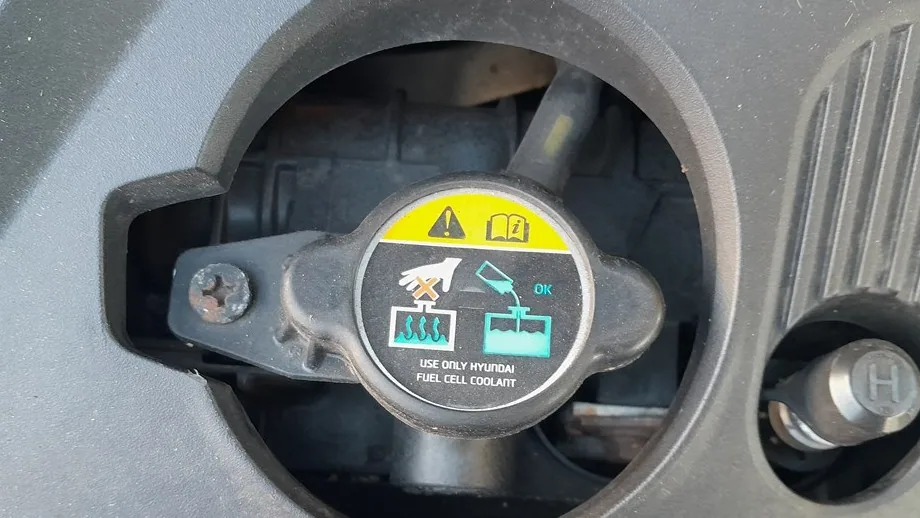
Two coolant systems, never mixed
Unlike a normal car, the Nexo runs two distinct coolant loops with different fluids:
- Fuel-cell coolant — a special low-conductivity fluid with a non-ionic anti-corrosion additive (Hyundai’s own FC Stack Coolant). Its cap is labeled “Use only Hyundai fuel cell coolant.”
- Motor/inverter (electric-system) coolant — a conventional pink long-life coolant (Hyundai’s LLC10), with higher electrical conductivity. Its cap is labeled “Motor inverter coolant.”
These must never be swapped. Putting electric-system coolant into the fuel-cell circuit damages the system’s insulation resistance and raises the risk of electric shock; putting fuel-cell coolant into the electric-system circuit lets its parts corrode. Always match the fluid to the cap’s label.

What you can check yourself
Hyundai lists a few fluids owners can check on the Nexo: the electric-system coolant level, the fuel-cell coolant level, the brake fluid level, and the tires. Check the levels against the MIN/MAX marks with the car cold and parked level.
The brake fluid reservoir is on the right side of the engine bay (looking from the driver’s seat), next to the motor/inverter coolant reservoir. Keep it between MIN and MAX; a dropping level can mean worn brake pads or a leak, so have it checked if it keeps falling.
The Nexo uses DOT 4 LV brake fluid, with a scheduled change about every 20,000 km or two years; the cabin and engine air filters fall on the same rough interval. The single-speed reduction gearbox is filled with SAE 75W-85 gear oil as a long-life fill — not a routine owner job.

What to leave to the dealer
Do not touch the coolant itself, the orange high-voltage cables, or the ion (deionizing) filter — all carry a shock risk. Replacing either coolant and the deionizing filter is a dealer job that needs the right low-conductivity fluid and tools.
If the cluster shows “Check fuel cell coolant and filter,” “Replace coolant and filter,” or “Fill electric-system coolant,” book the car in. Topping up or replacing these yourself with the wrong fluid risks serious, expensive damage to the fuel-cell stack.
Parts you must not touch
For your safety, stay away from the orange high-voltage cables, the ion filter, and anything with a high-voltage warning sticker. Also leave alone the hydrogen tank and storage system under the load floor, the hydrogen supply line under the car, and the hydrogen supply components on the right under the hood.
Frequently asked questions
What coolant does the Hyundai Nexo use?
Two different ones. The fuel-cell circuit uses a special low-conductivity “Hyundai fuel cell coolant,” and the motor/inverter circuit uses a conventional-type coolant. Each cap is labeled; never swap them.
Can I top up the Nexo coolant myself?
You can check the levels, but topping up or replacing the fuel-cell coolant is a dealer job — it needs the correct low-conductivity fluid, and the wrong fluid can damage the stack. If a coolant warning shows, see a Hyundai dealer.
Why does my Nexo say “Check fuel cell coolant and filter”?
It is a maintenance prompt for the fuel-cell cooling circuit and its deionizing filter. Have a Hyundai dealer check and service it; this is not an owner top-up.
Where is the brake fluid on a Nexo?
In the reservoir on the right side of the engine bay, beside the motor/inverter coolant reservoir. Check that it sits between MIN and MAX.
Independent guide — not affiliated with Hyundai. Always follow your official service manual and safety precautions. Read our full disclaimer.