These instructions apply to the Jeep Patriot Mk1 (MK) 2007-2017.
For other models, please choose your vehicle here.
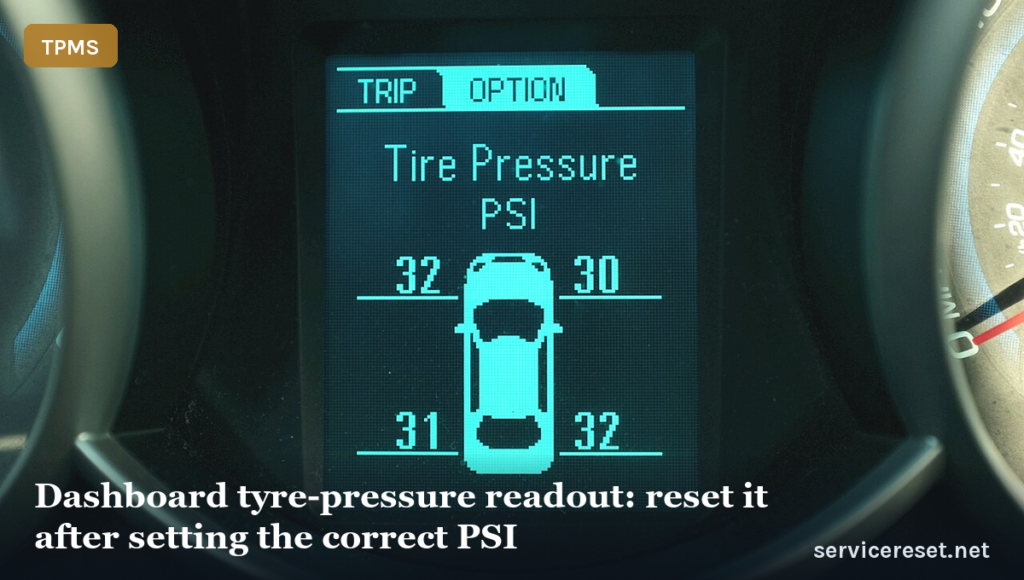
If the tyre-pressure warning has come on in your Jeep Patriot (2007–2017) after you’ve adjusted the pressures or changed a wheel, this generation uses an indirect system — there are no sensors in the wheels, so you reset it by setting the pressures and driving. Seeing the light after a top-up, a seasonal tyre swap, or the first cold snap of autumn is normal, not a sign of a fault: the system has simply lost the baseline it was comparing against and needs to learn the new one. Here’s how to clear it properly.
How the System Works
The indirect TPMS reads wheel-speed data to spot a tyre going soft, so after any pressure change you set the correct pressures and let the car relearn them on the move. Because a softer tyre has a slightly smaller rolling radius, it turns marginally faster than the others; the system watches for that difference through the ABS wheel-speed sensors rather than measuring pressure directly. That is why there is no in-wheel sensor to fail on a battery and no valve-stem electronics to worry about — but it also means the warning is a relative comparison, so it only works once you tell it what “correct” looks like by driving a fresh learn cycle.
Before You Begin
- Check the tyres cold — before driving, or after the car has stood for a few hours. Warm tyres read a few psi high and will set the baseline wrong.
- Find the placard figure on the label in the driver’s door shut, and set all four to exactly that.
- Don’t forget any corner that was topped up or swapped — the baseline is only as good as the softest tyre.
- Have a clear 20-minute route in mind so you can hold a steady speed rather than crawling in traffic.
Resetting the System
- Park level and set all four tyres to the correct cold pressures (placard in the driver’s door shut).
- Drive the vehicle for about 20 minutes at a steady speed above roughly 25 km/h (15 mph).
- The new pressures are stored as the baseline and the warning clears.
If the Warning Stays On
- Recheck every tyre — one corner a few psi low keeps the warning on.
- Complete the learn drive — a run of short trips may not add up to enough continuous driving.
- Check the spare or space-saver if one is fitted — a temporary spare runs at a different pressure and can trigger the light until the full-size wheel is back on.
- After a wheel change, make sure pressures are exactly to spec before you set off, then relearn.
- Rule out a slow puncture — if one tyre keeps dropping over a day or two, the light is doing its job; find the leak rather than resetting again.
- Still showing with correct pressures? A fault may be stored — look it up on autodtcs.com.
After the Reset
Once the learn drive is complete the warning goes out and stays off for the rest of the trip and beyond, as long as the pressures hold. On a cold morning you may see it flicker on again for a short drive and then clear itself as the tyres warm and the pressure rises back to normal — that is expected behaviour on an indirect system and not a repeat fault. If it comes on and stays on, treat it as a genuine low-pressure alert and check the tyres.
Frequently Asked Questions
How do I reset the tyre pressure light on a Jeep Patriot?
Set all four pressures correctly, then drive about 20 minutes above 25 km/h to relearn them.
Does it have sensors in the wheels?
This generation uses an indirect, wheel-speed-based system, so there’s no in-wheel sensor battery to fail.
Why won’t the warning clear?
Usually a tyre still below spec, or the learn drive wasn’t long enough.
Do I need a tool?
No — setting the pressures and driving is all that’s needed.
Why does it come back every cold morning?
Pressure falls roughly 1 psi for every 5–6 °C drop, so a cold night can push a borderline tyre under the threshold. It often clears once the tyres warm up. If it keeps returning, set the pressures a touch toward the upper end of the placard range and relearn.
Do I need to reset it after rotating the tyres?
Yes — set all four to the placard pressures first, then run the 20-minute learn drive so the system stores a fresh, correct baseline for the new positions.
If the warning came on with other lights, decode the code on autodtcs.com.
Independent guide — not affiliated with Jeep. Always follow your official service manual and safety precautions. Read our full disclaimer.