These instructions apply to the Jeep Patriot Mk1 (MK) 2007-2017.
For other models, please choose your vehicle here.
If the remote for your Jeep Patriot (MK, 2007–2017) only works when you are standing next to the tailgate, or has stopped responding altogether, the coin cell inside it is almost certainly flat — not the car. Across its ten-year run the Patriot shipped with two remotes: the common remote-head key, which has a fixed metal blade moulded into the same plastic body as the lock, unlock and panic buttons, and, on later Limited trims with Keyless Enter-N-Go, a proximity (keyless) fob with a slide-out emergency blade. Both use the same cheap, widely stocked battery, but they open differently and the cell does not seat the same way round — so it is worth knowing which one is in your pocket before you start prying.
How to Tell the Fob Battery Is Dying
- Shrinking range. You have to be within a metre of the Patriot — or hold the fob right against the door — before it will lock or unlock. This is the first and clearest sign.
- The remote’s red LED goes dim or dark. On a healthy cell the little indicator light flashes crisply with every press; a weak battery makes it faint or stops it lighting at all.
- Intermittent, weather-dependent response. Buttons that work in a warm garage but not on a frosty morning point to a cell that is near the end — lithium coin cells lose punch in the cold.
- Proximity fob no longer detected. On Keyless Enter-N-Go cars the doors stop unlocking on approach and push-button start needs the fob held against the start button.
A CR2032 in a Patriot remote typically lasts two to four years. If yours is older than that and doing any of the above, fit a fresh cell before you suspect the receiver or immobiliser.
The Battery You Need
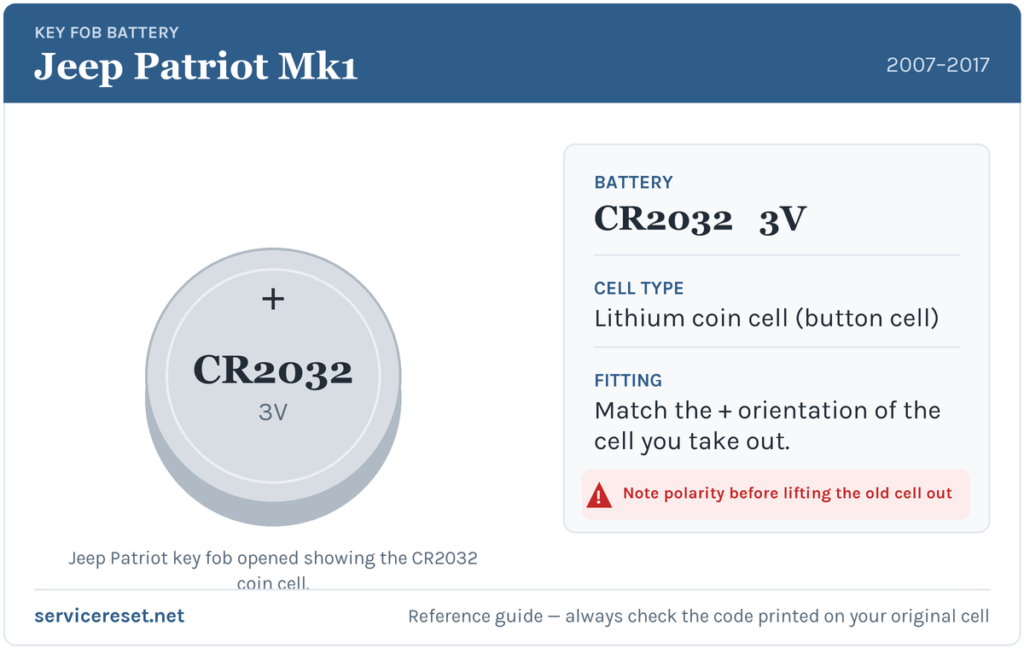
Every Patriot remote — the remote-head key and the proximity fob alike — takes a single CR2032 3-volt lithium coin cell. It is the most common fob battery made, sold in any supermarket, hardware shop or petrol station, and the same cell fits the related Compass and Wrangler remotes of this era. Buy a fresh, good-quality branded cell; a battery that has sat on a shelf for years, or a bargain-bin one, can sag under the brief current the transmitter draws and give poor range even when it reads “new” on a meter.
Method 1 — Remote-Head Key (fixed blade)
- Hold the fob buttons-down so you can see the seam that runs all the way around the edge where the two plastic halves meet.
- Insert a small flat-blade screwdriver or a plastic pry tool into that seam, close to the metal keyring loop at the bottom of the fob. Ease the halves apart with gentle leverage — press, don’t twist, or you can crack the plastic.
- Work the tool around until the back cover pops free and the circuit board and battery are exposed.
- Note how the old cell sits, then slide it out from under its retaining clip. Fit the new CR2032 with the positive (+) face pointing down, toward the front of the remote — on this key the printed side faces into the case, not up at you. Fitted the wrong way up it simply will not power the board.
- Line the two halves up and press them together, starting from the end nearest the blade, until the seam clicks shut all the way round. Test every button.
Method 2 — Proximity (Keyless Enter-N-Go) Fob
- Release the emergency blade first: slide the small catch on the side of the fob and pull the mechanical key blade straight out. This exposes the slot the blade sat in.
- Insert a flat plastic tool (or the emergency blade itself) into the seam and gently twist to separate the two halves of the case.
- Lift out the old coin cell. Fit the fresh CR2032 the same way up as the one you removed — the printed positive face usually sits up under the contact clip on the proximity fob, the opposite of the remote-head key, so copy the orientation rather than assuming.
- Make sure the cell slides fully under the metal contact tab and sits flush, then click the two halves back together and push the emergency blade home until it latches.
⚠️ Get the polarity right. A CR2032 fitted upside down can slowly discharge against the contacts and will leave the key dead — and the two Patriot fobs take the cell opposite ways up. Always match the orientation of the cell you just removed rather than trusting a photo from a different key.
Check It Worked
Stand back a few metres and lock, then unlock, the Patriot. Full range should return straight away and the LED should flash brightly again. On a Keyless Enter-N-Go car, walk up with the fob in your pocket and confirm the doors wake on the handle and push-button start reads the fob without you having to hold it to the button.
If a Fresh Cell Doesn’t Fix It
- Re-check polarity and seating. The remote-head key and proximity fob seat the cell opposite ways up — the single most common mistake — and the battery must click firmly under its clip against clean metal.
- Clean the contacts. A smear of finger grease or light corrosion on the terminals is enough to cause dropouts; wipe them with a dry cloth or a cotton bud.
- Rule out the car’s 12 V battery. A weak vehicle battery can make the whole car slow to respond and mimic a key fault; if the Patriot itself is sluggish to wake, have the main battery tested.
New Key or Spare — Why It’s a Dealer Job
Changing the coin cell keeps the fob’s existing coding, so nothing needs reprogramming and the key works the moment you close the case. Cutting or coding a new key is another matter: the Patriot’s Sentry Key immobiliser has to accept the new transponder, so a lost-key situation or a blank proximity fob generally needs a dealer or an auto-locksmith with a diagnostic tool and the car’s VIN. The cheap fix is prevention: keep the battery in your spare key fresh too, and you are never down to a single working remote.
Frequently Asked Questions
What battery does a Jeep Patriot key fob take?
A single CR2032 3-volt lithium coin cell. The same cell fits both the remote-head key and the Keyless Enter-N-Go proximity fob used across 2007–2017 Patriots.
Which way up does the battery go?
On the remote-head key the CR2032 goes in with the positive (+) face pointing down, into the case. The proximity fob usually seats it the other way, positive up under the contact clip. Whichever fob you have, match the orientation of the cell you removed.
Do I need to reprogram the fob after changing the battery?
No. A battery swap does not touch the coding, so the remote works straight away. Only a brand-new or replacement key needs programming to the immobiliser.
How long should a Patriot key battery last?
Usually two to four years. Heavy use of the remote, or leaving a proximity fob sitting close to the car so it keeps waking, shortens that.
My Patriot key still won’t work after a new battery — what now?
Re-check the cell’s polarity and seating first, then wipe the contacts and make sure the case is fully clicked shut. If the LED still won’t light with a known-good battery, the transmitter itself may have failed — rare next to a simple flat or upside-down cell.
Can I still drive the Patriot if the fob battery is completely dead?
Yes. Use the metal blade — built into the remote-head key, or hidden inside the proximity fob — to unlock the driver’s door. On Keyless Enter-N-Go cars you can still start the engine by holding the dead fob against the push-button start, so a flat cell won’t strand you.
If your Patriot’s remote stopped working at the same time as a warning light or an odd electrical fault, it is worth reading any stored trouble code before blaming the key — you can look up what a Jeep code means on autodtcs.com.
Independent guide — not affiliated with Jeep. Always follow your official service manual and safety precautions. Read our full disclaimer.