These instructions apply to the Lexus LS Mk2 (UCF20) 1994-2000.
For other models, please choose your vehicle here.
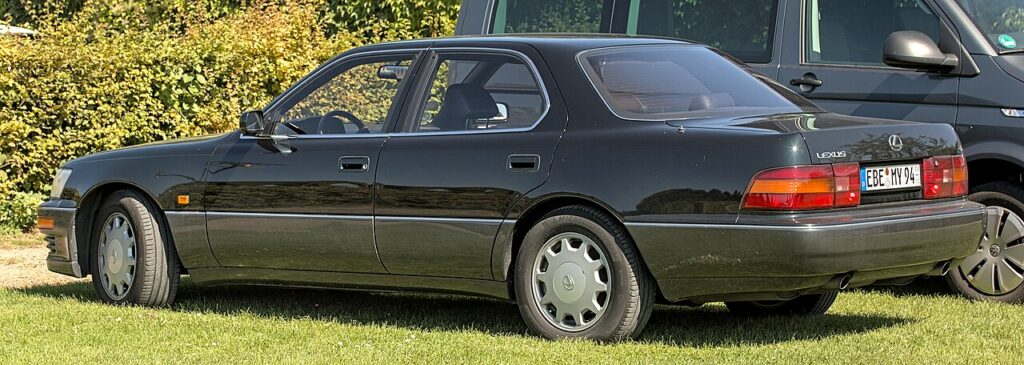
If the keyless entry on your second-generation Lexus LS 400 (XF20/UCF20, 1994–2000) has become unreliable — you have to stand right at the door, press twice, or it has stopped locking the car altogether — the culprit is almost always the small lithium coin cell inside the remote, not the car. These are now old cars, and the transmitter that came with them is a simple radio remote, not a modern proximity smart key. Across the run Lexus fitted two styles: an early separate keyless-entry transmitter (a slim standalone remote carried alongside a plain metal ignition key) and, on later cars, a remote-head key with the buttons built into the key head (FCC ID HYQ1512V). Both take the same cheap battery and both are a five-minute job on the kitchen table. Here is exactly what to buy and how to open each one without cracking the case.
How to Tell the Fob Battery Is Dying
- Shrinking range. The classic first sign — you used to lock the LS from across the car park, now it only works within a metre or two, or you have to hold the remote right against the door.
- Weak or dead indicator light. The little LED on the remote flashes faintly, or not at all, when you press a button. On a fob this age a dead LED is a strong hint the cell is flat rather than the electronics being at fault.
- You have to press twice. The first press wakes nothing; a second finally registers. A cell that has sagged under load does this before it dies completely.
- Cold-morning dropouts. Lithium cells lose voltage in the cold, so a marginal battery often fails on a frosty morning and then “recovers” by lunchtime — a sure sign it is on the way out.
A coin cell in one of these remotes typically lasts two to four years. The XF20 predates any dashboard “key battery low” warning — the car will not tell you, so if the remote is misbehaving and you cannot remember the last time you changed it, just fit a fresh one before suspecting anything more serious.
The Battery You Need
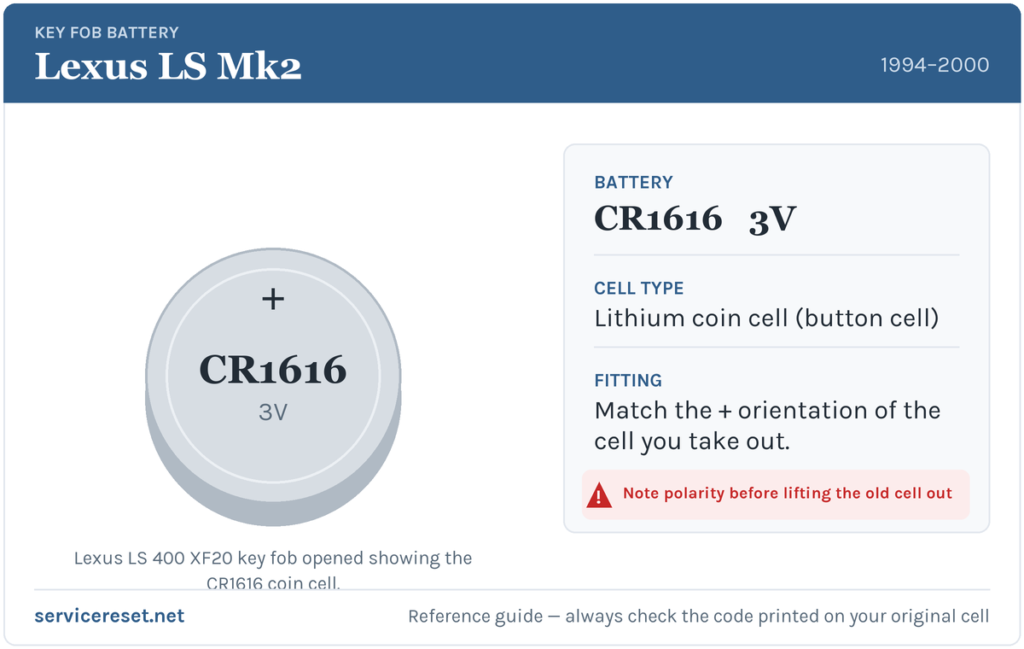
The Lexus LS 400 remote uses a single CR1616 3-volt lithium coin cell — a 16 mm-wide, 1.6 mm-thin button battery. It is a common size, sold in any supermarket, hardware shop or phone-accessory counter (equivalents are marked ECR1616, DL1616 or BR1616). Buy a fresh branded cell rather than a bargain multi-pack that may have sat on a shelf for years; a tired cell gives short range even straight out of the packet.
Because two remote styles were used over the model’s life, treat CR1616 as the expected fit but confirm it against the code printed on the cell you take out — the marking is stamped on the flat top face. That habit protects you if the car has had a non-standard remote fitted at some point in the last quarter-century.
Method 1 — Remote-Head Key (Later Cars, FCC HYQ1512V)
- Look on the back of the key head for a small cross-head (Phillips) screw holding the two halves together. Undo it with a jeweller’s or eyeglass screwdriver and keep the tiny screw somewhere safe — they are easy to lose.
- With the screw out, gently prise the seam apart around the edge of the head using a fingernail or a thin plastic tool. Work slowly so the plastic clips inside do not snap.
- Lift the circuit board or the battery clip enough to slide the old CR1616 out. Note which way up it sits before it comes free — the marked face and the way the metal clip presses on it.
- Drop the fresh CR1616 in the same orientation as the one you removed, seated fully under its retaining clip.
- Press the halves back together until the seam clicks flush, refit the screw and nip it up snugly — the case is plastic, so do not overtighten.
Method 2 — Separate Keyless Transmitter (Early Cars)
- Find the slot or seam running around the edge of the slim remote. Some have a tiny screw on the back; if so, remove it first.
- Insert a small flat-blade screwdriver or a coin into the seam and twist gently to pop the two halves apart — a little at a time around the edge rather than levering hard in one spot.
- Ease the old CR1616 out of its holder, again noting the orientation of the marked face.
- Fit the new cell the same way round, then squeeze the case back together until the clips latch and refit the screw if there was one.
⚠️ Match the orientation exactly. These holders are not keyed, so it is possible to seat a coin cell the wrong way up. A reversed cell will not power the remote and can slowly discharge — so before you lift the old battery out, take a moment to register which face points up, and copy it. If in doubt, snap a quick photo on your phone first.
Check It Worked
Stand a few metres from the car and press lock, then unlock. Full range should return at once and the remote’s LED should flash brightly with each press. If the LED is bright but the doors do not respond, walk closer and try again — range that is back to across-the-car-park distance confirms the new cell has done its job.
If a Fresh Cell Doesn’t Fix It
- Re-check the orientation and seating. An upside-down or loosely-seated cell is by far the most common reason a “new battery” changes nothing. Make sure it clicks firmly under the clip.
- Clean the contacts. On a remote this old the metal terminals can be dulled by finger grease or light corrosion. Rub them with a dry cloth or a pencil eraser until they are bright, then refit the cell.
- Confirm the cell size. If the remote was replaced at some point, it may not be the original CR1616 — check the marking on the battery you removed.
- Suspect the remote itself. If the LED still will not light with a known-good cell, the transmitter’s electronics may have failed — not unusual after two or three decades. A used or aftermarket remote can be sourced, but it will need programming to your car (see below).
New Key or Spare — Why It’s a Dealer or Locksmith Job
Simply changing the battery keeps the remote’s existing coding, so the car recognises it straight away with nothing else to do. Adding a spare remote, or replacing a lost one, is different: the transmitter has to be paired to the LS’s keyless receiver, and the later remote-head keys also carry a transponder chip that must be married to the immobiliser before the car will start. That programming needs the right equipment and, for the chipped keys, access to the car — which is why a new or additional key for an XF20 LS 400 is a job for a Lexus dealer or an auto-locksmith rather than a driveway task. The practical takeaway: keep the battery in your spare remote fresh too, so you are never relying on a single working key.
Frequently Asked Questions
What battery does a Lexus LS 400 (1994–2000) remote take?
A single CR1616 3-volt lithium coin cell. It is a common, inexpensive size — just confirm the code printed on the old cell before buying, since a couple of remote styles were used over the model’s life.
Does the remote use one battery or two?
One. Both the early standalone transmitter and the later remote-head key run on a single CR1616 — if you find two cells stacked, the remote is not original to the car.
How do I open the fob without breaking it?
Look for a tiny Phillips screw on the back and undo it first if there is one, then ease the seam apart gently with a fingernail or thin plastic tool. Levering hard in a single spot is what cracks these old cases — work around the edge a little at a time.
Which way up does the cell go?
Fit it the same way round as the one you took out. The holder is not keyed, so always note the orientation of the marked face before removing the old cell — a reversed battery simply will not work and can drain itself.
Do I need to reprogram the remote after a battery change?
No. Changing the battery does not affect the pairing, so the remote works immediately. Only a brand-new or replacement remote needs programming to the car.
Can I still get into and drive the car if the remote is completely dead?
Yes. The XF20 has a conventional metal key blade that unlocks the door and starts the engine, entirely independent of the keyless remote — a flat coin cell only stops the remote buttons working, it never leaves you locked out.
If the remote stopped working at exactly the same moment as another electrical niggle — rather than fading gradually — the car may have logged a fault worth reading before you spend money on parts; you can look up what a stored code means on autodtcs.com.
Independent guide — not affiliated with Lexus. Always follow your official service manual and safety precautions. Read our full disclaimer.