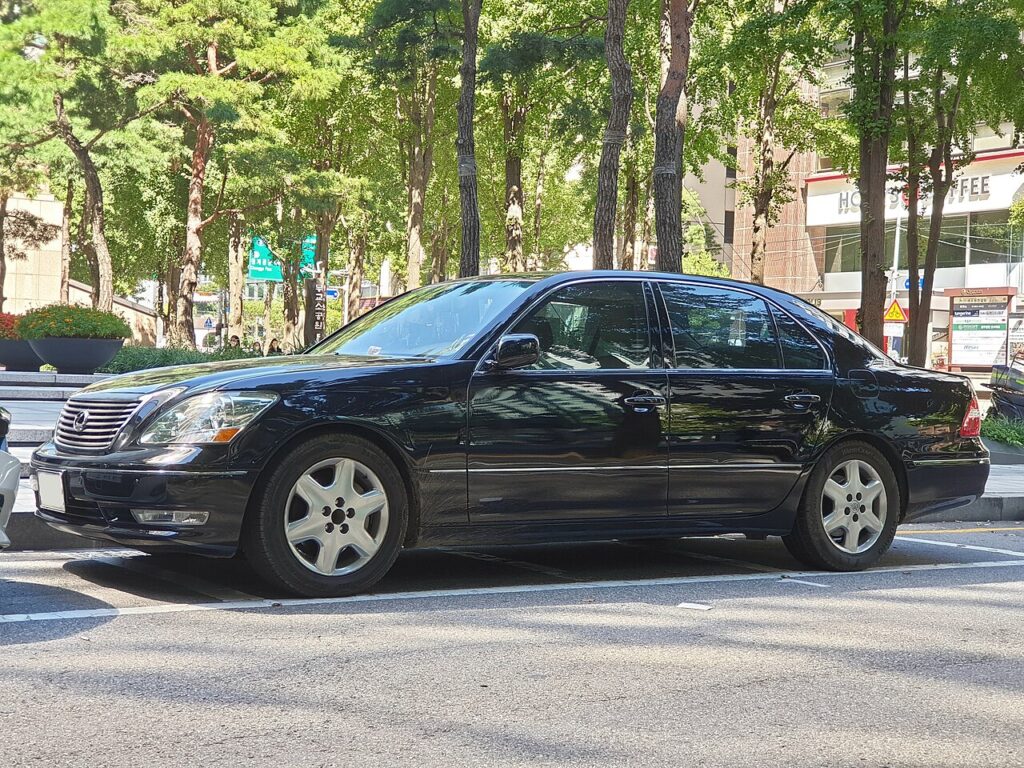
These instructions apply to the Lexus LS Mk3 (UCF30) 2000-2006.
For other models, please choose your vehicle here.
Disconnecting the 12 V battery on your Lexus LS 430 (2000–2006) — the UCF30 — for a new battery, winter storage, or work near the airbags is a straightforward job. The battery is in the engine bay, and provided you take the terminals off and put them back in the right order, this luxury saloon relearns the few settings it loses over your next drive.
Owners usually disconnect the LS 430’s battery for a straight renewal when it starts cranking slowly, to stop a parasitic drain flattening the car during long storage, before electrical or bodywork jobs, or to power the car down cleanly after a jump-start. The UCF30 is a petrol V8, not a hybrid, so there is only one battery and no high-voltage system to be wary of — but this LS carries a lot of memory settings, so it’s worth doing tidily.
Find the Battery First
Identify the terminals before you loosen anything: the negative post carries a black cover and a − symbol, the positive is red and marked +. Removing a plastic cover gives you clear access on this car.
The 12 V battery is in the engine compartment, under a cover (this LS is a petrol V8, not a hybrid). Note your radio presets and settings before you start.
Getting Ready
- Switch the ignition fully off and take the smart key away from the car.
- Turn off the headlights, climate, radio and any accessories so nothing is drawing power when you break the connection.
- Write down your radio presets, and note any security-code details in case they’re needed on power-up.
- Give the modules a minute or two to power down after switching off.
- Have the right spanner (usually 10 mm), gloves and eye protection to hand.
Disconnecting Safely
- Switch everything off and confirm the ignition is dead.
- Disconnect the negative (−) terminal first, lift the clamp off the post and move the cable clear so it can’t flick back onto the terminal.
- Then disconnect the positive (+) terminal.
- Working near airbags or seat-belt pretensioners? Wait a couple of minutes after disconnecting before you start such work, so the airbag system fully discharges.
Reconnecting and Re-initialising
Reconnect in reverse: positive (+) first, then negative (−) last, and tighten both clamps properly — a loose terminal is the usual cause of a car that feels “off” afterwards. The LS 430 then relearns a few items:
- Clock and radio presets — reset the time and re-store your stations.
- Steering angle / stability — settles after a short, steady drive with a full lock each way.
- Driver’s seat and mirror memory — check your saved position is still there and re-store it if it has been lost.
- Power windows — if one-touch is lost, pull the switch up and hold at the top for a moment to re-teach it.
If Something Isn’t Right Afterwards
- Check the clamps are tight first — most post-disconnect issues trace back to a loose terminal.
- Warning lights usually clear after a short drive once the systems have re-checked themselves.
- Redo the window and steering relearn if auto-up or the stability light hasn’t settled.
- The gear lever won’t leave ‘P’ after a flat battery? Use the console shift-lock release — prise the small cover, press the button and move the lever.
- A persistent light stores a code — look it up on autodtcs.com before spending money on parts.
Frequently Asked Questions
Where is the battery on a Lexus LS 430?
In the engine compartment, under a cover — this LS isn’t a hybrid, so there’s only the one 12 V battery and no high-voltage system to avoid.
Which terminal do I take off first?
Negative (−) off first when disconnecting, and reconnect it last. Positive (+) goes back on first. That order avoids shorting a spanner to the body while the battery is still live.
What needs resetting afterwards?
The clock and radio presets, the one-touch windows, the steering-angle learn, and your seat/mirror memory if it drops. Most of it settles on a short drive; the windows may want a quick pull-and-hold.
Do I need to wait near the airbags?
Yes — give it a couple of minutes after disconnecting before working on the airbags or seat-belt pretensioners, so the system fully discharges first.
Does a new battery need coding on the LS 430?
No. A like-for-like 12 V battery is a straight swap on this generation with no registration step. Fit it, reconnect in the right order, and let the car relearn its settings.
Will the remote key still work after disconnecting?
It normally does. If the remote stops locking the doors after the battery has been off, see our LS 430 remote-programming guide to re-pair it.
Independent guide — not affiliated with Lexus. Always follow your official service manual and safety precautions. Read our full disclaimer.