These instructions apply to the Lexus SC Mk2 (Z40) 2001-2011.
For other models, please choose your vehicle here.
The Lexus SC 430 (Z40, 2001–2011) is a folding-hardtop convertible from the era before push-button start, so it doesn’t carry a smart keyless fob at all. Instead you get a remote-head “master key” — a single black plastic head with three buttons (lock, unlock, boot) and a fold-out metal blade you turn in the ignition. The car may also have come with a plain valet key, which has no buttons and no battery. Only the master key holds a coin cell, and when that cell fades the symptoms are always the same: short range, a dead LED, or no response at all. Here is exactly how to open the SC 430’s master key, which battery it takes, and why cutting a fresh spare is the one part of the job you can’t finish at home.
How to Tell the Fob Battery Is Dying
- Shrinking range. You have to be right next to the SC 430 — or almost touching the door handle — before it locks or unlocks. A healthy remote works from several metres away, so a sudden drop in range is the classic first sign.
- The button LED stops lighting. The little red indicator on the key head should flash each time you press a button. If it’s dim or dead, the cell can no longer supply the short burst of current the transmitter needs.
- Buttons respond only sometimes. Intermittent locking — worse on a cold morning — is a near-flat cell sagging under load at low temperature.
- You’re back to the blade. Finding yourself folding out the metal key to get into the car is the honest tell that the remote side has gone quiet.
The SC 430 has no dashboard “key battery low” warning — that came in with later smart-key Lexus models — so the fob’s own behaviour is your only gauge. A coin cell in one of these remotes typically lasts three to four years; if yours is older and doing any of the above, fit a fresh one before suspecting the car.
The Battery You Need
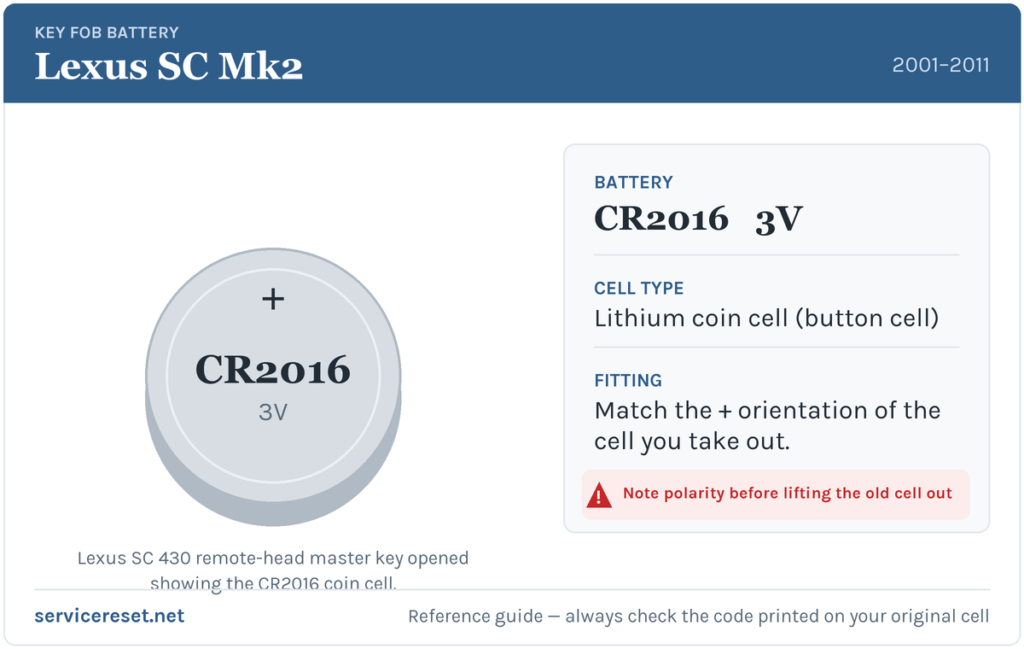
The SC 430’s three-button remote-head key (FCC ID HYQ12BBT, shared with the LS 430 and ES 330 of the same period) takes a CR2016 3-volt lithium coin cell — a 20 mm-wide, 1.6 mm-thin button battery sold in any supermarket, hardware shop or chemist. A few generic Lexus battery guides list a CR1616 for this era instead; that is a physically smaller cell (16 mm across) used in some other Lexus remotes, and it will rattle loose in an SC 430 head. The safest rule is the one that always works: read the code stamped on the flat face of the cell you take out and buy the same number. Fit a good branded cell — cheap ones sag under the transmitter’s brief current draw and can give short range even when “new”.
Method — Opening the Remote-Head Master Key
- Fold or release the metal blade first. On the SC 430 master key, press the small catch on the side of the head and let the blade swing or slide out of the way — it opens up the seam you’ll pry, and gives you something solid to hold.
- Split the case. Slip the tip of a small flat-blade screwdriver into the slot the blade came from (or the fine seam running round the head) and twist gently to pop the cover off the key head. It parts along the seam — work slowly, there’s a thin gasket inside you don’t want to tear.
- Free the circuit board if needed. On some of these heads a small electronic module or board sits over the battery. Lift it clear just enough to reach the cell — don’t yank the buttons or the transmitter contacts.
- Note the orientation, then swap the cell. Look at how the old CR2016 sits before you remove it — on these remote-head keys the positive (+) face points up toward the cover. Slide the flat cell out from under its retaining clip and press the new one in the same way round.
- Reassemble. Seat the board back down, line the gasket up, and click the cover halves together until the seam closes flush. Fold the blade back home and test every button.
⚠️ Match the polarity. A CR2016 fitted upside down bridges the wrong contacts, gives no range, and can slowly discharge while it sits there — so always copy the orientation of the cell you removed rather than guessing.
Confirm It Worked
Stand a few metres back and press lock, then unlock. Full range and a bright LED flash should return straight away. Changing the cell does not wipe the remote’s coding, so there’s nothing to reprogram — if it works from across the car park, you’re done.
If a Fresh Cell Doesn’t Fix It
- Re-check the cell and its seating. Confirm it’s a CR2016 (not a thinner cell swimming in the holder), that it’s the right way up, and that it’s pressed firmly under its clip against clean metal.
- Clean the contacts. A smear of finger grease or light corrosion on the terminals is enough to cause dropouts — wipe them with a dry cloth or a cotton bud.
- Try the other key. If your second master key works fine with its own fresh cell, the first head’s transmitter or board may have failed — uncommon, but it happens on twenty-year-old keys.
- Suspect the car only last. A very weak SC 430 12-volt battery can make the whole car slow to respond; if the interior lights and locks are sluggish generally, that’s a car-side issue rather than the fob.
New Key or Spare — Why It’s a Dealer Job
Changing the coin cell keeps the master key’s existing coding, so the remote and the immobiliser transponder both carry on working. Adding a new key is a different matter. The SC 430’s master key carries a 4D-68 transponder chip that has to be married to the car’s immobiliser with diagnostic equipment, and the remote side must be programmed to the receiver as well — on top of cutting the TOY48 blade to the lock. That combination puts a fresh or replacement key firmly in the hands of a Lexus dealer or an auto-locksmith who can pair the chip against your VIN. The practical takeaway: keep the battery fresh in both of your keys, so you’re never down to one and never forced into an expensive cut-and-code at short notice.
Frequently Asked Questions
What battery does a Lexus SC 430 key take?
The three-button remote-head master key uses a CR2016 3-volt lithium coin cell. Some general Lexus guides quote a CR1616, but that smaller cell is for other models — check the number printed on the battery you remove and match it exactly.
Which way up does the battery go?
Positive (+) side up, toward the cover, on the SC 430’s remote-head key. The surest habit is to note the orientation of the old cell before you lift it out and fit the new one the same way — upside down gives no range and can flatten the cell.
Do I have to reprogram the key after changing the battery?
No. A battery swap leaves the remote’s coding and the immobiliser transponder untouched, so the key works the moment you press a button. Only a brand-new key needs programming.
How long should the key battery last?
Roughly three to four years for a decent branded CR2016. Heavy day-to-day use of the remote will shorten that; a key that mostly sits in a drawer as a spare will last longer.
Can I still drive the SC 430 if the fob is completely dead?
Yes. Fold out the metal blade to unlock the driver’s door, then turn the same blade in the ignition to start — the SC 430 uses a normal keyed ignition, so a flat remote cell never stops you driving. Only the remote-locking convenience is affected.
My valet key has no buttons — does it need a battery?
No. The valet key is a plain mechanical key with no remote electronics and no coin cell. Only the black master key with the button pad holds a battery.
If your SC 430’s locking went haywire right after the car battery was disconnected — rather than the remote simply fading — the cause is more likely a pairing or electrical glitch than the coin cell, and it may have logged a fault code worth reading up on at autodtcs.com.
Independent guide — not affiliated with Lexus. Always follow your official service manual and safety precautions. Read our full disclaimer.