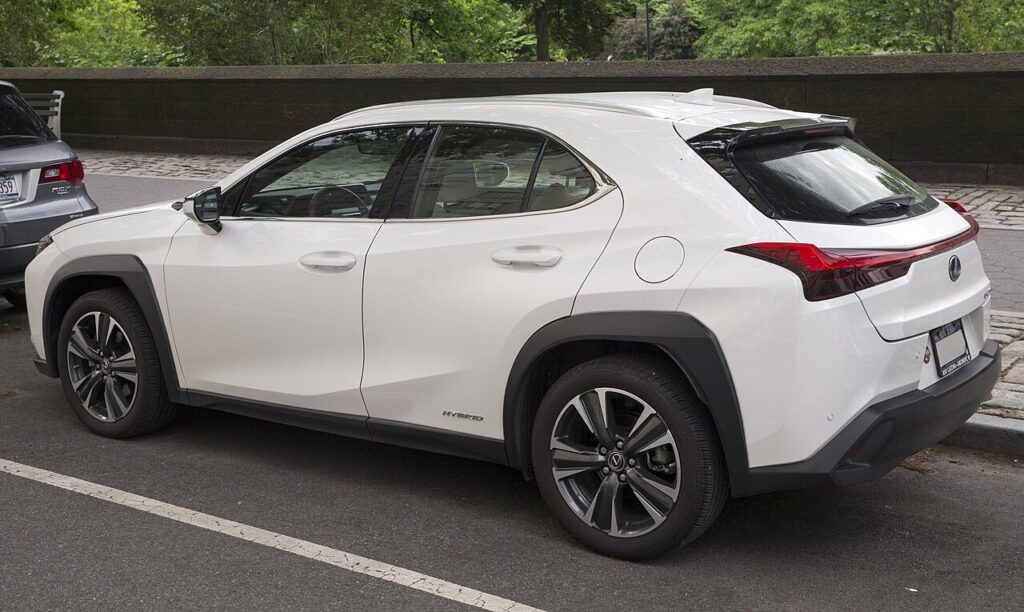
These instructions apply to the Lexus UX Mk1 (A1) 2019-Present.
For other models, please choose your vehicle here.
If the smart key on your Lexus UX (2019–present) has lost its range or shows a low-key-battery message, the coin cell inside is almost certainly flat. On the first-generation UX (chassis code A1, badged UX 200 and UX 250h) the key talks to the car constantly so it can unlock as you touch the handle and let you start with a button press, and that steady chatter wears the cell down faster than an old-fashioned lock-and-key remote. The usual signs are a range that shrinks week by week, a fob that only works on the second or third press, needing to almost touch the door handle before it responds, or a “key battery low” note on the driver’s display. None of that means the car or the key electronics are failing — it’s the little battery, and it’s a five-minute swap. Just check which key type you have first, because the two Lexus UX keys take different cells.
How to Tell the Fob Battery Is Dying
- Shrinking range. You used to lock the UX from across the car park; now you need to be a few steps away.
- Works on the second or third press. A weak cell can still fire, just not reliably first time.
- Keyless entry only up close. If you have to hold the fob near the handle or start button for it to register, the proximity signal is fading.
- “Key battery low” message. The UX displays this in the instrument cluster when it senses the cell is nearly done.
- Worse in the cold. A coin cell that’s marginal will act up first on a frosty morning, then recover slightly when it warms up.
As a rough guide, a smart key like the UX’s — which is constantly listening for the car — tends to need a fresh cell closer to once a year than the two-to-four years you’d get from a simple button-only remote. If yours has gone a couple of winters, it’s simply due.
The Battery You Need — Two Key Types
- Standard smart key (the one with a pull-out mechanical blade) — CR2032, a 3 V lithium coin cell.
- Card-style smart key (the flat card key) — CR2412, a taller, less common 3 V lithium cell — check before buying.
Both are 3 V lithium coin cells, but they are not interchangeable, so confirm which key you’re holding before you buy. Use a reputable branded cell (Panasonic, Sony/Murata, Duracell, Energizer) and don’t substitute a thinner cell that “looks close” — a CR2025 in place of a CR2032, for instance, sits loose and loses contact. The surest check is to open the key and read the code stamped on the cell you remove, then match it exactly.
Replacing the Cell
Standard smart key (CR2032):
- Slide out the mechanical blade. Push and hold the small release knob on the side and pull the metal emergency key free of the fob.
- Split the case at the seam. Use the slot the blade left behind, or the seam around the edge, and gently prise the two halves apart with a small flat screwdriver or a coin. Work around the joint rather than forcing one spot.
- Note which way up the cell sits before you lift it — the marked + face is normally uppermost. Take a quick phone photo if you want a reference.
- Lift the old CR2032 out by its edge, handling the new one by the rim too — finger grease on the flat faces shortens battery life.
- Fit the new CR2032 the same way up, positive side up, and press it home so it’s fully seated under the retaining clip.
- Clip the case shut until it clicks all the way round, then push the mechanical blade back in until it locks.
Card key (CR2412): slide off the cover, lift out the old cell noting its orientation, fit a new CR2412 positive side up, and refit the cover.
⚠️ Polarity matters. Fitting the cell upside down won’t damage the key, but it simply won’t work — and it’s the most common reason a “new” battery seems dead. Positive (the flat face with the writing) faces up unless the holder clearly shows otherwise.
Did It Work?
Stand back a few metres and lock, then unlock, the car — the range should be back to normal. Walk up with the fob in your pocket and try the door handle to confirm keyless entry, and press the START button with your foot on the brake to confirm the car recognises the key. If a “key battery low” message was showing, it usually clears on its own after a drive cycle or two once the fresh cell is in.
If a Fresh Cell Doesn’t Help
- Re-check polarity and seating — positive up, cell fully under the clip and not sitting proud.
- Confirm the right code — a CR2032 in the standard key, a CR2412 in the card key; a mismatch that’s slightly too thin won’t make solid contact.
- Wipe the contacts in the key with a dry cloth or a cotton bud — a smear of oxide or grease can block a good cell.
- Use the backup start in the meantime: hold the fob flat against the START button as you press it, and the car reads the key directly.
- Rule out the car’s 12 V battery. If the UX is also slow to wake or the dash flickers, a tired vehicle battery can mimic key faults.
- Still flagging a fault? A smart-entry problem can store a code — look it up on autodtcs.com.
New Key or Spare — Why It’s a Dealer Job
Swapping the coin cell keeps all the existing coding, so the key works exactly as before — no reprogramming needed. A new or replacement key is different: it has to be coded to your car’s VIN through the immobiliser with dealer or auto-locksmith diagnostic equipment, and there is no owner button-sequence that does it on the UX. If you keep a spare key in a drawer, change its cell every few years too, so it’s ready when you need it rather than dead when you reach for it.
Frequently Asked Questions
What battery does the Lexus UX key use?
The standard smart key (the one with a pull-out mechanical blade) uses a CR2032 3 V lithium coin cell. The flat card-style key uses a CR2412. Both are 3 V lithium but they are not interchangeable — check which key you have, or read the code stamped on the cell you take out.
Which way up does the battery go?
Positive side up in almost every case — that’s the flat face carrying the writing and the CR2032 or CR2412 marking. Note the orientation before you lift the old cell out, and fit the new one the same way. Wrong-way-round is the number-one reason a fresh battery seems dead.
Do I need to reprogram the key after changing the battery?
No. A battery swap keeps all the existing coding, so the key locks, unlocks and starts the UX exactly as before. Reprogramming is only needed for a brand-new or replacement key that has never been paired to your car.
How long should the new battery last?
Because the UX smart key is always listening for the car, expect roughly a year or so from a fresh cell — less if you keep the key near the car overnight, a bit more if it’s stored away. A simple button-only remote would last longer, but a proximity smart key drains faster by design.
The key still doesn’t work after a new battery — now what?
Re-check the cell is the right code, the right way up, and fully seated, and wipe the contacts inside the key. Confirm you didn’t fit a too-thin substitute. If it still won’t respond, the car’s 12 V battery or a smart-entry fault could be involved — use the backup start (fob to the START button) and have it checked.
Can I still drive if the fob battery is completely dead?
Yes. Use the mechanical blade hidden in the standard key to unlock the driver’s door, then hold the fob flat against the START button as you press it — the car reads the transponder directly and will start even with a flat coin cell. You’re never stranded by a dead key battery alone.
If the key flagged low after a battery disconnection, see our UX battery disconnect/reconnect guide. For any stored fault code, look it up on autodtcs.com.
Independent guide — not affiliated with Lexus. Always follow your official service manual and safety precautions. Read our full disclaimer.