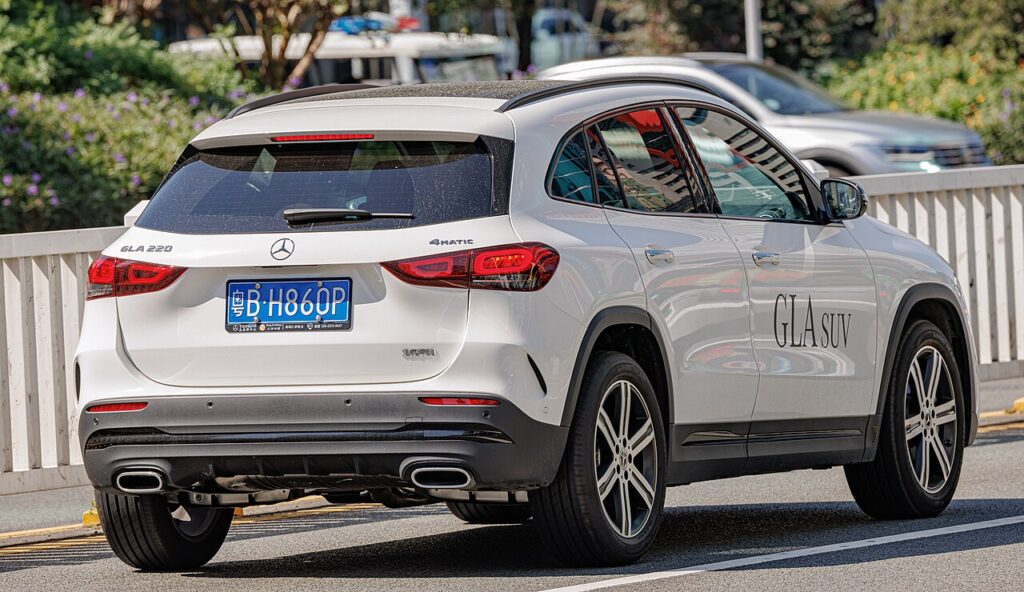
These instructions apply to the Mercedes GLA Mk2 (H247) 2020-Present.
For other models, please choose your vehicle here.
When the SmartKey on your Mercedes-Benz GLA (H247, 2020–present) only locks the car from arm’s length, needs a second press to respond, or has stopped working altogether, the coin cell inside it is almost certainly flat. The second-generation GLA ships with a single style of key — the current chunky black SmartKey shared with the W177 A-Class and the GLB — whether your car has plain keyless-start or the optional KEYLESS-GO hands-free system. It uses one small coin cell and opens using the emergency key blade hidden in the fob as the tool. Here is the exact battery, how to tell a dying cell from a real fault, and why cutting a brand-new key is the one job that has to go to Mercedes.
How to Tell the Fob Battery Is Dying
- Shrinking range. You have to stand right next to the GLA — or almost touch the fob to the door handle — before it locks or unlocks. This gradual loss of range is the classic first sign.
- A dashboard warning. The GLA shows a “Key battery low” style message in the instrument display when the SmartKey cell is running down, and repeats it on later start-ups. It is the clearest early warning you will get.
- Keyless entry gets flaky first. On KEYLESS-GO cars the hands-free door and boot sensors draw more from the cell than a plain button press, so passive locking and the “walk-up” unlock start missing before the buttons do.
- Cold-morning dropouts. A cell that is fine at midday can sag in the cold, so a fob that fails first thing on a frosty morning but recovers later is usually near the end of its life.
A SmartKey cell in a GLA typically lasts two to four years, though a KEYLESS-GO fob left sitting near the car so it wakes constantly can run flat noticeably sooner. If yours is a few years old and doing any of the above, fit a fresh cell before you suspect the car’s receiver or immobiliser.
The Battery You Need
The GLA H247 SmartKey takes a single CR2025 3-volt lithium coin cell — Mercedes lists it as an official part (“Keyless Remote Coin Battery, type CR2025”). It is a common, inexpensive cell sold in any supermarket, chemist or hardware shop. Note the code carefully: a CR2025 is 2.5 mm thick, whereas the CR2032 that fits many other cars is 3.2 mm. A too-thick CR2032 can be forced in but strains the tray contacts, so match the CR2025 printed on the cell you remove, and buy a good-quality branded one — cheap cells sag under the brief current the transmitter draws and give poor range even when “new”.
How to Change the GLA SmartKey Battery
- Release the emergency key blade. Slide the small latch on the SmartKey and pull the mechanical key blade straight out of the body. On the GLA this blade doubles as the tool for the next step, so keep it to hand.
- Pop the battery tray. Insert the tip of the emergency key blade into the opening the blade left behind and press it in the direction of the arrow marked on the fob until the battery tray cover releases and lifts.
- Remove the old cell. With the tray open, tip or gently tap the fob against your palm so the flat CR2025 drops out. Handle the new cell with a clean, lint-free cloth — grease from your fingers on the faces of the cell can cause poor contact and short battery life.
- Fit the new CR2025. Seat the fresh cell with the positive (+) side facing up, exactly as the old one sat. Make sure it lies flat under its retaining clip against clean contacts.
- Close it up. Press the battery tray cover back until it clicks home, then slide the emergency key blade back into the fob until it latches. Test every button and, on KEYLESS-GO cars, the hands-free door and boot.
⚠️ Keep the polarity and cell size right. Fit the CR2025 positive-side up as it came out; an upside-down cell will not power the transmitter and can discharge. Forcing a thicker CR2032 in place of the CR2025 can bend the tray contacts — use the size printed on the old cell.
Make Sure It Took
Step back several metres and lock, then unlock, the GLA. Full range should return straight away, and the LED should flash cleanly on each press. Any “Key battery low” message clears once the car reads a healthy fob — usually the next time you unlock or start it, occasionally after one short drive rather than instantly. On KEYLESS-GO models, confirm the passive walk-up unlock and boot sensor are working again as well as the buttons.
If a Fresh Cell Doesn’t Fix It
- Re-check the cell. Confirm it is a CR2025 seated positive-side up and sitting flat under its clip — a loose or upside-down cell is the most common reason a “new” battery seems dead.
- Wipe the contacts. A film of finger grease or light corrosion on the terminals is enough to cause dropouts; clean both the cell faces and the tray contacts with a dry, lint-free cloth.
- Try the spare. If the second GLA key works normally with its own battery, the problem is the first fob, not the car. If neither works, look at the car’s side.
- Rule out the 12 V battery. A weak or recently-disconnected vehicle battery can make the GLA slow to recognise the key and mimic a fob fault. If the car itself is sluggish to wake, a stored fault code will point you to the real cause.
New Key or Spare — Why It’s a Dealer Job
Swapping the coin cell keeps all of the fob’s existing coding, so nothing needs reprogramming and the key works the moment you close it up. Cutting or coding a new key is a different matter. Every GLA SmartKey is tied to the car’s immobiliser, and Mercedes locks that system down tightly: a blank fob has to be ordered against the car’s VIN and married to the vehicle electronically, work that needs Mercedes dealer or approved-locksmith access. That is why adding a spare or replacing a lost key can’t be done on the driveway — so keep the battery in your second key fresh too, and you are never left relying on a single working remote.
Frequently Asked Questions
What battery does a Mercedes GLA H247 key take?
A single CR2025 3-volt lithium coin cell. Mercedes lists it as the official keyless-remote coin battery, and the same cell fits whether your GLA has plain keyless-start or KEYLESS-GO.
Is it a CR2025 or a CR2032?
The GLA SmartKey uses a CR2025, not the thicker CR2032 found in many other fobs. They look similar, but a CR2025 is 2.5 mm thick against the CR2032’s 3.2 mm — always match the code printed on the cell you take out.
Which way up does the battery go?
Positive (+) side facing up, the same way the old cell sat in the tray. Fitting it upside down leaves the fob dead and can flatten the new cell.
Do I need to reprogram the key after changing the battery?
No. A battery swap doesn’t touch the fob’s coding, so it pairs with the GLA straight away. Only a brand-new key needs programming to the car.
How long should a GLA key battery last?
Usually two to four years. A KEYLESS-GO fob kept close to the car, so it keeps waking to hand-free requests, can run down faster — sometimes in little over a year.
Can I still drive the GLA if the fob battery is completely dead?
Yes. Use the emergency key blade inside the fob to unlock the driver’s door, then hold the SmartKey against the marked spot on the steering column or start button as described in the owner’s manual to start the car — the system is designed to read the key even with a flat cell, so a dead battery won’t strand you.
If your GLA’s remote stopped responding suddenly — especially right after the 12 V battery was disconnected — rather than fading over weeks, the cause may lie in the car rather than the cell; checking any stored fault code on autodtcs.com is a good next step.
Independent guide — not affiliated with Mercedes. Always follow your official service manual and safety precautions. Read our full disclaimer.