These instructions apply to the Volkswagen T-Cross Mk1 (C11) 2019-Present.
For other models, please choose your vehicle here.
After you change a tyre’s pressure or swap a wheel on your Volkswagen T-Cross (C11, 2019–present), you store the new pressures as the system’s reference. It’s done in the infotainment menu (or a TPMS button on some cars), not with a tool.

The amber tyre symbol on the T-Cross’s cluster is not a fault with the car itself — it is the tyre-pressure monitoring system flagging that at least one tyre has drifted from the pressure it last memorised. It usually appears after a cold snap, after you have topped the tyres up, or after a wheel has been off the car. Once the pressures are correct, a quick menu confirmation tells the system “this is now normal” and the light goes out. No garage, scan tool or valve reset kit is needed.
How It Works on the T-Cross
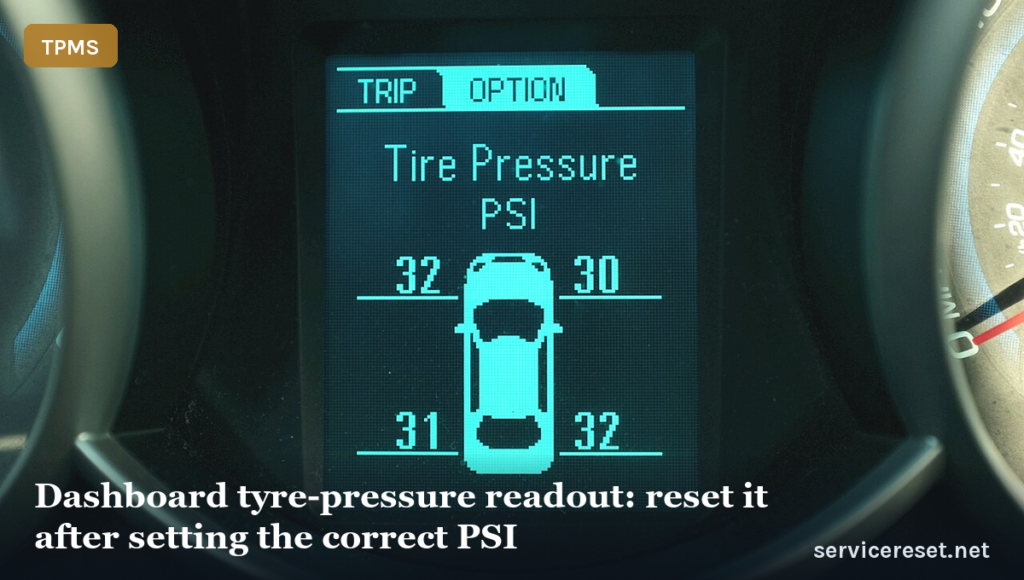
Most T-Cross trims use an indirect monitoring system. Rather than battery-powered sensors inside the wheels, it reads the ABS wheel-speed signals: a tyre losing air shrinks slightly in rolling radius and has to turn a little faster than the others, and the software spots that difference. Because it works from a learned baseline rather than a live pressure figure, it must be told what “correct” is — which is precisely what the store/SET step does. A minority of higher-spec cars may carry direct in-wheel sensors instead; if yours displays an individual pressure per tyre, treat the store step as re-teaching that system its targets.
First, a Few Checks
- Set the pressures with the tyres cold — parked a couple of hours, or driven under a mile or two.
- Use the figures on the driver’s door-pillar label (or inside the fuel flap), matched to your load and wheel size.
- Check the spare if a full-size one is carried, and remember a space-saver runs at a much higher pressure.
- Have the ignition on for the menu steps; the engine doesn’t need to be running.
- Only store once every tyre is right — storing with a soft tyre teaches a bad baseline.
Inflate First
Set all four tyres cold to the door-pillar label figure, then store the reference.
Storing via the Menu
- With pressures set, switch the ignition on.
- Open ‘Car’ / ‘Vehicle’ → ‘Settings’ on the touchscreen.
- Choose ‘Tyres’ → ‘Store tyre pressures’ (SET) and confirm.
Or via the Button
If a physical TPMS button is fitted, set the pressures, ignition on, then hold the button until it confirms.
If the Light Won’t Clear or Won’t Stay Off
- Check every corner with a gauge. The system reacts to one odd tyre, and a corner that looks fine by eye can still be several PSI low.
- Re-store after any change. Topping up, bleeding air, or a seasonal wheel swap all move you off the stored baseline — always run store/SET again afterwards.
- Cold mornings. Pressure drops roughly 1–2 PSI for every 10°C fall, so a light that appears overnight and clears as the tyres warm usually just needs a small top-up.
- A slow puncture. If one tyre keeps dropping days after you store, suspect a leak at a nail, valve or corroded rim rather than the electronics.
- Space-saver or spare fitted. Its different size and pressure can set off the warning until the normal wheel is back on and the system re-stored.
- Store didn’t take. Confirm the final prompt with the ignition on; a half-finished menu step leaves the old baseline in place.
- Persistent flashing. A symbol that flashes then stays solid points to a system fault (or, on sensor-equipped cars, a failed wheel sensor) rather than a low tyre — that needs a diagnostic check.
Once It’s Done
Once you confirm the store, the amber light should go out straight away or within a short drive as the system settles. From then on the T-Cross treats those pressures as its reference and stays quiet unless a tyre drifts meaningfully again. Seeing the light return on the first cold morning after inflating is normal — a quick check and, if needed, a re-store sorts it permanently.
Frequently Asked Questions
How do I reset the tyre pressure light on a VW T-Cross?
Set every tyre to the door-pillar pressure while cold, switch the ignition on, then go to Car/Vehicle → Settings → Tyres → Store tyre pressures and confirm. If your car has a physical TPMS button, set the pressures and hold that button until it acknowledges. The light should clear immediately or within a mile or two.
Do I need a tool or a garage?
No — the T-Cross stores the reference itself.
Why does it trigger in the cold?
Air contracts as temperature falls, so pressures that were correct in a warm garage can read low after a cold night — enough to wake the monitor. This is normal seasonal behaviour, not a fault. Top the tyres up to the label figure while they are cold and store the reference again, and the warning should stay away.
It lit after a wheel swap — is that normal?
Yes. Any time a wheel comes off — a rotation, a puncture repair, or fitting winter tyres — the rolling characteristics change and the stored baseline no longer matches. Set all four to the correct cold pressures and run the store/SET step so the new wheels become the reference.
Will the store step hide a genuinely flat tyre?
It can, which is why you inflate first and only store when every tyre is correct. Storing tells the system the current pressures are normal, so if you store with one tyre low you simply teach it to ignore that tyre. If a tyre keeps losing air after you have set and stored it, look for a puncture rather than resetting again.
The light flashes and then stays on — what does that mean?
A steady amber light generally means low pressure, but a symbol that flashes for a while before going solid usually signals a monitoring-system fault. On indirect cars that can follow certain traction or ABS conditions; on cars with in-wheel sensors it can mean a sensor has failed or lost signal. Do a proper pressure check and re-store first; if it persists, have it read for fault codes.
Stored a fault code? Look it up on autodtcs.com. To clear a service reminder, see our T-Cross service reset.
Independent guide — not affiliated with Volkswagen. Always follow your official service manual and safety precautions. Read our full disclaimer.