These instructions apply to the Mitsubishi L200 Mk3 (K60/K70) 1996-2007.
For other models, please choose your vehicle here.
The third-generation Mitsubishi L200 uses a part-time Easy Select four-wheel-drive system operated by a second lever on the floor — the transfer shift lever — alongside the normal gearstick. It gives you three modes: 2H for everyday driving, 4H for loose or slippery going, and 4L for slow, high-effort work. Knowing when and how to move between them keeps the drivetrain happy and gets you the traction you actually need.
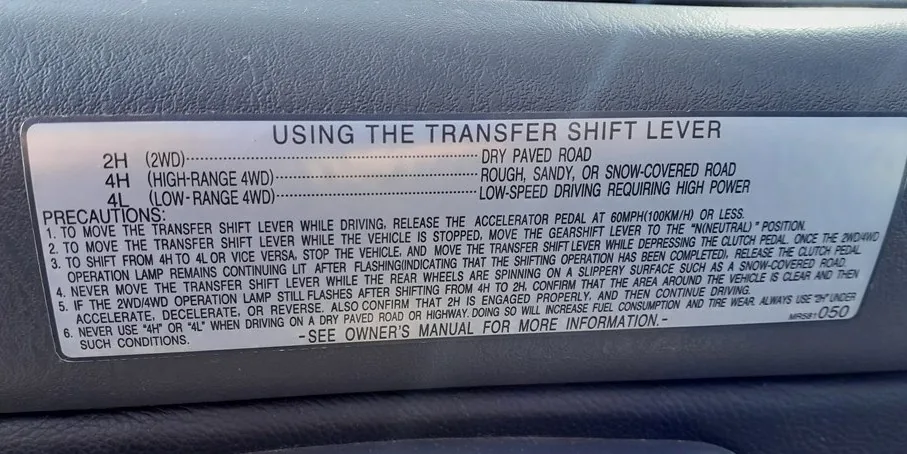
What each mode is for
- 2H (2WD) — dry paved road. Drive in this mode almost all of the time.
- 4H (high-range 4WD) — rough, sandy, or snow-covered roads where you need extra grip at normal speeds.
- 4L (low-range 4WD) — low-speed driving that needs high pulling power, such as steep, deep, or heavily loaded going.
How to move the transfer shift lever
- To change between 2H and 4H while moving, lift off the accelerator and, at 60 mph (100 km/h) or less, move the transfer lever. There is no need to stop or use the clutch for this change.
- If you prefer to change while stopped, put the main gearstick in N (neutral) first, then move the transfer lever.
- To shift between 4H and 4L, bring the vehicle to a complete stop, hold the clutch pedal down, and move the transfer lever to the position you want.
- Watch the 2WD/4WD indicator lamp: it flashes while the change is taking place. Wait until it stops flashing and stays lit — that confirms the shift is complete — then release the clutch.
- Never move the transfer lever while the rear wheels are spinning on a slippery surface such as snow; wait until they have grip.
Good to know
Never use 4H or 4L on a dry paved road or motorway. A part-time system locks the front and rear axles together, so on grippy tarmac it winds up the drivetrain, increases fuel use, and wears the tyres. Always drop back to 2H once you are back on a hard, dry surface.
If the 2WD/4WD lamp keeps flashing after you shift from 4H back to 2H, the front drive has not fully disengaged. With the area around the vehicle clear, gently accelerate, decelerate, or reverse a short distance — that lets the front free-wheeling mechanism release — then confirm 2H is properly engaged before driving on.
Frequently asked questions
Can I shift into four-wheel drive while the L200 is moving?
You can change between 2H and 4H on the move — lift off the accelerator and do it at 60 mph (100 km/h) or below. Changing between 4H and 4L is different: you must stop completely and hold the clutch down.
Why is the 4WD indicator light flashing?
A flashing lamp means the transfer shift is still in progress and the drive has not fully engaged or disengaged yet. Wait for it to become steady; if it still flashes after returning to 2H, drive gently forwards and backwards a little to let the front free-wheeling mechanism release.
Is it bad to leave it in 4H on the road?
Yes. On a dry, grippy surface a part-time system has nowhere to release the difference in wheel speeds, so it strains the drivetrain and wears the tyres. Use 4H and 4L only off dry tarmac, and return to 2H afterwards.
If a warning light appears on the dashboard, you can look up what the specific symbol or fault code means on autodtcs.com.
Independent guide — not affiliated with Mitsubishi. Always follow your official service manual and safety precautions. Read our full disclaimer.