These instructions apply to the Toyota Hilux Mk8 (AN120/AN130) 2016-2024.
For other models, please choose your vehicle here.
The correct cold tyre pressures for the Toyota Hilux depend on your wheel size and how heavily the truck is loaded. The authority for your exact vehicle is the placard in the driver’s door jamb — the figures below match it and the owner’s handbook.
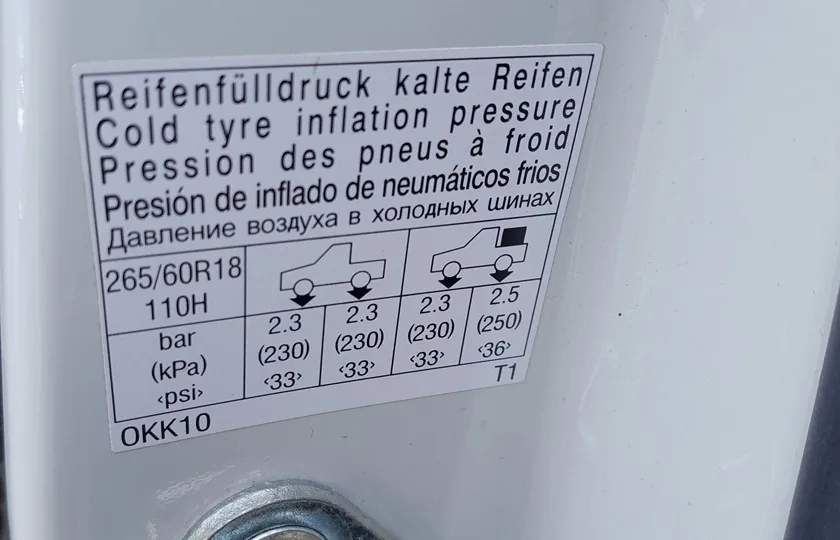
Always check pressures cold (parked 3 hours, or driven less than a mile). It is normal for pressure to read higher when the tyres are warm — never let air out to “correct” a warm reading.
Hilux cold tyre pressures by wheel size
| Tyre size | Front | Rear (normal) | Rear (full load) |
|---|---|---|---|
| 265/60 R18 110H (our truck’s placard) | 2.3 bar / 33 psi | 2.3 bar / 33 psi | 2.5 bar / 36 psi |
| 265/65 R17 112S | 2.3 bar / 33 psi | 2.3 bar / 33 psi | 2.5 bar / 36 psi |
| 225/70 R17C 108/106S | 2.4 bar / 35 psi | 2.4 bar / 35 psi | 3.0 bar / 44 psi |
| 205 R16C 110/108S | 2.7 bar / 39 psi | 2.7 bar / 39 psi | 3.4 bar / 49 psi |
The 18-inch figures above are taken from the door placard on our UK/EU double-cab. Some other-market Hilux on 17/18-inch tyres run a lighter 2.0 bar / 29 psi front and rear when unladen — so always follow the placard on your truck.
Towing and heavy loads
When towing with a hitch, add 0.2 bar (3 psi) to the recommended pressures and keep below 100 km/h (62 mph). For a full bed or a full crew plus luggage, use the “full load” rear figure. The wheel-nut torque is 105 N·m (77 lb·ft) across all wheel sizes.
Does the Hilux have TPMS?
In the UK and Europe the Hilux is type-approved as an N1 light commercial vehicle, which is exempt from the TPMS requirement, so most European trucks do not have a tyre-pressure warning system — you check pressures by hand. Markets that do fit TPMS use a dashboard reset switch: inflate all tyres to the placard values, switch the ignition on and hold the reset switch until the warning light blinks, then let it finish initializing.
If a tyre-pressure or ABS warning appears on a truck fitted with sensors, read the code on autodtcs.com.
Independent guide — not affiliated with Toyota. Always follow your official service manual and safety precautions. Read our full disclaimer.