These instructions apply to the Hyundai Nexo Mk1 (FE) 2018-2023.
For other models, please choose your vehicle here.
Full specifications for the first-generation Hyundai Nexo (FE, 2018–2023), Hyundai’s hydrogen fuel-cell SUV. It carries a 120 kW electric motor fed by a 95 kW fuel-cell stack and three 700-bar hydrogen tanks, with a WLTP range of about 666 km. Figures below are verified against the owner’s manual and Hyundai’s published data.
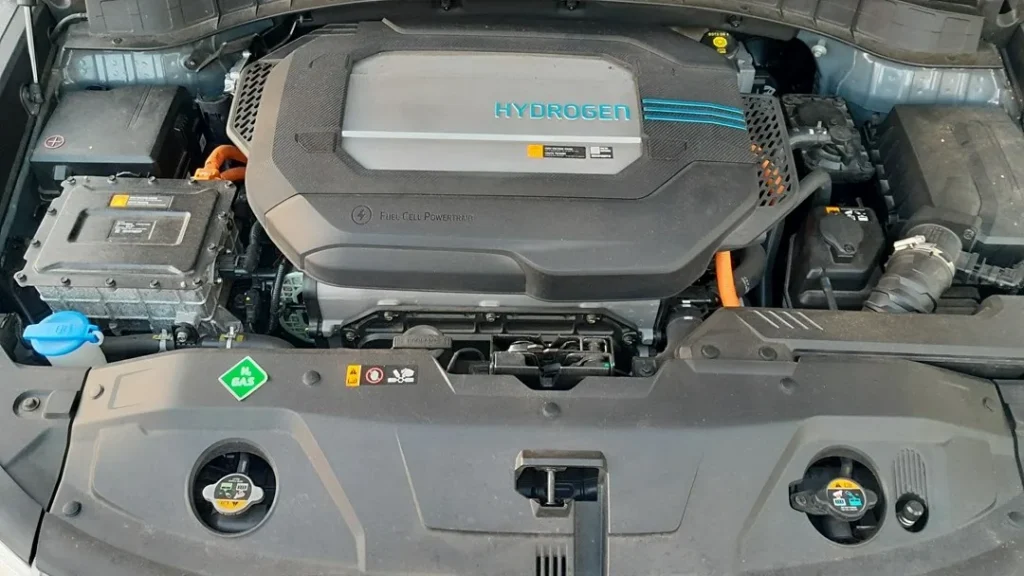
Each column is one specific vehicle — a single engine or motor and, where shown, body style. Dimensions and several weights are specific to that body and drivetrain; other body or powertrain versions differ, so match the column to your own vehicle.
| Fuel Cell 120 kW (163 hp)EU | |
|---|---|
| Length | 4,670 mm |
| Width (excl. mirrors) | 1,860 mm |
| Height | 1,630 mm |
| Wheelbase | 2,790 mm |
| Track (front / rear) | 1,614 / 1,625 (19-inch) mm |
| Fuel Cell 120 kW (163 hp)EU | |
|---|---|
| Kerb weight | 1,814-1,889 (by trim / wheel) kg |
| Gross vehicle weight | 2,340 kg |
| Payload (approx.) | — |
| Max axle load, front | — |
| Max axle load, rear | — |
| Towing (braked trailer) | — |
| Fuel Cell 120 kW (163 hp)EU | |
|---|---|
| Electric motor(s) / layout | Single motor, front axle |
| Electric motor power | 120 kW (163 hp) |
| Electric motor torque | 395 Nm |
| Combined system power | 135 kW (fuel cell + buffer battery) |
| Traction battery (type) | Lithium-ion polymer buffer, 240 V, 40 kW |
| Battery capacity (usable) | 1.56 kWh |
| Heat pump | — |
| Fuel Cell 120 kW (163 hp)EU | |
|---|---|
| Fuel-cell stack type | PEM (proton-exchange membrane) |
| Fuel-cell stack power | 95 kW |
| Hydrogen tanks | 3 |
| Hydrogen capacity | 156 L (total) |
| Usable hydrogen | 6.33 kg |
| Storage pressure | 700 bar (70 MPa) |
| Hydrogen range (WLTP) | About 666 km (414 miles) |
| Hydrogen consumption | 0.95 kg / 100 km (WLTP) |
| Refuelling time | About 5 minutes (full fill) |
| Fuel Cell 120 kW (163 hp)EU | |
|---|---|
| 0–100 km/h (0–60 mph) | 9.2 s (0-100 km/h) |
| Top speed | 179 km/h (111 mph) |
| Drive | Front-wheel drive |
| Transmission | Single-speed reduction gear |
| Fuel Cell 120 kW (163 hp)EU | |
|---|---|
| Front brakes | — |
| Rear brakes | — |
| Tyre sizes | 245/45 R19 98W or 225/60 R17 99H/V |
| Rim sizes | 7.5J x 19 or 7.0J x 17 |
| Tyre pressures, normal (front / rear) | 2.5 bar (250 kPa, 36 psi) front & rear |
| Tyre pressures, laden (front / rear) | 2.5 front / 2.75 rear bar (36 / 40 psi) |
| Wheel-nut torque | 107-127 Nm (11-13 kgf·m) |
| Fuel Cell 120 kW (163 hp)EU | |
|---|---|
| Coolant | Two circuits: fuel-cell (Hyundai FC Stack Coolant) & motor/inverter (pink LLC10) — never mix |
| 12 V battery | Lithium-ion polymer 12 V, ~60 Ah, in the rear/luggage area (12V BATT RESET switch) |
| Air-con refrigerant | R-1234yf, 575 ± 25 g |
Sources: Owner's manual · Workshop data. Where an owner’s manual or homologation figure exists it takes precedence; workshop data fills only what those omit.
How the Nexo’s fuel-cell drivetrain works
The Nexo is a fuel-cell electric vehicle (FCEV), not a plug-in. It stores hydrogen rather than grid electricity, so there is no charging cable and no charge port.
Inside the fuel-cell stack, hydrogen from the tanks reacts with oxygen from the air to make electricity on demand. That electricity drives the 120 kW (163 hp) front motor, and the only tailpipe output is water vapor.
A small 1.56 kWh lithium-ion buffer battery sits between the stack and the motor. It banks energy recovered under braking and adds up to 40 kW of boost, giving a combined system output of about 135 kW.
Range, refueling and running costs
Hyundai quotes a WLTP range of roughly 666 km (about 414 miles) from 6.33 kg of hydrogen, at a consumption of about 0.95 kg per 100 km.
Refueling is quick — a full fill takes about five minutes at a 700-bar station, far closer to a gasoline stop than to charging a battery EV. See our Hyundai Nexo hydrogen refueling guide for the step-by-step.

Tires, pressures and wheels
The Nexo FE runs 245/45 R19 tires on the common Plus Pack, or 225/60 R17 on lower trims. Both sizes use the same cold pressures: 2.5 bar (36 psi) front and rear for normal loads, with the rear raised to 2.75 bar (40 psi) when fully loaded.
Full pressure details, plus how the Nexo’s direct TPMS works, are in the Nexo tire pressures and TPMS guide.
Frequently asked questions
Is the Hyundai Nexo electric or hydrogen?
Both, in a sense. It is an electric vehicle driven by an electric motor, but it makes its own electricity from hydrogen in a fuel cell instead of storing it in a large battery. You refuel it with hydrogen, you do not plug it in.
What is the Hyundai Nexo’s range?
About 666 km on the WLTP cycle. Real-world range depends on weather, speed, and use of heating or air conditioning, much like any other vehicle.
How much hydrogen does the Nexo hold?
6.33 kg of hydrogen, stored at 700 bar across three tanks with a combined volume of 156 liters.
Can the Hyundai Nexo tow?
The Nexo is not homologated for towing in most European markets, so a tow bar is not approved. Always check the data plate and your owner’s manual before fitting any towing equipment.
Does the Nexo have a spare wheel?
No. Like most Nexo FE cars it is supplied with a tire mobility (repair) kit rather than a spare, which is why keeping the correct cold pressures matters.
Independent guide — not affiliated with Hyundai. Always follow your official service manual and safety precautions. Read our full disclaimer.