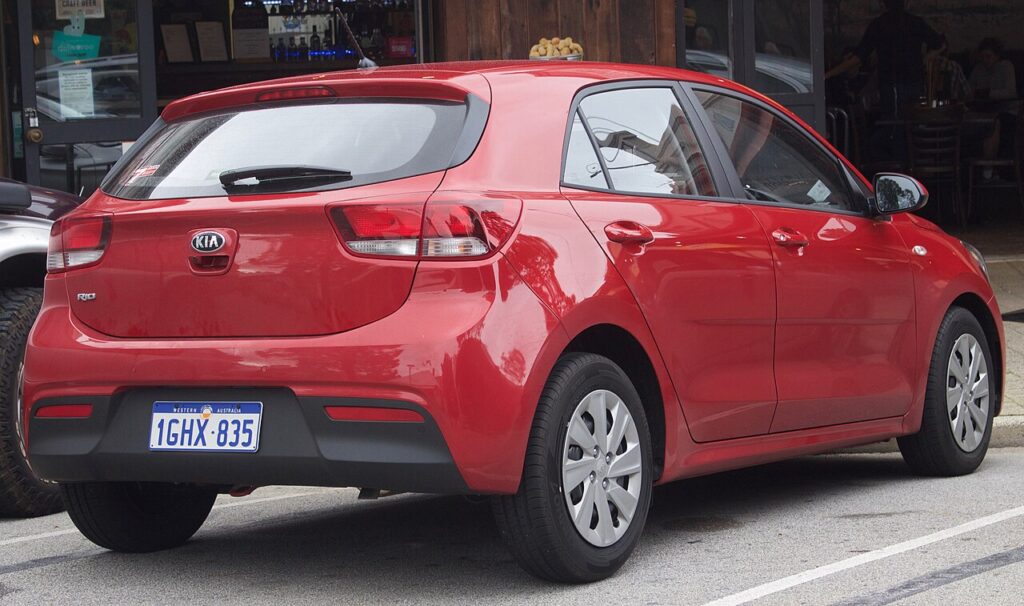
These instructions apply to the Kia Rio Mk4 (YB) 2017-2023.
For other models, please choose your vehicle here.
The fourth-generation Kia Rio (YB chassis, 2017–2023) brought a more sophisticated 12-volt battery management architecture than the older Mk3. The Mk4 fits a battery management system (BMS) sensor on the negative terminal that tracks state of charge, state of health, and discharge profile. Disconnecting the battery clears not only the usual volatile state (clock, radio presets, idle adaptation, window calibration) but also the BMS’s running estimate of battery condition — which means the Stop & Start system (on equipped trims) won’t arm until the BMS has re-sampled. This guide covers the safe disconnect/reconnect sequence and the post-reconnection re-learns specific to the Mk4.
Before you start
The Mk4’s battery sits in the engine bay’s front-right corner (right-hand-drive UK/IRL spec) or front-left (left-hand-drive EU). The negative terminal carries the BMS sensor — a small black box clamped between the cable and the post. Don’t lose or disturb this sensor; replacing it requires Kia’s GDS diagnostic tool to register the new sensor ID. Battery type is conventional flooded on ‘1’ and ‘2’ trims, EFB on ‘3’ and GT-Line S which have the ISG (Idle Stop & Go) system.
- Pyrotechnic safety wait — 3 minutes. Kia’s airbag control unit on the Mk4 holds capacitor charge for 3 minutes after the negative terminal lifts. Don’t touch airbags, pretensioners, or the steering column for the full 3 minutes.
- Open a front window before disconnecting. If the central locking misbehaves after reconnection (rare but possible with the smart-key system), you’ll have a way back in.
- Have the smart key in the cabin during reconnection. The Mk4’s immobiliser cross-checks the smart key for several procedures, especially after a power interruption.
- Don’t disturb the BMS sensor. If you remove the negative cable, lift it cleanly from the BMS sensor’s terminal clamp — don’t pry the sensor off the cable. A misaligned sensor reads incorrectly and the BMS algorithm won’t trust it.
Tools required
- 10 mm spanner or socket (terminal nuts)
- 12 mm socket (battery hold-down bolt at the base)
- Optional: memory saver lead with 9 V supply, terminal brush, terminal grease
Disconnect procedure
- Switch off the ignition and remove the smart key from the cabin (or place it well away from the car — at least 5 metres). The Mk4’s BCM only enters proper sleep state when no key is detected.
- Wait one full minute for control modules to enter sleep state and bus communication to settle.
- Open a front window.
- Loosen the negative (−) terminal nut with the 10 mm spanner. The terminal clamp connects to the BMS sensor; lift the assembly clear of the post but keep the sensor attached to the cable. Tuck it to one side away from the post.
- Loosen the positive (+) terminal nut. Lift the clamp off and cover the bare post with a clean rag.
- If removing the battery: undo the 12 mm hold-down bolt at the front of the battery base. The clamp lifts forward; the battery (around 11 kg on ‘1’, 13 kg EFB on ‘3’/GT-Line S) lifts straight out.
Reconnect procedure
- Clean both posts and clamps with a wire brush until they show bright fresh lead.
- Fit the battery and secure the hold-down clamp before any cable work. Tighten the 12 mm bolt to 5 Nm.
- Connect the positive (+) terminal first. Tighten the 10 mm nut to 5 Nm.
- Connect the negative (−) terminal second, with the BMS sensor properly oriented (the sensor’s body should be against the cable, not against the post). Tighten to 5 Nm.
- Apply terminal grease to the outside of both joints.
- Bring the smart key back into the cabin and press START with the brake pedal pressed. The engine should crank and fire normally.
Post-reconnection tasks
- Set the clock and date via the cluster menu (most Mk4 trims auto-sync via GPS if the head unit has navigation; ‘1’ and ‘2’ trims need manual setting).
- Re-pair the head unit Bluetooth on phones that were previously paired. The radio presets typically survive a disconnect on the Mk4 because the head unit has its own backup capacitor — but Bluetooth pairings can be lost.
- Re-initialize the electric windows — see Kia Rio Mk4 power windows initialize.
- For ISG-equipped cars (3 and GT-Line S trims): Stop & Start will be disabled until the BMS has re-sampled state of charge. This requires approximately 20–30 minutes of mixed driving (not just motorway, not just stop-go) plus one overnight rest period before the system fully re-arms.
- Drive straight at 30 km/h or above for at least 1 minute to allow the steering angle sensor to re-zero. Then slowly turn full lock to the left, return to centre, then full lock to the right. This combination clears any ABS/ESC lamps that activated after the disconnect.
- If the car has direct TPMS (3 and GT-Line S trims), check tyre pressures cold and drive normally for 15 minutes — see Kia Rio Mk4 TPMS reset.
When It Won’t Cooperate
Warning lights stuck on after reconnection. Most common: ABS and ESC together, from the steering angle sensor needing a re-zero. Drive in a straight line for a minute, then full-lock both ways. The airbag lamp may stay on briefly from a momentary terminal short during work — clears with one normal drive cycle.
Stop & Start refuses to arm even after 30 minutes of driving. The BMS hasn’t yet decided the battery is healthy enough. Two likely causes: (a) battery state of charge is still below the threshold — leave it overnight after a charge cycle and try the next day; (b) the BMS sensor on the negative terminal is misaligned or disturbed — re-tighten the negative terminal making sure the sensor body is straight along the cable.
Engine cranks but won’t start. The smart-key immobiliser has lost sync. Touch the smart key directly to the START button (the Mk4 has a backup inductive antenna in the button) and press with the brake pedal pressed. This forces a direct authentication.
Idle hunts for the first 5–10 minutes. Normal — the ECU is re-learning idle-air adaptation. Let it idle for 3 minutes from cold without accessories, then drive normally.
The radio shows “ENTER CODE”. Only on ‘1’ trim with the basic head unit — ‘2’ and higher have the no-code Kia head unit. The code is on a card in the owner’s manual pouch, or Kia dealers can retrieve it from the head-unit serial number and the VIN.
Frequently asked questions
Does the Kia Rio Mk4 need battery registration after replacement?
For ISG-equipped trims (‘3’ and GT-Line S), yes — the BMS needs to know that a fresh battery has been fitted so it can baseline the state-of-charge algorithm. This is done with Kia’s GDS scan tool (dealer) or compatible aftermarket tools (Carista with the Kia subscription supports it). Without registration, ISG will work eventually but the BMS will report inaccurate state-of-health values. For non-ISG trims (‘1’ and ‘2’), no registration is required.
What’s the OEM battery spec for the Mk4?
‘1’ and ‘2’ trims (1.0 T-GDI, 1.25 MPI, 1.4 MPI): 50–55 Ah, 480 A CCA, conventional flooded EN50/55. ‘3’ and GT-Line S with ISG: 60 Ah EFB, 540 A CCA. Always check the label on the original battery for the exact spec when ordering a replacement.
Can I fit an AGM battery to a non-ISG Mk4?
The charging system isn’t optimised for AGM — voltage tops out around 14.4 V which is on the low end for AGM. AGM will work but won’t last as long as in a properly AGM-coded car. Stick with conventional flooded unless you have a specific reason.
How long can the Mk4 sit without a battery?
Indefinitely — nothing is damaged by long disconnection. Smart-key codes, ECU adaptation parameters, ABS calibration — all survive. What’s lost: clock, Bluetooth pairings, idle adaptation, window calibration, and the BMS state-of-charge estimate.
Should I use a smart charger to charge the battery in-car?
Yes — modern smart chargers (CTEK, NOCO) are safe on Mk4 electronics. Use the dedicated positive jump-start post under the bonnet and a chassis earth point rather than reaching down to the BMS sensor at the negative terminal.
For diagnostic trouble codes that surface after the battery work and don’t clear with a normal drive cycle, see autodtcs.com.
Registering or Coding the New Battery
Depends on the model. Cars with a battery sensor (IBS) need the battery data reset so charging is managed for a new battery — usually with a diagnostic tool (dealer or a capable scanner). Simpler models with no sensor need nothing beyond a short relearn drive.
Independent guide — not affiliated with Kia. Always follow your official service manual and safety precautions. Read our full disclaimer.