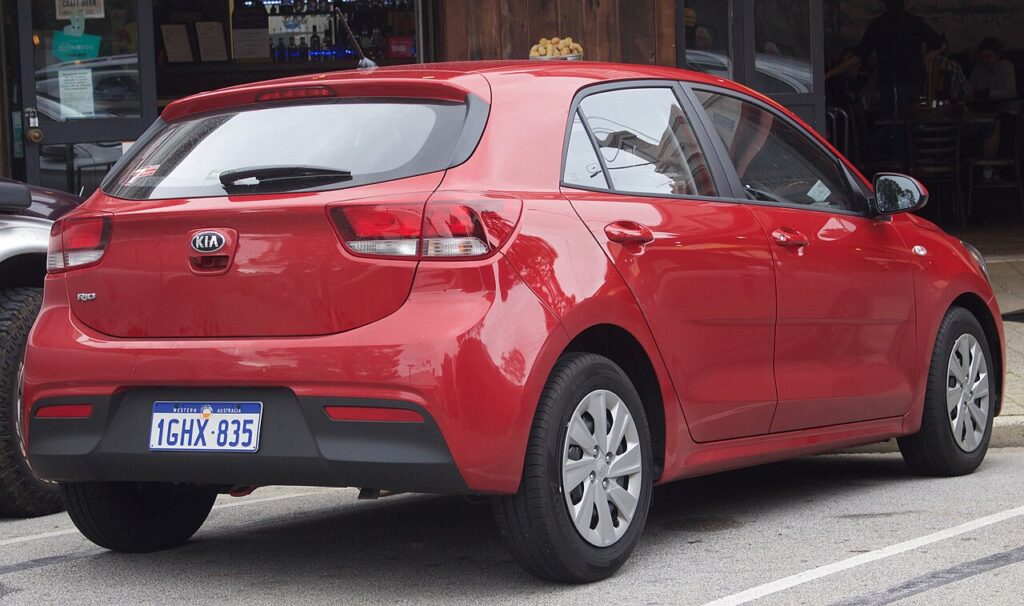
These instructions apply to the Kia Rio Mk4 (YB) 2017-2023.
For other models, please choose your vehicle here.
Kia’s Idle Stop & Go (ISG) system is standard on the ‘3’ and GT-Line S trims of the fourth-generation Rio (YB chassis, 2017–2023). It shuts the engine when the car comes to a stop with the brake held and restarts it when you lift off — saving an average 3–5% fuel in urban use. The system defaults to ON every time you start the car (regulatory requirement in the EU), but it can be disabled for the current drive cycle via a dashboard button. This guide covers the manual override, the conditions that auto-disable the system, and the situations where you’d want to turn it off.
Before you start
The Mk4’s ISG button is on the centre console next to the climate-control panel — a button marked with the ISG icon (an “A” inside a circular arrow). A green light on the cluster confirms ISG is armed; the same icon in amber with “OFF” confirms it’s disabled. ISG only works when a set of operating conditions is satisfied:
- Battery state of charge ≥ 75%. The BMS sensor on the negative terminal tracks this continuously. A new or just-replaced battery may take 20–30 minutes of driving before the BMS classifies it as ready.
- Engine coolant warmed to ~50 °C or above. The system won’t arm with a cold engine.
- Outside temperature above approximately 3 °C and below 35 °C. Extreme heat or cold suppresses ISG to avoid overstressing the starter or the battery.
- No active diagnostic faults. A warning lamp on the dashboard — ABS, ESC, airbag, EPS — suppresses ISG until cleared.
- Climate-control demand low. If the AC compressor is running at full duty, ISG suppresses auto-stop because the engine needs to run to maintain cabin cooling.
Tools required
None.
Disable ISG for the current drive — Method 1 (button)
- Press the ISG-OFF button on the centre console.
- The amber “ISG OFF” warning lamp illuminates on the cluster to confirm the system is deactivated for the current ignition cycle.
- The engine continues to run at idle when stationary — it will not auto-stop.
- To re-enable ISG for the current drive: press the button again. The amber lamp extinguishes; the system re-arms within a few seconds, contingent on the operating-condition gates.
Disable ISG for the current drive — Method 2 (driver seat belt)
ISG includes a safety override that disables auto-stop whenever the driver is about to exit the cabin:
- Unbuckle the driver’s seat belt while stationary: ISG immediately disables for the rest of the drive.
- If the engine has already auto-stopped, the seat belt unbuckle restarts the engine within about 0.5 seconds.
- Re-buckling does not automatically re-arm ISG — you must press the ISG-OFF button to bring it back, or end the drive and start fresh.
Disable ISG for the current drive — Method 3 (open the bonnet)
Lifting the bonnet triggers the bonnet-ajar microswitch, which the ISG system reads as a “do not auto-stop” condition. This is a safety feature to prevent the engine restarting while you have your hands in the engine bay. If you need to work under the bonnet with the engine running, open the bonnet fully — ISG will not trigger.
How to verify the disable has worked
- The amber “ISG OFF” warning lamp is illuminated on the cluster.
- Coming to a stop at a red light or junction does not cause the engine to cut.
- The cluster’s instantaneous fuel-economy reading shows the engine running at idle (≈0.5 L/h) rather than zero.
When to disable ISG
- Heavy stop-go traffic where the system would cycle several times per minute — the starter and AC compressor benefit from fewer cycles, even though they’re rated for hundreds of thousands of stops.
- Towing a trailer — the Rio Mk4 is rated for light towing only; the extra mass means each restart pulls more torque from the starter.
- Aggressive driving where the engine is at temperature but the battery hasn’t been topped up by a long enough drive.
- Cold mornings below about 0 °C — though the system usually self-disables in extreme cold, manual override is more reliable.
- Under-bonnet work with the engine running.
Troubleshooting
“ISG OFF” is permanently illuminated even after pressing the button. The system has self-disabled due to one of the gate conditions. Most common cause on a Mk4 over 4 years old: weak battery — the BMS algorithm has decided the battery can’t sustain a restart. Have the battery load-tested, or fit a smart charger overnight and try the next morning. Second most common: a stored fault code in another module (e.g., a steering angle sensor needing a re-zero after suspension work). Read with a Kia-aware scan tool.
Engine auto-stops but won’t restart automatically. Two common causes. (a) Battery state of charge dropped below the algorithm’s threshold mid-stop (typically because radio/AC were drawing while parked). The starter cranks normally but the system aborts further auto-stops for the rest of the drive. (b) On manual cars, the clutch pedal switch is faulty — the engine won’t restart on clutch press because the ECU doesn’t see the signal. Replacement is straightforward (≈£25 part, 15 minutes).
ISG works yesterday but not today. Temperature effect: cold mornings tighten the operating-condition gates. Drive for 10 minutes to warm up before expecting ISG to arm.
ISG keeps disabling itself after only one auto-stop. Indicates marginal battery health — the algorithm classified the recovery from the first restart as borderline and suppressed further attempts. Load-test the battery or replace if 4+ years old.
I want ISG to be the default-OFF — is there a software setting?
Not factory-officially. Some aftermarket modules (“ISG memory” or “Stop-Start Disable”) plug between the ISG-OFF button and the ECU and “press” the button automatically at every start. These cost around £30–50 and install in 10 minutes. They’re road-legal because they don’t modify the ECU software.
Frequently asked questions
Why doesn’t my ‘1’ or ‘2’ trim Rio Mk4 have ISG?
ISG was a top-spec feature on the Mk4 — only ‘3’ and GT-Line S got it as standard. ‘1’ and ‘2’ trims don’t have the BMS sensor, EFB battery, or upgraded starter required for the system. Retrofitting ISG to a lower-trim Mk4 is technically possible but cost-prohibitive (around £700 in parts).
Will disabling ISG hurt fuel economy?
By about 2–4% in urban driving. In free-flowing or motorway use the difference is negligible because the engine rarely auto-stops at speed anyway. Most Mk4 owners who disable ISG do so for comfort rather than fuel.
Does the Mk4 ISG use a special starter motor?
Yes. The Mk4’s ISG starter has a reinforced solenoid and uprated brushes rated for 300,000+ starts versus the conventional starter’s typical 30,000–50,000. Replacing an ISG starter with a non-ISG part means the system needs to be permanently disabled to avoid premature failure of the substitute starter.
Will the AC keep working when ISG auto-stops the engine?
Briefly — the cabin stays cool for about 30 seconds from residual cold in the evaporator. After that, the AC pauses (the compressor needs the engine running). If you turn the AC to “MAX” or set climate to its strongest setting, the system suppresses ISG entirely until the demand drops.
My ISG worked in summer but never in winter — is something wrong?
Probably not. The gate temperature thresholds tighten in cold weather, especially with the heater running. If your dashboard shows “Battery condition does not allow ISG” or a similar message, the BMS algorithm has decided the battery couldn’t sustain a cold-start restart — usually this clears as the engine warms.
Related: Kia Rio Mk4 battery disconnect and reconnect. For DTCs related to ISG or the battery management sensor, see autodtcs.com.
Independent guide — not affiliated with Kia. Always follow your official service manual and safety precautions. Read our full disclaimer.