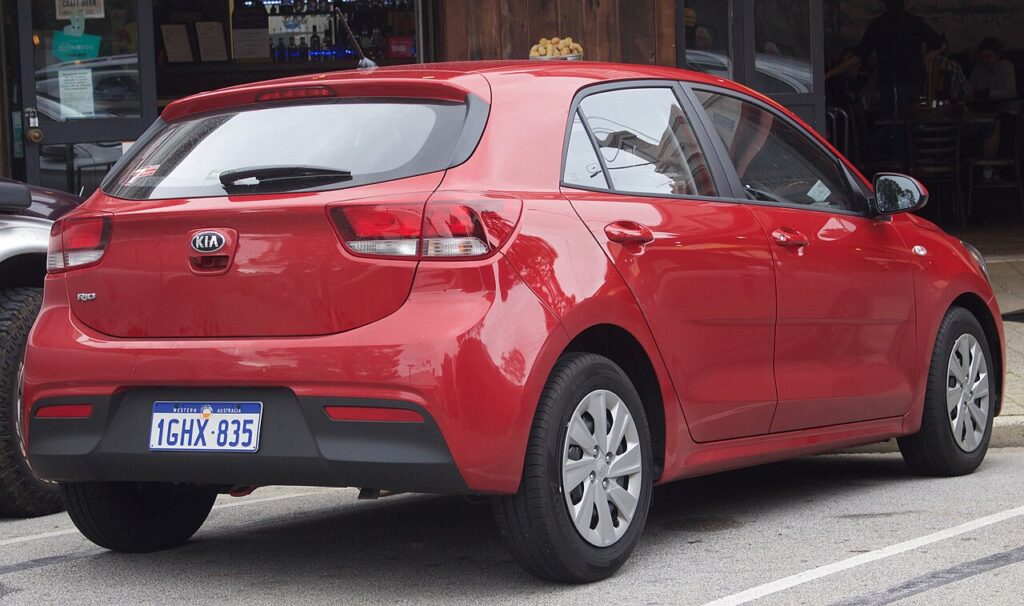
These instructions apply to the Kia Rio Mk4 (YB) 2017-2023.
For other models, please choose your vehicle here.
The fourth-generation Kia Rio (YB chassis, 2017–2023) is fitted with a Tyre Pressure Monitoring System on every trim sold in the EU, UK, and most international markets — a legal requirement on cars first registered after November 2014. The Mk4 typically uses an indirect TPMS (pressure inferred from ABS wheel-speed asymmetry) on lower trims and a direct TPMS (valve-stem sensors with their own batteries) on ‘3’ and GT-Line S trims. Both systems need a manual reset after re-inflating tyres, changing wheels, or after a battery disconnection.
Before you start
Identifying which TPMS variant your car has is the first step:
- Indirect TPMS: the cluster shows only a single warning lamp (exclamation mark inside a horseshoe). No per-wheel pressure values are displayed.
- Direct TPMS: the cluster’s information display can show pressure values for each wheel, usually accessed via the steering-wheel buttons under a “Tyre pressure” menu item.
The reset procedure differs slightly between the two — both are covered below.
- Check pressures cold. The car must have been stationary at least 3 hours, or driven less than 1 km. Warm tyres read higher than their true cold value, and a baseline taken on warm tyres will trigger the warning again once the car cools overnight.
- Driver’s door jamb placard. The OEM cold pressures are on a sticker in the driver’s door pillar — typically 2.2 bar / 32 psi all round on standard 14″ or 15″ tyres, with slightly higher rear pressures listed for full-load operation.
- Accurate gauge required. Forecourt gauges are often miscalibrated by ±0.2 bar. A £15 dial or digital gauge is more reliable.
- Don’t reset before re-inflating. Resetting first would baseline the system on the under-inflated state.
Tools required
- Accurate tyre pressure gauge
- Compressor or foot pump (a properly-calibrated forecourt machine is acceptable)
Reset procedure — indirect TPMS
- Inflate all four tyres cold to the placard pressures, verified with your own gauge.
- Switch the ignition ON and navigate the cluster menu using the trip stalk or steering-wheel arrow buttons until “TPMS Reset” or “Tyre Pressure Reset” appears (in the User Settings sub-menu on most Mk4 trims).
- Press and hold the OK / SET button for 3 seconds until the cluster confirms “Reset complete” or “Reset OK”.
- Start the engine and drive normally for at least 10 minutes at 25 km/h or above.
- The TPMS warning light extinguishes automatically once the system has sampled enough wheel-speed data to recognise the new baseline as correct.
Reset procedure — direct TPMS
Direct TPMS systems on the Mk4 self-learn during normal driving once the pressures are correct. There is no menu-driven reset, but you can verify the system has accepted the new pressures by checking the per-wheel display.
- Inflate all four tyres cold to the placard pressures.
- Start the engine and drive for 10–15 minutes at 25 km/h or above on a mix of straight roads and gentle curves.
- Navigate the cluster’s TPMS menu via the steering-wheel buttons to see the per-wheel readings update.
- The warning light extinguishes once each sensor has reported a pressure within the acceptable range for at least 5 minutes of continuous driving.
How to verify it has worked
- The TPMS warning light is no longer illuminated.
- The cluster shows “Tyre pressures normal” or no message at all when scrolled to the TPMS menu.
- On direct TPMS cars, the per-wheel readings match what you set (within ±0.1 bar tolerance).
- A 24-hour test: leave the car overnight, drive the next morning. If the light returns, one of the tyres has a slow puncture.
Common Snags
Indirect TPMS: light stays on after 10 minutes of driving above 25 km/h. Most common cause: one tyre is still under-inflated. Re-check all four cold; even a small (3–5 psi) deviation can keep the warning active. Second most common: the reset menu was navigated to but the OK/SET button wasn’t held long enough (3 seconds required, some Mk4 firmware needs 5).
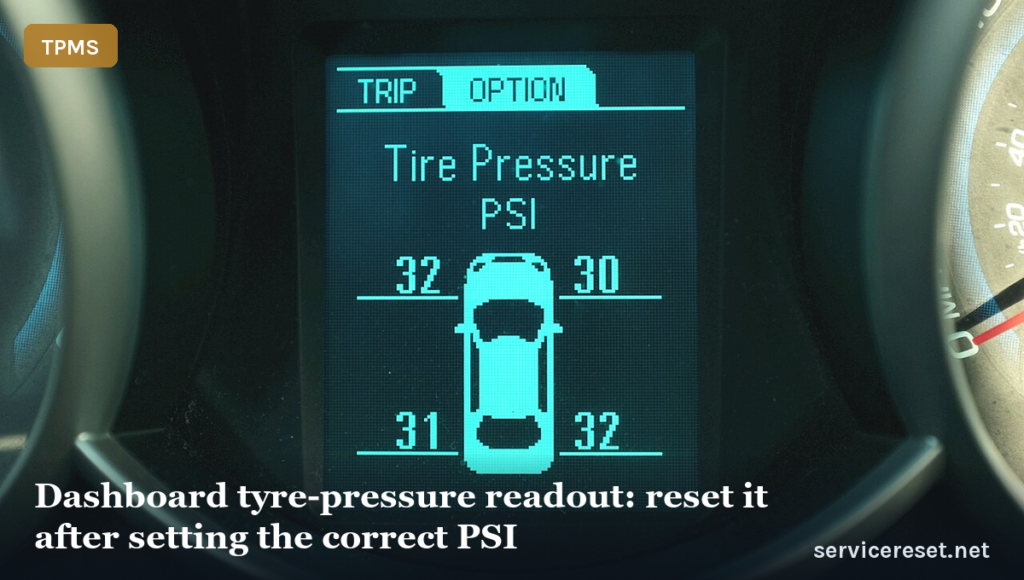
Direct TPMS: one specific wheel shows “—” instead of a pressure value. The valve-stem sensor on that wheel has failed (typically the internal battery — sensors are rated for 7–10 years on this generation). Replacement requires a tyre dismount and rebalance; cost is around £40–60 per sensor at most independent tyre shops.
“Check TPMS System” text message persists. The TPMS module has logged a stored fault rather than a low-pressure reading. Read the module with a Kia-aware scan tool (Carista, OBDeleven, or a generic OBD-II tool with Kia code support).
Light returned 24 hours after the reset. Slow puncture on one tyre. Re-check pressures cold and look for the offending tyre. Common locations: a nail in the tread, a slow leak at the valve core, or a tiny bead leak (a film of soapy water around the bead will bubble at the leak point).
I changed to winter wheels with different tyre size. Now TPMS won’t reset. Indirect TPMS bases its baseline on rolling circumference. A different tyre size invalidates the calibration. Re-run the reset procedure cold; some Mk4 firmware also requires entering the new tyre size in the User Settings menu.
Frequently asked questions
How do I tell if my Mk4 has direct or indirect TPMS without the manual?
Switch the ignition on and navigate the cluster’s “Vehicle Information” or “TPMS” menu. If you can see per-wheel pressure values (typically 4 numbers like “FL 2.3 / FR 2.2 / RL 2.2 / RR 2.3”), you have direct. If you see only a single warning state with no per-wheel data, you have indirect.
How long do direct TPMS sensors last?
The internal battery in each sensor is rated for 7–10 years on the Mk4. On the indirect system there are no batteries to fail — it uses the ABS sensors that are already in the car.
Does cold weather cause false TPMS warnings?
Yes. Tyre pressure drops about 0.1 bar per 10 °C cool-down. The first cold morning of autumn often triggers the warning on cars set to summer placard pressures. Top up to placard cold and run the reset (indirect) or just drive (direct).
Should I reset after rotating tyres front-to-back?
Indirect TPMS: yes, because the baseline is based on relative rotational speed. Direct TPMS: no, because the sensors continue to report their wheel’s actual pressure regardless of position. Some direct-TPMS Mk4 cars do have a “wheel position relearn” function that maps sensor IDs to physical positions — that’s an optional refinement, not required.
Will the system warn me about a fully flat tyre, or only gradual deflation?
Both — a sudden complete deflation (puncture) shows up as a large asymmetry within seconds and triggers the warning immediately. Gradual deflation takes longer to register but is also caught.
For TPMS-related diagnostic trouble codes that won’t clear with a drive cycle, see autodtcs.com.
Independent guide — not affiliated with Kia. Always follow your official service manual and safety precautions. Read our full disclaimer.