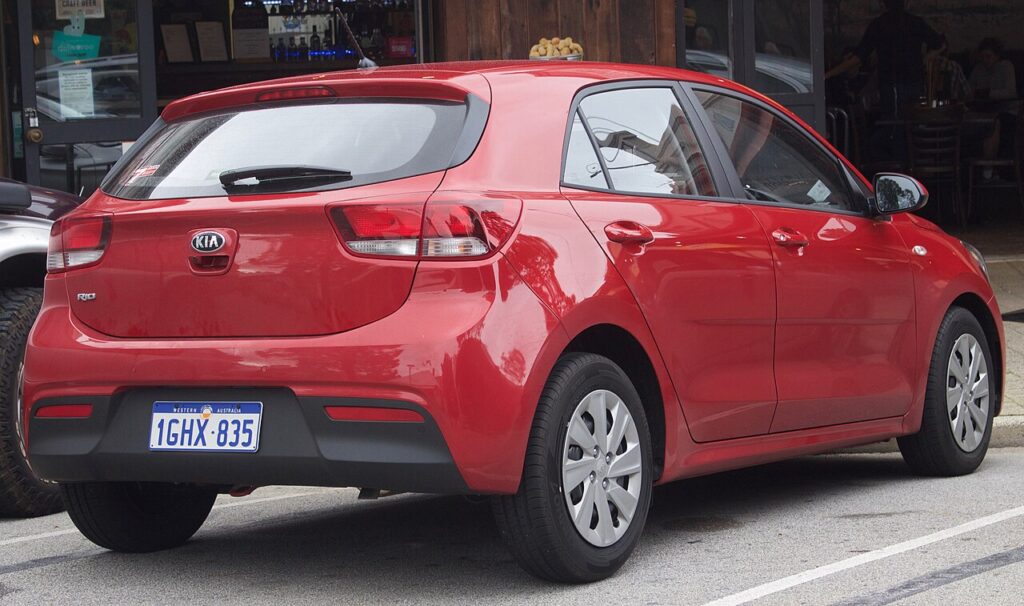
These instructions apply to the Kia Rio Mk4 (YB) 2017-2023.
For other models, please choose your vehicle here.
The fourth-generation Kia Rio (YB chassis, 2017–2023) offered an electric tilt-and-slide sunroof as an option on the GT-Line and GT-Line S trims. After a battery disconnection — for replacement, jump-starting, or other electrical work — the sunroof controller loses its memory of the fully-open, fully-closed, and tilt end-positions. One-touch operation stops, anti-pinch reverse mis-triggers, and the remote-key auto-close (where equipped) stops working until you re-initialize. The procedure is owner-method and takes about a minute with no tools.
Before you start
The Mk4’s sunroof switch sits in the headliner above the rear-view mirror. The controller is integrated into the motor assembly above the rear-seat headliner. The system supports tilt-up (rear edge raised), slide-open (rearward), and a small soft-close ramp into the seal. The Mk4 uses a different sunroof unit supplier from the Mk3, so the initialization sequence differs slightly.
- Battery voltage matters. Sunroof initialization is the most voltage-sensitive of the standard Mk4 owner procedures — the motor needs to run at consistent speed throughout. Make sure the battery is healthy (12.4 V or higher at rest) or run the engine during the procedure for stable voltage.
- Clean the sunroof rails. Grit and dry seal lubricant at the front corners cause the motor to bind during calibration. A wet-cloth wipe in the rails and a light spray of silicone on the seal prevents this.
- Park out of direct sun. Hot seals expand and add motor load; cool conditions give cleaner calibration.
- Sit inside the car with all doors closed. Door-ajar inputs interrupt the calibration timer mid-procedure.
- Make sure the smart key is in the cabin if your car has push-button start, so the ignition stays in the ON state cleanly.
Tools required
None.
Initialization procedure
- Switch ignition ON (press the START button once without the brake pedal pressed, or turn the key to position II on basic ‘1’-style trim if equipped).
- Verify the sunroof is fully closed in its normal park position. If it isn’t, briefly press the switch in the close direction to bring it to the seal, then release.
- Press and hold the sunroof switch in the tilt-up direction (the position you would normally use to pop the rear of the glass up for ventilation).
- Hold the switch for approximately 5 seconds. After 2–3 seconds the roof reaches its tilt limit and stops moving; keep holding. The controller enters calibration mode at the 5-second mark.
- Release the switch briefly. The roof stays in the tilted position.
- Press and hold the switch in the tilt-up direction again. The roof will now run through an automatic self-test sequence: tilt down → slide open → slide closed → tilt up → tilt down. The whole sequence takes about 30 seconds.
- Do not release the switch during the self-test sequence. Releasing aborts and leaves the system uncalibrated.
- Once the roof has completed the cycle and stopped moving, release the switch. The initialization is complete.
- Test normal operation: a brief press in tilt direction should pop the rear up to maximum tilt and stop. A brief press in slide direction should slide the roof fully open. Another brief press should slide it fully closed.
How to verify it has worked
- One-touch tilt and one-touch slide both work from brief switch presses.
- The roof reverses by approximately 10 cm if you obstruct it during a close (test gently with a soft cloth — never your hand).
- Holding the remote-key lock button for 3 seconds (on GT-Line S which has the global-close feature) closes the sunroof automatically along with the windows.
- The closed position aligns flush with the rear edge of the roof opening — no overshoot (audible thunk) and no undershoot (visible gap).
If Something Goes Wrong
The calibration cycle starts but stops half-way through the self-test. The motor has detected resistance above its protection threshold. Most common cause: stiff seal rubber that’s gripping the glass. Spray silicone lubricant on the seal surface, work the roof through one full open-close cycle manually (the manual override is a small hex-key port in the headliner near the dome light), then re-run the procedure.
Switch press doesn’t initiate the calibration cycle (no movement at the 5-second mark). The controller hasn’t recognised the entry sequence. Two possibilities: (a) you didn’t reach the full tilt position first — make sure step 3 ends with the roof at maximum tilt, not somewhere in the middle; (b) the switch itself is failing — common on Mk4 cars 5+ years old; replace the headliner switch unit (≈£30 part, 30 minutes to fit).
Water drips at the front corners after the procedure. Not an initialization issue — the four drain tubes in the front corners of the sunroof frame are blocked. Push a thin cable tie (or compressed air at low pressure) down each drain from the corner of the aperture; water should exit under the front wheel arches.
One-touch returns but anti-pinch doesn’t trigger on obstruction. Run the procedure twice in succession. The first pass establishes the end-stops; the second pass establishes the anti-pinch torque reference. This is a Mk4-specific quirk — the Mk3 captured both in a single pass.
The roof closes too far and squeaks against the seal. The closed end-stop was captured slightly past the optimal position. Re-run the procedure — the controller re-samples each time.
“AUTO” function fails — sunroof goes only while you hold the switch. The calibration didn’t take. Most common cause: weak battery causing motor speed to vary mid-sequence. Charge the battery overnight on a smart charger and re-run the procedure.
Frequently asked questions
Which Mk4 Rio trims have the sunroof option?
GT-Line and GT-Line S in the UK and most EU markets. In some markets a sunroof was also available as a dealer-fit option on the ‘3’ trim. Lower trims (‘1’ and ‘2’) don’t have the headliner cut-out or the wiring to support a retrofit.
How is this different from the Mk3 Rio sunroof procedure?
The Mk3 used a 10-second held tilt-up to enter calibration mode in a single pass. The Mk4 splits the procedure: a 5-second hold to enter the mode (step 4), a brief release (step 5), then a second hold to trigger the self-test cycle (step 6). The motor sequence is also different — the Mk4 runs through tilt-down → slide-open → slide-closed → tilt-up → tilt-down rather than the Mk3’s tilt-slide-tilt sequence.
Will the sunroof still work without initialization?
Yes — it tilts and slides while you hold the switch in either direction. You lose: one-touch in both directions, anti-pinch reverse, and the remote-key global-close (GT-Line S). The car is safe to drive indefinitely with the calibration absent.
Does the procedure clear sunroof-related fault codes?
No. The procedure only recalibrates positional memory. If the sunroof has logged a fault code (typically B-prefix in the body computer), that needs a scan tool to clear. The fault code is independent of the calibration.
How often will I need to do this?
Only after a power interruption to the sunroof controller. A normal Mk4 in normal use will hold its calibration for the life of the car.
Related: Kia Rio Mk4 battery disconnect and reconnect. For sunroof-related fault codes that won’t clear after the procedure, see autodtcs.com.
Independent guide — not affiliated with Kia. Always follow your official service manual and safety precautions. Read our full disclaimer.