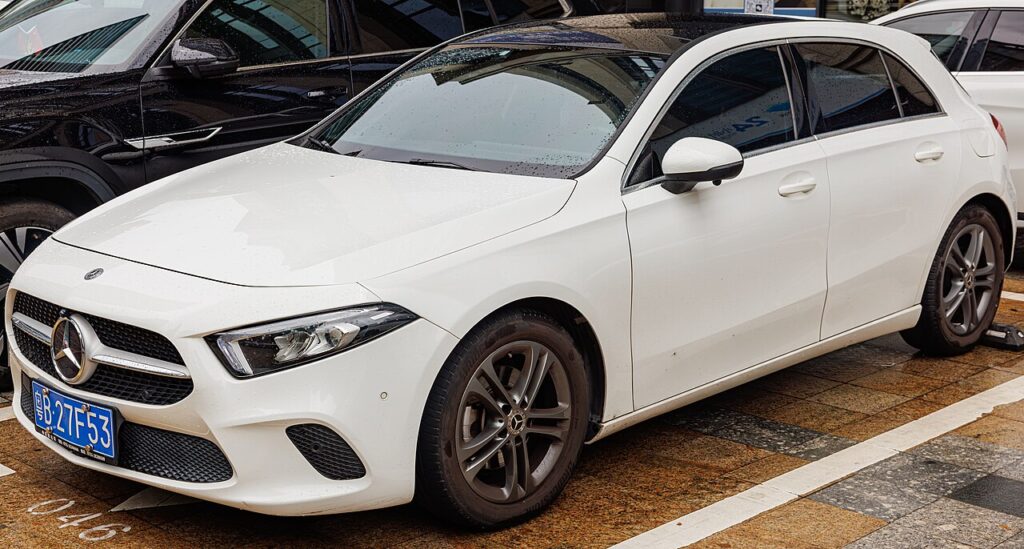
These instructions apply to the Mercedes A-Class Mk4 (W177) 2018-Present.
For other models, please choose your vehicle here.
If the SmartKey on your Mercedes A-Class Mk4 (W177, 2018–present) is getting weak — you have to stand right by the car to lock it, the buttons only respond on the second or third press, KEYLESS-GO is fussy, or a “key battery” message shows in the cluster — the coin cell inside the key has simply worn out. It is not a fault with the immobiliser, the doors or the car’s electronics: it is the small 3 V battery that powers the remote. The A-Class SmartKey takes a CR2032 and opens with its slide-out emergency key blade, and because the key only carries its coding rather than storing it, swapping the cell needs no programming at all. It is a two-minute job at the kitchen table.
How to Tell the Fob Battery Is Dying
The cell fades gradually, so the signs build up over a few weeks rather than appearing overnight:
- Shrinking range. You once locked the A-Class from across the car park; now it only answers within a metre or two.
- A “key battery” message in the instrument cluster — the car monitors the SmartKey and flags a low cell in good time.
- KEYLESS-GO only works up close. A proximity key transmits constantly to answer the door handle and start button, so it drains faster than a button-only remote and is the first function to weaken.
- Second or third press needed to lock or unlock, or the key working only intermittently.
- Worse in cold weather — a marginal coin cell struggles on frosty mornings and seems to recover once it warms up.
As a rough guide a button-only remote runs two to four years on one cell, while a KEYLESS-GO key that is always awake is often nearer a year. Leaving the key next to another transmitter or charger overnight can shorten that.
The Battery You Need
The A-Class W177 SmartKey uses a single CR2032 — a 20 mm, 3 V lithium coin cell sold in every supermarket, hardware shop and pharmacy. Buy a branded cell (Panasonic, Sony/Murata, Duracell, Energizer); the fresh voltage and shelf life are more dependable than cheap multipacks that can arrive half-flat. Do not fit a thinner CR2025 — it can sit loose, lose contact and give you the exact weak-range symptom you are trying to cure. If you are unsure, the code is stamped on the flat face of the old cell: take it out, read it and match it. For the A-Class that code is CR2032.
How to Replace the A-Class W177 Key Battery
- Slide out the emergency key blade. Push the release catch on the back of the SmartKey and pull the metal blade out — this is the key you use to unlock the door manually if the fob ever dies, and removing it frees the cover.
- Slide off the back cover. With the blade removed, use its slot to slide the back cover off the fob — it moves in the same direction the blade came out. Ease it, do not force it.
- Note the orientation before you lift. Look at which way up the old CR2032 sits so the new one goes back exactly the same way.
- Lift out the old cell and fit the new one the same way round, by the edges only — skin oils on the flat faces leave a film that can weaken the contact.
- Slide the cover back on until it seats, then refit the blade until it clicks home.
- Test lock and unlock, and KEYLESS-GO, from a normal distance.
⚠️ Watch the polarity. Fitting the cell upside down is the most common reason a fob stays dead after a “new” battery. Match the way up of the cell you removed — note it before you lift the old one out and there is nothing to guess.
Confirm It Worked
Stand back a few metres and press lock, then unlock — the indicators should flash and the mirrors respond as usual. Try KEYLESS-GO: with the key in your pocket, touch the door handle to lock and unlock. A “key battery” message usually clears itself after the next drive once the fob is transmitting at full strength again.
If a Fresh Cell Doesn’t Fix It
- Re-check polarity and seating. Re-open the fob and confirm the cell is the right way up and sitting flat under its clip.
- Confirm the code. Make sure you fitted a CR2032, not a thinner look-alike.
- Wipe the contacts. Clean the spring terminals and both faces of the cell with a dry cloth — a fingerprint film or light corrosion is enough to cause dropouts.
- Use the backup start. If KEYLESS-GO is slow, hold the SmartKey against the start button (or the marked spot) to start — this uses the built-in transponder and re-syncs the remote.
- Rule out the 12 V car battery. A tired vehicle battery causes its own keyless quirks; if the car is also slow to wake or crank, have the 12 V checked.
New Key or Spare — Why It’s a Dealer Job
Changing the battery leaves the SmartKey’s coding intact, which is why it works instantly with no programming. A lost or additional key is different: it must be coded to your A-Class’s VIN with diagnostic equipment, so a new SmartKey can only be ordered and paired by a Mercedes dealer, and you will need proof of ownership. If you keep a spare key in a drawer, change its cell every couple of years too — a flat spare is no help in an emergency.
Frequently Asked Questions
What battery does the A-Class W177 key take?
A single CR2032 — a 3 V lithium coin cell, 20 mm across. One cell powers the SmartKey. To be sure, read the code stamped on the old cell as you take it out; on the W177 A-Class it is CR2032.
Which way up does the cell go?
The same way up as the cell you removed. Note the orientation before you lift the old one out. Fitting it upside down is the usual reason a fob stays dead after a fresh battery, so check before you slide the cover back on.
Do I need to reprogram the SmartKey after changing the battery?
No. The battery only powers the remote; it does not store the pairing, so the key works the instant the new cell is in. Programming is only needed for a brand-new or replacement key, which is a dealer job requiring proof of ownership.
How long should the new battery last?
A button-only remote manages two to four years per cell. With KEYLESS-GO the key is always awake and drains faster — expect nearer a year to eighteen months. Cold weather and storing the key near other transmitters shorten it.
The key still won’t work after a new battery — what now?
Re-open the fob and confirm the CR2032 is seated the right way up on clean contacts. Wipe the terminals. If it still will not respond, use the backup start (hold the SmartKey to the start button/marked spot) and have the key checked; also rule out a weak 12 V car battery.
Can I drive the A-Class with a completely dead fob battery?
Yes. Use the emergency blade to unlock the driver’s door, get in, then hold the SmartKey against the start button (or the marked spot) to start on the built-in transponder. That gets you moving so you can fit a fresh CR2032 when it suits you.
To clear a service reminder after maintenance, see our A-Class W177 service reset guide. For warning lights, look up the code on autodtcs.com.
Independent guide — not affiliated with Mercedes. Always follow your official service manual and safety precautions. Read our full disclaimer.