These instructions apply to the SEAT Leon Mk4 (KL) 2020-present.
For other models, please choose your vehicle here.
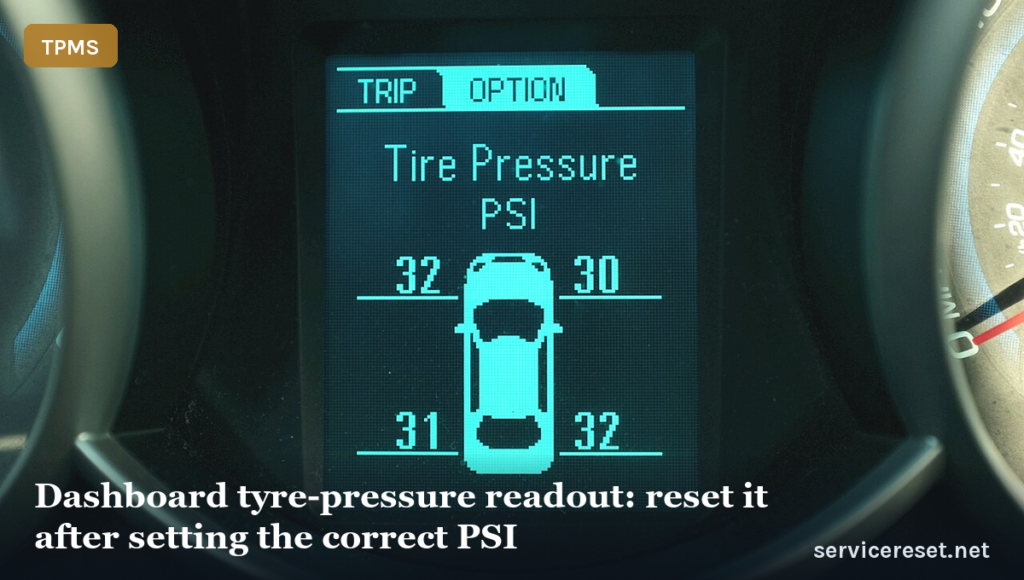
After you change a tyre’s pressure or swap a wheel on your SEAT Leon (KL, 2020–present), you store the new pressures as the system’s reference. It’s done in the infotainment menu (or a TPMS button on some cars), not with a tool. The amber tyre-pressure symbol that prompts this is a maintenance reminder rather than a fault — it means the current pressures no longer match the figures the car last memorised, so once you correct them and store again it clears.
How the System Works on This Model
The Leon typically uses an indirect monitor that watches wheel-speed data from the ABS: a soft tyre has a slightly smaller rolling radius, spins fractionally faster than the others, and the system flags the difference. That is why you store a reference through the menu rather than reading a live pressure for each wheel, and why re-storing is needed after any inflation change or wheel swap. Cars with a physical TPMS button work the same way — the button simply saves the current pressures as the new baseline.
Before You Start
- Set the pressures when the tyres are cold — before driving, or after the car has stood a couple of hours.
- Use the figure on the driver’s door-pillar label for your wheel size and load.
- Do all four corners, and check the spare if one is carried.
- Park level with the ignition on before you store.
- Only store once every tyre is correct — the car memorises whatever it reads at that moment.
Inflate First
Set all four tyres cold to the door-pillar label figure, then store the reference.
Storing via the Menu
- With pressures set, switch the ignition on.
- Open ‘Vehicle’ / ‘Settings’ on the touchscreen.
- Choose ‘Tyres’ → ‘Store tyre pressures’ (SET) and confirm.
Or via the Button
If a physical TPMS button is fitted, set the pressures, ignition on, then hold the button until it confirms.
Light Won’t Clear?
- Check every tyre — the system reacts to one odd corner, and an indirect monitor only needs a small difference.
- Always re-store after inflating or a wheel change so the baseline matches what is on the car.
- Look for a slow puncture if one corner keeps dropping over a day or two — a nail or leaking valve is the usual cause.
- Fitted the spare or space-saver? Its different size can upset the reading until you re-store.
- Cold snap? Pressure falls roughly 0.1 bar for every 10 °C drop, so a frosty morning can wake the light. Top up to spec and re-store.
- Give it a short drive after storing so the system can settle against the new reference at road speed.
What to Expect After
Once you confirm the store, the amber symbol should go out at once or within the first few minutes of driving. From then on the stored figure is the baseline the car watches, so the warning stays off for the trip and only returns if a tyre genuinely loses pressure. If it comes back the same day with pressures you know are correct, treat it as a real leak to investigate rather than a glitch.
Frequently Asked Questions
How do I reset the tyre pressure light on a SEAT Leon?
Set the pressures while cold, switch the ignition on, then go to Vehicle → Settings → Tyres → Store tyre pressures and confirm — or hold the TPMS button if one is fitted. The current pressures are stored as the new reference and the light clears within a short drive.
Any tool needed?
No — the Leon stores the reference itself from the menu or button, so no diagnostic tool or garage visit is needed for a normal reset. A tool is only involved if new pressure sensors are being fitted to a car with a direct system, which is a workshop task.
Where do I find the store option in the menu?
It sits under the vehicle or car settings on the touchscreen, usually within a Tyres section as ‘Store tyre pressures’ or SET. Menu wording varies with software version, so if the exact label differs look through the tyre or driver-assistance settings until you find the store function.
Why does it trigger in the cold?
Cold air is denser, so pressure drops as the temperature falls overnight. A tyre set correctly in a warm garage can read low on a frosty morning and wake the warning. Top the tyres back up to the label figure while cold and re-store the reference, and the light should stay off.
It lit after a wheel swap — normal?
Yes — re-store so the new pressures become the baseline. Rotating tyres, fitting winter wheels or using the spare changes the rolling radii the system has memorised, so it needs to relearn. Set the pressures first, then store from the menu or with the button.
Is a lit tyre-pressure light an MOT concern?
A permanently illuminated TPMS symbol is a test failure in many regions, and it signals that at least one tyre needs attention. Beyond the test, an under-inflated tyre wears faster and handles worse, so check and correct the pressures promptly rather than leaving the light on.
Stored a fault code? Look it up on autodtcs.com. To clear a service reminder, see our Leon service reset.
Independent guide — not affiliated with SEAT. Always follow your official service manual and safety precautions. Read our full disclaimer.