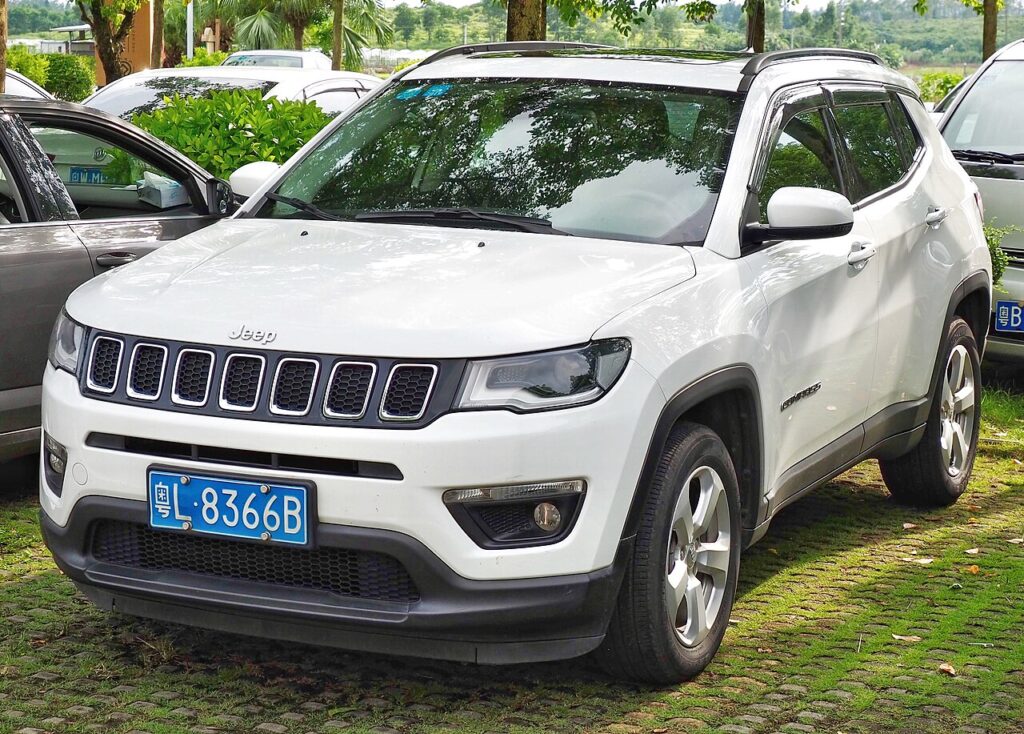
These instructions apply to the Jeep Compass Mk2 (MP) 2017-Present.
For other models, please choose your vehicle here.
If the remote on your Jeep Compass (MP/552, 2017–present) has started making you stand right beside the car before it will lock, or the push-button start throws a “key not detected” message, the coin cell in the fob is almost certainly on its way out. The second-generation Compass shipped with two different keys depending on trim — a remote-head key with a fixed metal blade built into the body (Sport and lower trims that start with a twist), and a Keyless Enter-n-Go proximity fob for push-button-start cars. Both take the same battery, but they come apart in slightly different ways, so it is worth knowing which one is in your pocket before you start prying.
How to Tell the Fob Battery Is Dying
- You have to be almost touching the car. Lock and unlock range collapses from across the car park to arm’s length — the earliest and most reliable warning.
- “Key Fob Battery Low” in the cluster. The Compass shows this message in the instrument-panel display when the proximity fob’s cell is weak; it is easy to miss if you rarely look at the trip screen.
- Push-button start gets fussy. On Keyless Enter-n-Go cars the engine may refuse to fire until you hold the fob against the start button — the car reading it by backup induction rather than radio.
- Cold mornings make it worse. A cell that is fine at midday can drop below the transmitter’s threshold on a frosty start, so intermittent winter dropouts point at the battery too.
A coin cell in a Compass fob usually lasts two to four years. If yours is around that age and doing any of the above, fit a fresh one before you start worrying about the receiver or the immobiliser.
The Battery You Need
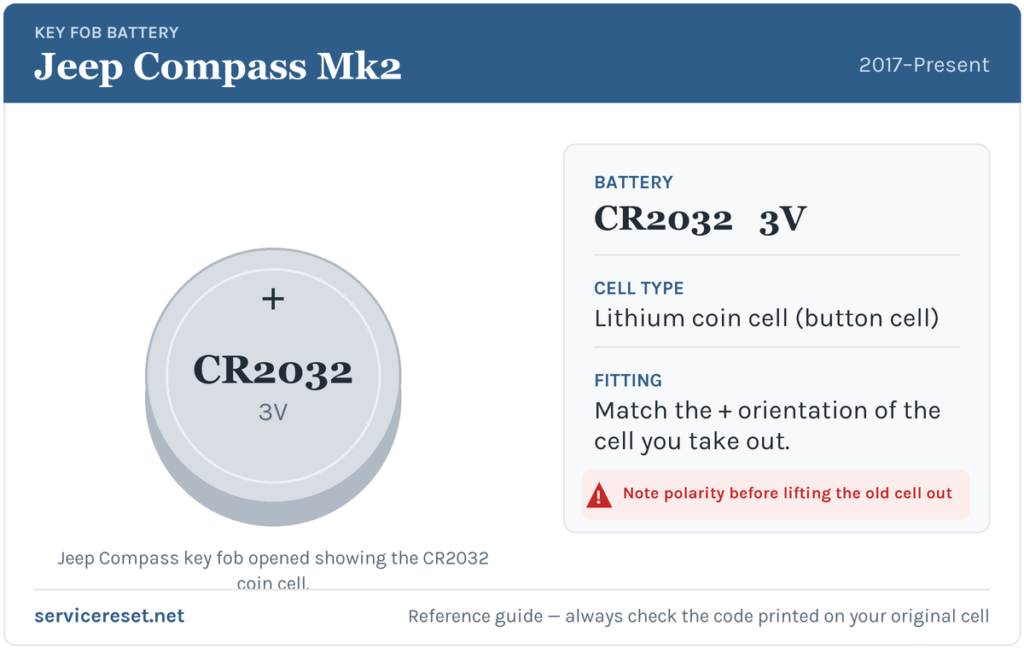
Both the remote-head key and the Keyless Enter-n-Go proximity fob use a single CR2032 — a 3-volt lithium coin cell about the diameter of a five-pence piece. It is the most common fob battery on the market, stocked by every supermarket and hardware shop. Buy a reputable branded cell rather than a bargain multipack; cheap cells sag under the short, sharp current pulse the transmitter draws and can give poor range even fresh out of the packet.
Method 1 — Keyless Enter-n-Go Proximity Fob
- Slide the small release catch on the side of the fob and pull the emergency key blade straight out of the body.
- Insert a flat plastic tool (or the blade you just removed) into the slot the blade left behind and twist gently to split the two halves of the case. They are clipped, not screwed.
- Note which way the old cell faces, then lift it out. Fit the new CR2032 the same way round — on most Compass fobs the marked positive (+) face sits upward toward you as the case lies open.
- Press the halves back together until they click all the way round, then slide the emergency blade home until it latches.
Method 2 — Remote-Head Key (Twist-to-Start Trims)
- There is no separate emergency blade to remove here — the metal blade is fixed into the head. Find the seam running around the edge of the plastic head.
- Slip a thin flat tool into the seam near the key-ring end and work your way round, easing the two shells apart. Take your time; forcing one point cracks the plastic.
- Ease the old CR2032 out from under its retaining clip and drop the fresh cell in with the same face showing.
- Line the two shells up and press them shut until every edge is flush, then test the buttons.
⚠️ Watch the polarity. A CR2032 fitted upside down will not power the transmitter, and left in reverse for long it can partially discharge against the contacts — so always copy the orientation of the cell you took out rather than guessing.
Confirm It Worked
Stand back several metres and lock, then unlock, the Compass. Full range should return the instant the fresh cell is seated. The “Key Fob Battery Low” message clears once the car next reads a healthy fob — sometimes immediately, sometimes after one start cycle. On a Keyless Enter-n-Go car, confirm the engine now fires with the fob simply in your pocket rather than pressed to the button.
If a Fresh Cell Doesn’t Fix It
- Re-check polarity and seating. The commonest reason a “new” battery does nothing is that it went in the wrong way or is not sitting flat under its clip against clean contacts.
- Clean the terminals. A film of finger grease or a fleck of corrosion is enough to cause dropouts — wipe the cell faces and the fob contacts with a dry cloth before deciding the fob is dead.
- Try the backup start. If the car still will not detect the fob, hold it flat against the start button and press — that confirms the immobiliser transponder is fine and the fault is purely the radio side.
- Rule out the car’s own 12 V battery. A weak vehicle battery can produce erratic locking and no-start symptoms that mimic a dead fob, so have it checked if everything else looks right.
New Key or Spare — Why It’s a Dealer Job
Changing the coin cell leaves the fob’s coding untouched, so it keeps working with no programming. A brand-new key is a different matter: Jeep’s Sentry Key immobiliser has to accept the new transponder through the car’s security system, the emergency blade has to be cut to the door lock, and blank proximity fobs are ordered against the VIN. That means adding a spare or replacing a lost key is a job for a Jeep dealer or an established auto-locksmith with the right diagnostic kit — so keep the battery in your spare fresh too, and you are never down to one working key.
Frequently Asked Questions
What battery does a Jeep Compass key fob take?
A single CR2032 3-volt lithium coin cell — the same one whether you have the remote-head key or the Keyless Enter-n-Go proximity fob.
Which way round does the battery go?
Match the cell you removed. On most Compass fobs the marked positive (+) face sits upward as the case lies open; fitting it the wrong way simply leaves the fob dead, so copy the original orientation rather than assuming.
Do I have to reprogram the fob after changing the battery?
No. A battery swap does not affect the stored coding, so the remote and proximity functions work straight away. Only a replacement key needs programming to the car.
How long should the battery last?
Typically two to four years. Leaving a proximity fob sitting close to the car so it wakes and transmits constantly — on a hall table by the driveway, for instance — runs it down faster.
My Compass fob still will not work with a new battery — what now?
Re-check the polarity and seating first, then wipe the contacts. If a proximity car still starts when you hold the fob against the button but not otherwise, the transponder is healthy and the radio transmitter or a contact is the issue — worth a locksmith’s look before assuming the worst.
Can I still drive if the fob battery is completely flat?
Yes. Use the emergency blade inside the fob to unlock the driver’s door, and on push-button cars hold the fob against the start button as you press it — the car reads the transponder by induction and starts normally.
If the remote died the moment the car’s 12 V battery was disconnected rather than fading over weeks, the cause is more likely a lost pairing or a stored fault than a flat coin cell — you can look up what any related code means on autodtcs.com.
Independent guide — not affiliated with Jeep. Always follow your official service manual and safety precautions. Read our full disclaimer.