These instructions apply to the Jaguar XE Mk1 (X760) 2015-Present.
For other models, please choose your vehicle here.
If the tyre-pressure warning has come on in your Jaguar XE (2015–present) after you’ve adjusted the pressures or changed a wheel, the system is largely self-managing — set the pressures correctly and the warning clears on its own. Here’s how it works. Seeing the amber tyre symbol after a cold night or a pressure change is normal behaviour, not a fault; it’s the car asking you to check the tyres, and it goes out once they’re right.

How the XE’s System Works
The XE uses direct sensors in each wheel that report actual pressures. There’s no reset button — once the pressures are correct, the system recognises them and the warning light goes out (it may take a short drive to confirm).
First, a Few Checks
- Check pressures cold where possible — before driving, or after the car has stood, so warmth doesn’t mask a low tyre.
- Read the placard in the driver’s door shut; the XE lists a normal figure and a higher one for full load or sustained high speed.
- Do all four corners, and the spare if fitted, so nothing is left below spec.
- Use a trusted gauge — the on-screen readout is a good cross-check but set them with a known-good gauge or pump.
- Allow a short drive for the sensors to report before expecting the light to clear.
Clearing the Warning
- Check the tyres cold where possible (or let them reach ambient temperature).
- Set all four tyres to the correct pressures (placard in the driver’s door shut or the handbook) — the XE lists higher pressures for full load or high speed.
- Switch the ignition on; with the pressures correct, the warning light should go out.
- If it doesn’t clear immediately, drive for a few minutes so the sensors report and the system updates.
If the Warning Stays On
- Recheck every tyre — one below spec keeps the warning on.
- Use the right load setting — the placard lists normal and laden pressures.
- Give it a longer drive — the sensors report as the wheels turn, so the light can take a few miles to clear.
- Cold snap? Pressures fall overnight and can dip below the threshold; top up cold and drive.
- Slow puncture — if one corner keeps needing air, have the tyre inspected rather than repeatedly re-inflating.
- After a wheel change, a fitted sensor must be recognised; a replacement sensor is matched at a workshop.
- Still lit with correct pressures? A sensor may have a flat internal battery or fault, which needs a workshop — look up the stored code on autodtcs.com.
Once It’s Done
With every tyre at the placard figure, the warning clears within a short drive and stays off. Because the system reads real pressures, a light that returns later means an actual loss of pressure — re-check the tyres cold rather than assuming a glitch.
Frequently Asked Questions
How do I reset the tyre pressure warning on a Jaguar XE?
Set all tyres to the correct pressures — the system recognises them and the light goes out, possibly after a short drive. There’s no reset button.
Why is there no reset button?
It uses direct sensors that read actual pressures, so it clears itself once the pressures are right.
Why won’t the light go out?
Usually a tyre still below spec, the wrong load setting, or a sensor with a failing battery.
Do I need a tool?
Not for a normal reset; a failed sensor needs replacing and matching at a workshop.
Can I see the actual pressures on the screen?
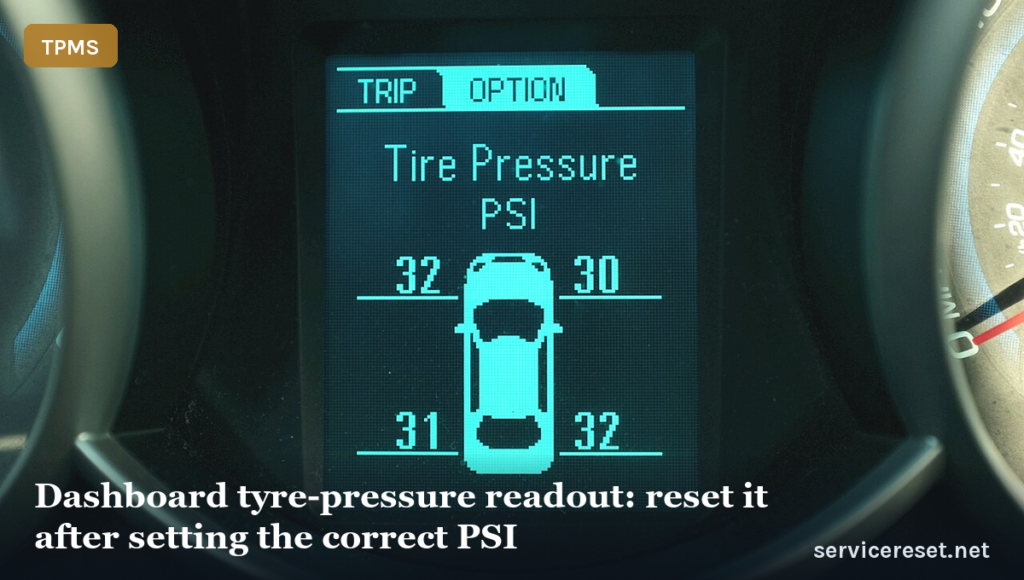
Yes — because the XE reads each wheel directly, the infotainment display can show the individual tyre pressures. That’s a useful cross-check: it tells you which corner is low so you can top up the right one, rather than guessing, and lets you watch the reading come up to spec as you inflate.
It came on after a wheel change — what now?
If a good sensor is in the wheel, set the pressures and drive a few minutes so it’s recognised. A brand-new sensor, or one moved between positions, may need matching with a workshop tool — that isn’t a dashboard step on this car.
If the warning came on with other lights, decode the code on autodtcs.com.
Independent guide — not affiliated with Jaguar. Always follow your official service manual and safety precautions. Read our full disclaimer.