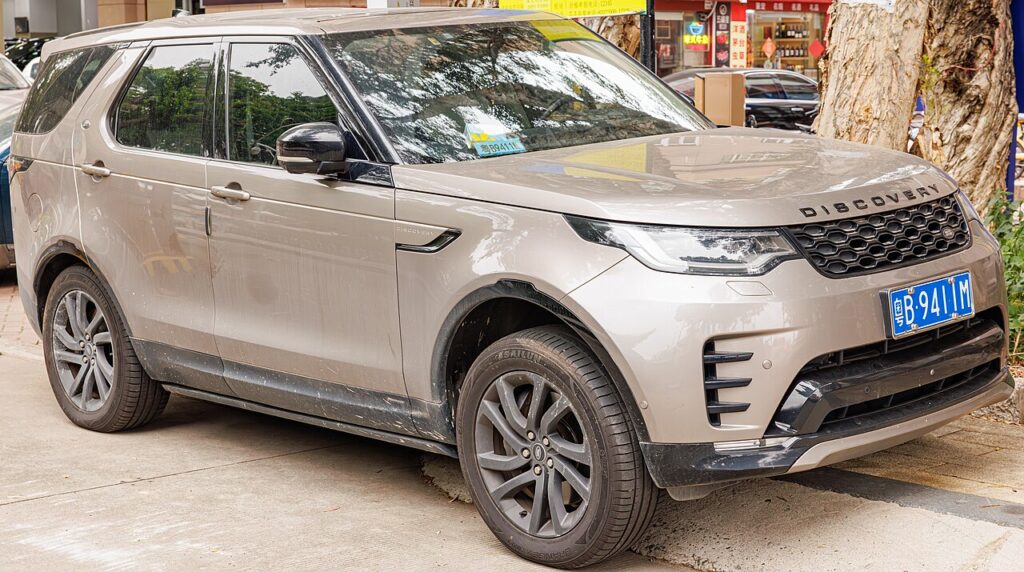
These instructions apply to the Land Rover Discovery Mk5 (L462) 2017-Present.
For other models, please choose your vehicle here.
The fifth-generation Land Rover Discovery (L462, 2017–present) is keyless from the driver’s point of view, so the smart key lives in a pocket and only makes itself known when the coin cell inside starts to fade. If your Discovery has begun demanding the fob right against the door handle, or the driver display shows a low-key-battery warning, that flat cell — not the car’s keyless module — is nearly always to blame. Swapping it is a quick job once you find the hidden emergency-blade release. Below is the exact battery, the correct way to open the case, and the reason a brand-new key still has to come from a dealer.
How to Tell the Fob Battery Is Dying
- Range shrinks dramatically. The Discovery stops sensing the key as you approach and you have to hold the fob almost onto the handle to lock or unlock. This is the earliest warning.
- A low-key-battery message. The L462’s instrument display flags the smart key as low when its voltage drops — a cue to change the cell soon rather than run it to nothing.
- Keyless start becomes fussy. The engine may not fire on the first press, or you have to bring the fob close to the start button or steering column before the car acknowledges it.
- Cold weather tips it over. A cell that is already weak drops further in the cold, so a marginal fob often dies completely on a frosty morning.
A CR2032 in a Discovery key typically gives two to four years of service. As the fob is constantly answering the car, parking with it hung up a metre away by the door drains it faster than carrying it about does.
The Battery You Need
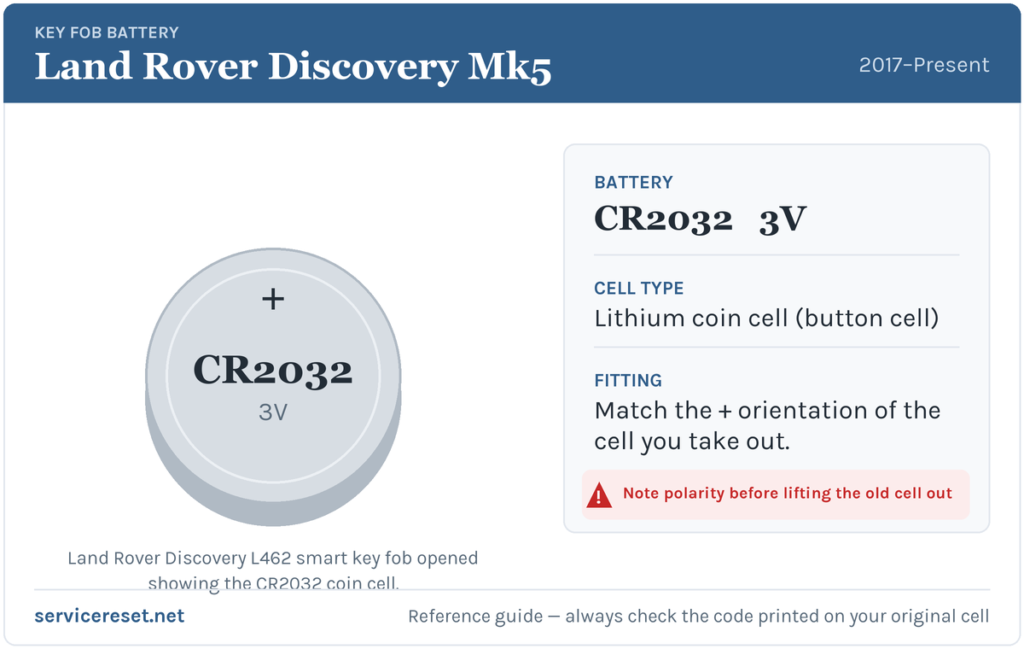
The Discovery L462 smart key runs on one CR2032 — the 3-volt lithium coin cell that measures 20 mm across and 3.2 mm thick. It is stocked by every supermarket, hardware shop and newsagent. Use a fresh, good-quality branded cell and avoid the slimmer CR2025, which looks almost identical but is 0.7 mm thinner and can lose contact with the terminals, giving poor range even from new. Touch the replacement only by its edges so skin oils don’t reach the flat faces and corrode the contacts.
Method — Keyless Smart Fob
- Slide off the side trim and release the blade. Move the small catch on the side of the fob and pull the metal emergency key blade out of its channel.
- Open the case with the blade. Slot the tip of the emergency blade — or a slim plastic tool — into the gap the blade left and gently work the back cover away from the fob body. It releases with light leverage, so there is no need to force it.
- Remove the old cell, noting its orientation. The CR2032 in the Discovery fob sits with its positive (+) face upward. Check how the old one is seated before you lift it out so you can copy it.
- Fit the new battery and close up. Press the fresh CR2032 in under its retaining clip the same way round, clip the cover back on until the seam sits flush, then slide the emergency blade back home until it latches.
⚠️ Watch the polarity. A coin cell fitted the wrong way up can bridge the holder incorrectly and slowly discharge, so a “new” battery ends up flat and the key never wakes. Always match the orientation of the cell you removed — positive side up here.
Make Sure It Took
Move a few metres from the car and lock, then unlock, with the fob; full keyless range should return straight away. Climb in and press start — recognition should be immediate. The low-key-battery message clears once the car has read a healthy fob, which may take a wake-up cycle or a short drive rather than clearing the instant you close the case.
If a Fresh Cell Doesn’t Fix It
- Double-check orientation and seating. A cell that is upside down or not fully clipped in is the usual reason a new battery seems not to help.
- Clean the contacts. Wipe the terminals and the battery faces with a dry cloth to remove grease or light corrosion that can cause dropouts.
- Fall back on the backup start. If the fob is truly dead, hold it against the marked point on the steering column and press start with the brake applied — proof the car’s immobiliser is fine and only the fob is at fault.
- Consider the 12 V battery. A weak vehicle battery can make the whole keyless system sluggish and imitate a fob problem; if the Discovery is generally slow to wake, check that as well.
New Key or Spare — Why It’s a Dealer Job
A battery change leaves the fob’s coding exactly as it was, so nothing needs reprogramming — the key just carries on working. A new key is a separate matter: the Discovery’s keyless-vehicle and immobiliser modules must be accessed with JLR-approved diagnostic gear, and blank fobs are ordered against the car’s VIN and security data. That makes adding a spare or replacing a lost key a job for a Land Rover dealer or an experienced auto-locksmith. Keep the second fob’s battery fresh and you are never reduced to one working key at the worst possible moment.
Frequently Asked Questions
What battery does a Land Rover Discovery L462 key fob take?
A single CR2032 3-volt lithium coin cell, the same cell used across Land Rover’s current smart keys. There is one button-fob type on the Discovery, so there is no ambiguity about size.
Which way up does the battery go?
Positive (+) side up in the Discovery fob. Note the old cell’s position before you take it out and match it — a battery fitted the wrong way can drain itself and leave the key dead.
Do I need to reprogram the key afterwards?
No. Changing the coin cell doesn’t disturb the pairing, so the fob reconnects to the car by itself next time you use it. Only a genuinely new key needs programming.
How long should the Discovery fob battery last?
Around two to four years. Leaving the fob close to the car, where it wakes repeatedly to answer the vehicle, shortens the life.
My Discovery key still won’t work with a new cell — is the car faulty?
Usually not. Re-check that the cell is the right way up and fully seated, then clean the contacts. If it still won’t respond, use the emergency blade to get in and start the car by holding the fob to the column; if that works, the fob’s transmitter has probably failed and needs replacing.
Can I drive the Discovery with a completely dead fob?
Yes. Pull out the hidden emergency blade to unlock the door, then hold the fob against the marked spot by the steering column and press start with your foot on the brake. A flat coin cell won’t leave you stuck.
If the remote failed abruptly — right after the 12 V battery was disconnected, say, rather than fading over time — the cause may be in the car’s electronics rather than the cell, and a stored fault code can narrow it down. You can look up what any logged code means at autodtcs.com.
Independent guide — not affiliated with Land Rover. Always follow your official service manual and safety precautions. Read our full disclaimer.