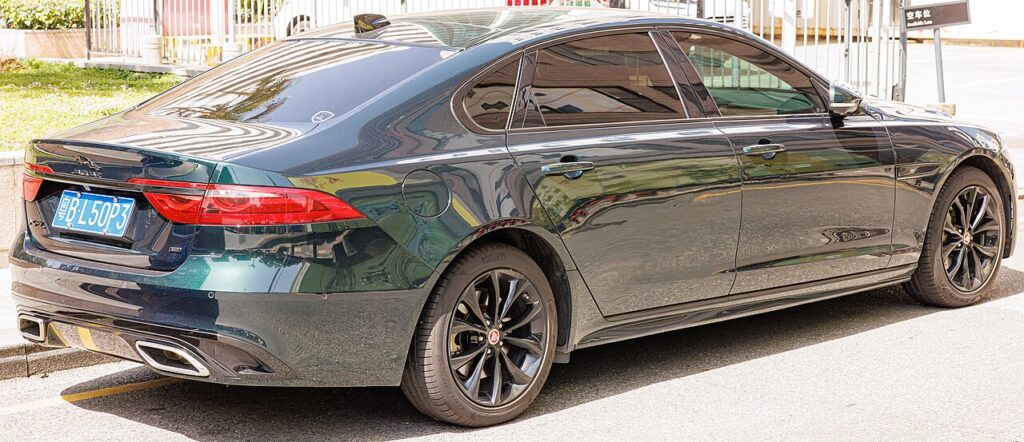
These instructions apply to the Jaguar XF Mk2 (X260) 2015-Present.
For other models, please choose your vehicle here.
If the tyre-pressure warning has come on in your Jaguar XF (2015–present) after you’ve adjusted the pressures or changed a wheel, the system is largely self-managing — set the pressures correctly and the warning clears on its own. Here’s how it works. Seeing the light after a cold night, a top-up, or a seasonal wheel swap is normal behaviour, not a fault: the sensors simply report that a corner is below target, and the warning goes out once you correct it.
How the System Works
The XF uses direct sensors in each wheel that report actual pressures. There’s no reset button — once the pressures are correct, the system recognises them and the warning light goes out (it may take a short drive to confirm).
Because each sensor measures real pressure rather than inferring it from wheel-speed data, the car always knows the true figure at every corner and doesn’t need you to teach it a baseline. That also means a steady warning almost always reflects a genuine pressure difference — trust it and check with a gauge rather than assuming a glitch.
Before You Begin
- Check pressures cold — before driving or after the car has stood a few hours; warm tyres read high.
- Use the placard figures from the driver’s door shut or the handbook, and note the higher pressures listed for full load or high speed.
- Set all four corners with an accurate gauge; forecourt airlines can be a few psi out.
- Check the spare if it’s a monitored full-size wheel.
- Plan a short drive so the sensors can report the corrected pressures.
Clearing the Warning
- Check the tyres cold where possible.
- Set all four tyres to the correct pressures (placard in the driver’s door shut or handbook) — note the higher pressures listed for full load or high speed.
- Switch the ignition on; with the pressures correct, the warning light should go out.
- If it doesn’t clear immediately, drive for a few minutes so the sensors report.
If the Warning Stays On
- Recheck every tyre — one below spec keeps the warning on.
- Use the right load setting from the placard — the wrong target can trip the warning even at a sensible pressure.
- You only did a short trip — give it a longer steady drive so every sensor transmits.
- It came on overnight in the cold — pressures fall as temperature drops; top up to the placard figure.
- After a wheel swap — confirm each fitted wheel actually has a working sensor.
- Still lit with correct pressures? A sensor may have a flat internal battery or fault — look up the code on autodtcs.com.
After the Reset
With the pressures correct, the light typically goes out as soon as you switch on, or after a few minutes of driving while the sensors report in. It then stays off for the rest of the trip and beyond — there’s nothing to save on screen. If it returns after a few days, one tyre is losing air slowly and should be checked. Expect it to reappear on the first cold morning of autumn; that’s the pressure drop, not a fault.
Frequently Asked Questions
How do I reset the tyre pressure warning on a Jaguar XF?
Set all tyres to the correct pressures — the system recognises them and the light goes out, possibly after a short drive. There’s no reset button.
Why is there no reset button?
It uses direct sensors that read actual pressures, so it clears itself once the pressures are right.
Why won’t the light go out?
Usually a tyre still below spec, the wrong load setting, or a sensor with a failing battery.
Do I need a tool?
Not for a normal reset; a failed sensor needs replacing and matching at a workshop.
Can I read individual tyre pressures on the display?
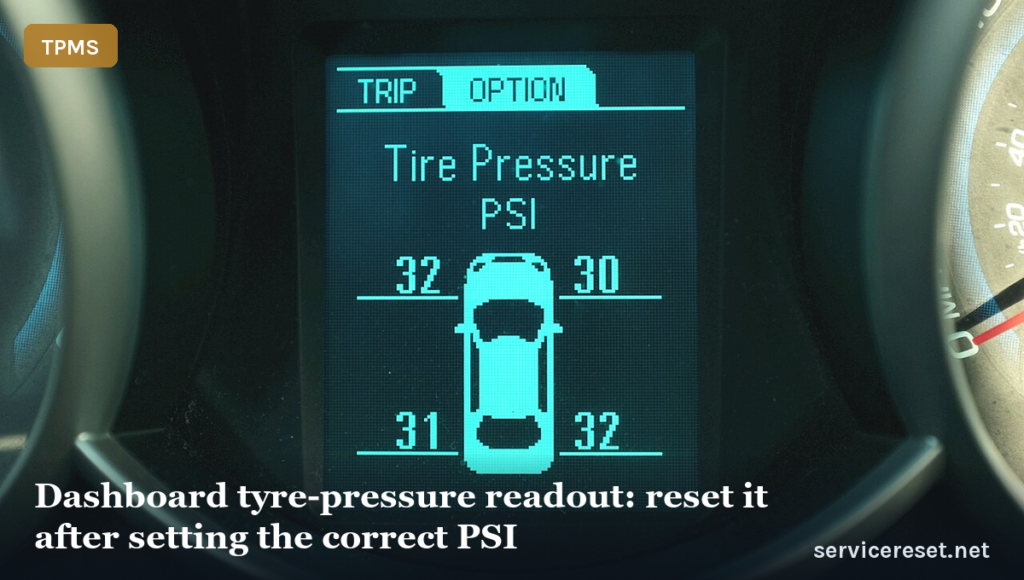
Because the XF has direct sensors, the on-screen tyre menu can show a live pressure for each corner, which makes it easy to spot the low tyre. Check there first before reaching for a gauge; the display points you straight to the corner that needs attention.
Do I need to reset after rotating the tyres?
No special reset is needed for a straight rotation, since each wheel keeps its own sensor and the car reads it wherever it’s fitted. Just confirm every pressure matches the placard afterwards and drive; the system continues to monitor each corner correctly.
If the warning came on with other lights, decode the code on autodtcs.com.
Independent guide — not affiliated with Jaguar. Always follow your official service manual and safety precautions. Read our full disclaimer.