These instructions apply to the Jeep Grand Cherokee Mk5 (WL) 2022-Present.
For other models, please choose your vehicle here.
Disconnecting the 12 V battery on your Jeep Grand Cherokee (2022–present) is one of those jobs that looks daunting but is well within reach for an owner with a spanner and a few minutes of patience. You might be doing it to fit a fresh battery, to isolate the electrics before body or trim work, to lay the car up over a winter, or to recover from a jump-start that hasn’t quite settled. Done in the correct order — and with the ignition genuinely off — the Grand Cherokee wakes up cleanly and relearns almost everything on its own. The 12 V battery is in the engine bay; on the 4xe plug-in hybrid there is also a high-voltage system you must leave completely alone.
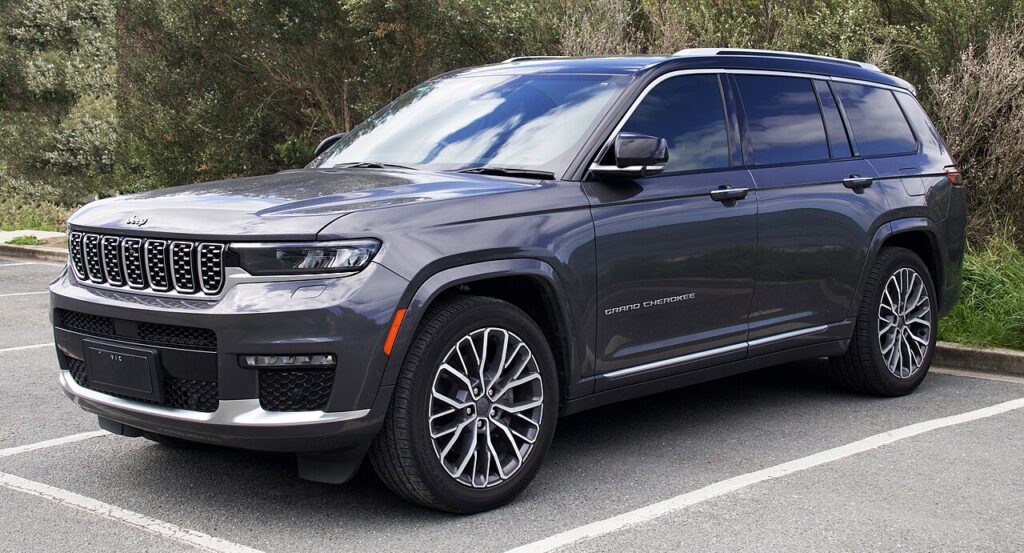
Where the 12 V Battery Is
The 12 V battery is in the engine compartment, usually tucked under a plastic cover or trim panel that lifts or unclips away once the bonnet is up. Lift the cover and you will find the two terminals: the negative (−) post carries a black lead and is the earth connection, while the positive (+) post wears a red lead and is often hidden under a hinged red cap. Identify both before you touch a spanner — getting the order right is the whole trick to a clean disconnect. On the 4xe plug-in hybrid, the high-voltage traction battery is an entirely separate system: never touch the orange high-voltage cabling. You only ever work on the ordinary 12 V battery, exactly as you would on any petrol or diesel car.
First, a Few Checks
- Make sure the ignition is fully off and, on the 4xe, that the car is not in READY — no green READY light on the cluster.
- Take the key fob well away from the vehicle so it cannot wake the car up while you work.
- Switch off the lights, climate control, radio and anything else, and close the doors and tailgate.
- Note down your radio presets and any personalised settings; if your audio uses a security code, make sure you have it to hand.
- Wait a couple of minutes after switching off so the modules power down before you disturb anything.
- Wear gloves and eye protection, and have the correct spanner ready so you are not fumbling at a live terminal.
Disconnecting
- Switch everything off and confirm the car is asleep.
- If fitted, disconnect the intelligent battery sensor (IBS) from the negative terminal first.
- Slacken and lift off the negative (−) terminal first, then the positive — negative always comes off before positive.
- Tuck each disconnected lead aside so it cannot spring back and touch its post.
- Working near airbags or seat-belt pretensioners? Wait 2 minutes after disconnecting before starting that work, so the safety circuits are fully discharged.
Reconnecting
- Refit the positive (+) terminal first, seat it squarely and tighten it.
- Refit the negative (−) terminal last and tighten it, then reconnect the IBS to the negative post.
- Check both clamps are properly tight — a loose clamp causes odd electrical faults — and refit the cover.
What You’ll Need to Reset Afterwards
With power restored, the Grand Cherokee will want a few things put back:
- Clock, date and audio presets re-entered, along with any security code your radio uses.
- Power windows and tailgate re-initialised — hold each window switch at the fully-up and fully-down limits so one-touch and anti-pinch relearn, and let the power tailgate cycle so it relearns its travel. If your one-touch is still misbehaving, our Grand Cherokee power-window reset guide walks through it.
- Air suspension (if fitted) usually settles to its correct ride height after a short drive.
- A fresh AGM battery should be a like-for-like match — the stop/start system and the IBS expect the correct type to keep their charging strategy accurate.
- A few warning lights may glow at first and then self-clear after a short drive once the modules have re-synchronised.
If a Warning Light Stays On or the Car Feels Off
- Double-check that both terminal clamps — and the IBS connector — are fully tight and clean.
- Take the car for a short, gentle drive so the systems can relearn before you assume anything is wrong.
- Repeat the window and tailgate re-initialisation if one-touch or the tailgate travel is still off.
- Rule out a genuinely tired or flat battery — a weak battery can throw its own warnings straight after reconnection.
- If a light is stubborn, it has stored a fault code you can look up on autodtcs.com.
Frequently Asked Questions
Where is the 12 V battery on a Jeep Grand Cherokee (WL)?
In the engine compartment, generally under a plastic cover. On the 4xe the high-voltage traction battery is a completely separate system — you only work on the 12 V battery and never touch the orange high-voltage cabling.
Which terminal do I disconnect first?
Take the negative (−) terminal off first and reconnect it last. On reassembly the positive (+) goes back on first, then the negative. If an intelligent battery sensor is fitted to the negative post, disconnect it first and refit it after.
What needs resetting after I reconnect the battery?
Mainly the clock, date and audio presets, plus re-initialising the power windows and tailgate by holding them at their limits. Air suspension settles on a short drive, and any warning lights that appear usually clear once the car has relearned.
Does a new battery need coding on the Grand Cherokee?
A like-for-like 12 V swap does not need special coding to run. Fit the correct AGM type so the stop/start system and the intelligent battery sensor keep their charging strategy accurate; only some workshops register a new battery to keep that management spot-on.
Will disconnecting the battery clear my fault codes or service light?
Disconnecting can clear some temporary stored codes and warning messages, but it is not a proper fix — a genuine fault simply returns. It will not reliably reset a mileage-based service reminder, which follows its own schedule.
Can I just jump-start it instead of disconnecting?
If the battery is only flat you can jump-start rather than remove it, and that avoids all the resets. Disconnecting is for renewing the battery, isolating the electrics for other work, or long storage — not for a simple recharge.
For any warning light that lingers after the job, look up the stored code on autodtcs.com.
Independent guide — not affiliated with Jeep. Always follow your official service manual and safety precautions. Read our full disclaimer.