These instructions apply to the Jeep Commander Mk1 (XK/XH) 2006-2010.
For other models, please choose your vehicle here.
If the tyre-pressure warning has come on in your Jeep Commander (2006–2010) after you’ve adjusted the pressures or changed a wheel, this model uses an indirect system — there are no sensors in the wheels, so you reset it by setting the pressures and driving. Here’s how.
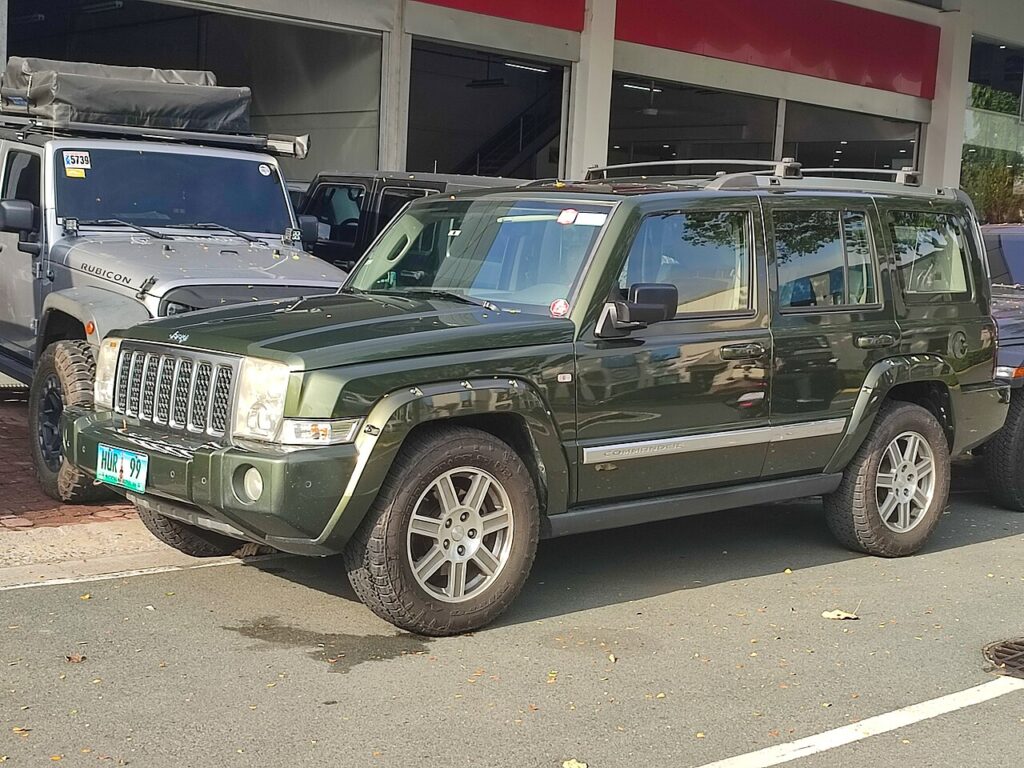
On the Commander the amber tyre-pressure symbol is a monitoring warning, not a mechanical fault. It lights when the system decides one corner is running softer than the others, and it is completely normal for it to appear after you have topped the tyres up, rotated them, or refitted a wheel — because the old reference no longer matches what is now in the tyres. Once you set the correct pressures and let the system relearn, the light goes out on its own.
How the System Works
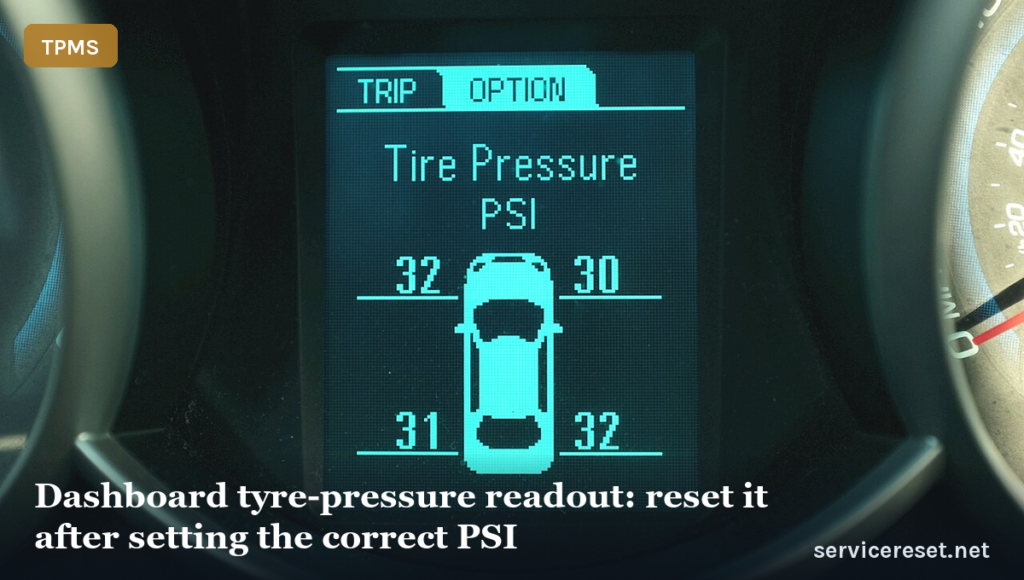
The indirect TPMS reads wheel-speed data to spot a tyre going soft, so after any pressure change you set the correct pressures and let the car relearn them on the move.
Because it works from wheel-speed rather than in-wheel sensors, there is no sensor battery to go flat and nothing to physically fail inside the tyre. The trade-off is that the system knows nothing about actual pressure figures — it only compares the four wheels against a stored baseline. That is why setting the pressures accurately and then storing them is the whole job: an incorrect baseline is just as likely to trigger the warning as a genuinely soft tyre.
Before You Start
- Check the tyres cold — parked for a few hours, or driven less than a mile — because warm tyres read high.
- Use the placard figure in the driver’s door shut, which lists the correct pressures front and rear.
- Set all four corners first, including any that already looked fine.
- Have a reliable gauge to hand; forecourt airlines are often out by a few psi.
- Don’t forget the load setting — the placard usually lists a higher figure for a full load.
Resetting the System
- Park level and set all four tyres to the correct cold pressures (placard in the driver’s door shut).
- Drive the vehicle for about 5 minutes at over 25 km/h (15 mph).
- The new pressures are stored as the baseline and the warning clears.
If the Warning Stays On
- Recheck every tyre — one below spec keeps the warning on.
- Complete the learn drive — a very short trip may not be enough; keep a steady speed for the full few minutes.
- After a wheel change, make sure pressures are exactly to spec before driving.
- Cold morning? A sharp overnight temperature drop can pull a tyre below the threshold; top up and relearn.
- Watch for a slow puncture — if one tyre keeps needing air every few days, the warning is doing its job.
- The space-saver spare runs at a much higher pressure; if it is fitted, the system can flag the mismatch until the road wheel is back on.
- Still showing with correct pressures? A fault may be stored — look it up on autodtcs.com.
What to Expect After
Once the pressures are correct and the short learn drive is done, the warning should stay off for the rest of the trip and every drive after it — there is no need to repeat the routine unless you change the pressures again. If it clears and then returns a day or two later, treat that as a real signal to check the tyres rather than a glitch.
Frequently Asked Questions
How do I reset the tyre pressure light on a Jeep Commander?
Set all four pressures correctly to the door-shut placard figures while the tyres are cold, then drive for about five minutes at more than 25 km/h (15 mph). The system learns the new pressures as its baseline and the warning clears by itself. There is no button sequence or menu step to complete on this model.
Does it have sensors in the wheels?
No. This model uses an indirect, wheel-speed-based system, so there is no in-wheel sensor battery to fail and nothing inside the tyre to replace. The monitoring is done by comparing how fast each wheel spins, which is why the reset is simply a matter of setting pressures and driving rather than pairing sensors.
Why won’t the warning clear?
Usually a tyre is still below spec, or the learn drive wasn’t long enough. Recheck all four cold, confirm they match the placard exactly, and then complete a steady drive. If every pressure is correct and the light still won’t go out, a fault may be stored in the system.
Do I need a tool?
No — setting the pressures and driving is all that’s needed. Because the system is indirect, there are no sensors to program and no diagnostic pairing step. The only kit worth having is an accurate pressure gauge so the baseline you store is correct in the first place.
Why did the light come on after I rotated the tyres?
Moving the wheels around changes which corner sits where, so the stored reference no longer matches. As long as the pressures are set correctly, simply completing the learn drive lets the system re-establish its baseline and the warning goes out. It is expected behaviour after any wheel swap, not a sign of a problem.
Is it safe to keep driving with the light on?
The light is warning you that a tyre may be low, so check the pressures at the next safe opportunity rather than ignoring it. A soft tyre affects grip, braking and fuel use, and a slow leak will only get worse. Once you confirm the pressures are correct and relearn, it is fine to carry on.
If the warning came on with other lights, decode the code on autodtcs.com.
Independent guide — not affiliated with Jeep. Always follow your official service manual and safety precautions. Read our full disclaimer.