These instructions apply to the Lexus LS Mk3 (UCF30) 2000-2006.
For other models, please choose your vehicle here.
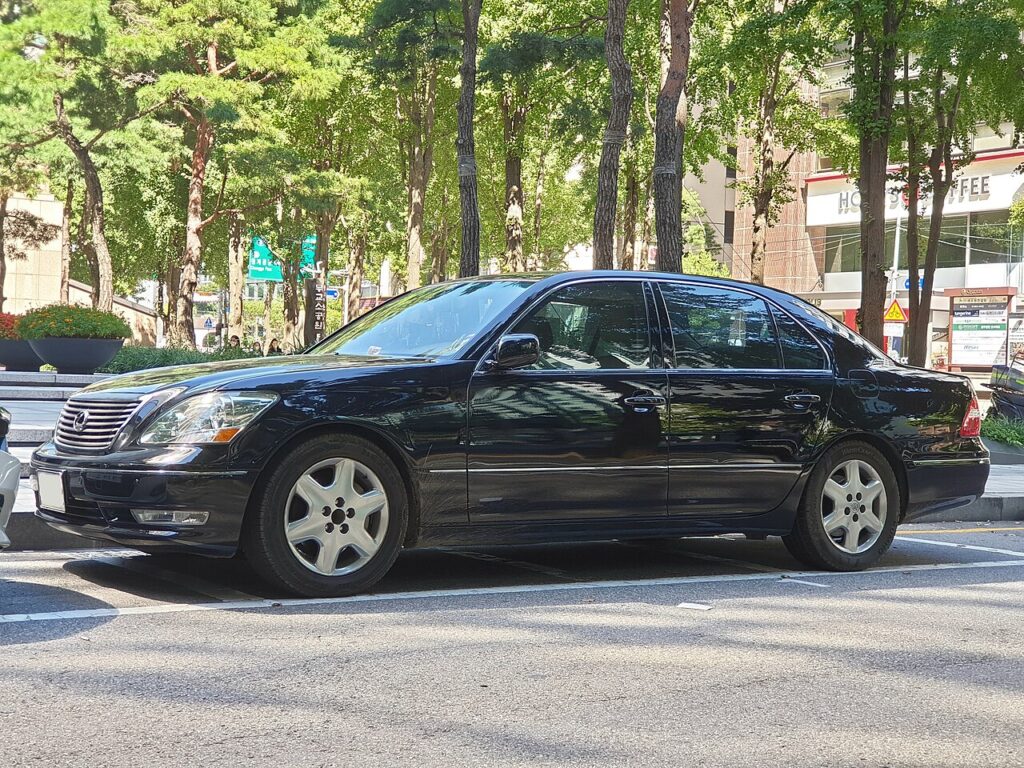
If the remote on your Lexus LS 430 (XF30, 2000–2006) only locks the car from arm’s length, flashes weakly, or has stopped responding altogether, the coin cell inside it has almost certainly gone flat. Most XF30 cars carry the familiar remote-head master key — a one-piece key where the buttons are moulded into the head and the metal blade is fixed — while later 2004–2006 cars specified with Smart Access also came with a separate keyless smart fob. The two keys open differently and take different cells, so it is worth knowing which one is in your pocket before you start. Here is how to tell a dying battery from a genuine fault, the exact cell each key needs, and why a brand-new key is the one job you can’t finish at home.
How to Tell the Fob Battery Is Dying
- Shrinking range. You have to stand right beside the car, or almost touch the door with the key, before it will lock or unlock. This is the classic first sign on the LS 430.
- Weak or dead button LED. The little red indicator on the remote-head key normally winks each time you press a button; once the cell is low it dims or stops lighting entirely — a quick way to confirm the key, not the car, is at fault.
- Buttons work only sometimes. Intermittent response, especially on a cold morning, is a near-flat cell that can no longer supply the brief burst of current the transmitter needs.
- Smart Access wake-up trouble. On a Smart Access car, if the doors no longer unlock as you touch the handle and you find yourself reaching for the buttons instead, the smart key’s cell is fading.
A coin cell in an LS 430 key typically lasts two to four years. If yours is older than that and showing any of the above, fit a fresh cell before you start suspecting the receiver or the immobiliser.
The Battery You Need
This is where the LS 430 catches people out, so read carefully.
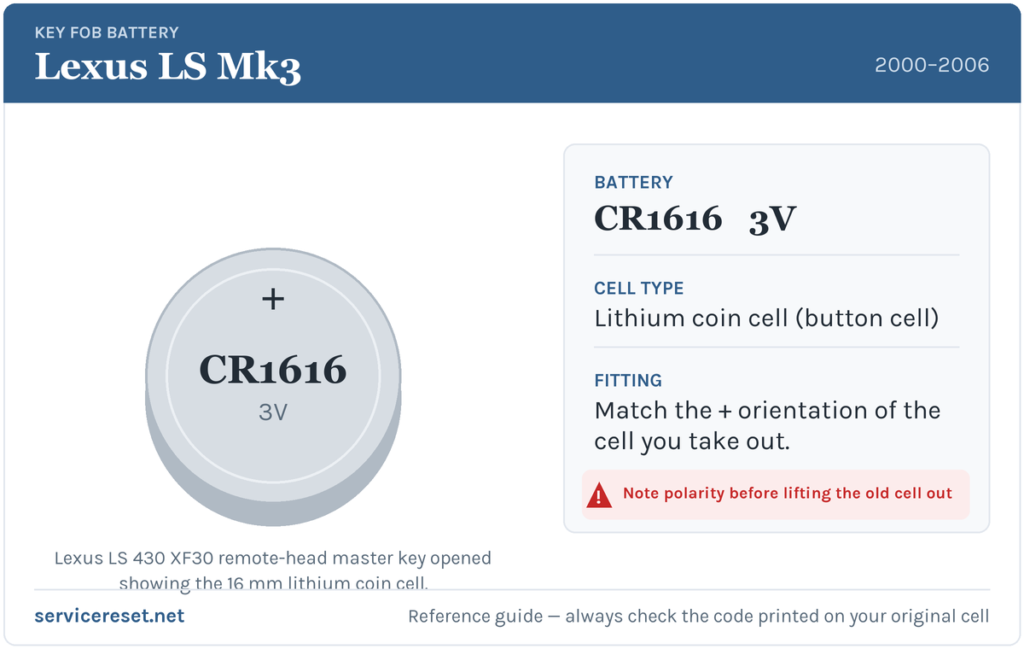
The remote-head master key (the common one, FCC ID HYQ12BBK) takes a single 16 mm 3-volt lithium coin cell. Parts listings for this exact key are genuinely split between a CR1616 and a CR2016 — same diameter, differing only in thickness (1.6 mm versus 2.0 mm). So the reliable rule is to open the key first and match the code printed on the cell you take out. Most were fitted with a CR1616; if yours reads CR2016, buy that. Don’t grab a “CR2032” from a supermarket multipack — that is the fatter 20 mm cell and it will not fit.
The optional Smart Access smart key (FCC ID HYQ12BZE, on some 2004–2006 cars) uses a CR1632 lithium coin cell. Again, confirm against the cell you remove before buying.
Method 1 — Remote-Head Master Key (most LS 430s)
- Look at the back of the key head. There is a small cross-head (Phillips) screw holding the two halves together — undo it with a fine screwdriver and set it somewhere safe, as it is tiny and easy to lose.
- Slip a flat plastic tool or a thin flat-blade screwdriver into the seam around the edge of the head and gently work your way round to pop the two halves apart.
- Note which way the old cell sits, then ease it out. There is usually a small metal tab holding one edge — lift the cell away from that tab rather than prising against it, and it lifts straight out.
- Drop in the fresh cell positive (+) side facing up, the same way the old one sat, and make sure it clicks fully under its retaining tab.
- Press the two halves back together until the seam closes evenly, drive the screw back in snugly but not hard (the case is plastic), and test every button.
Method 2 — Smart Access Smart Key (2004–2006, if fitted)
- Release the mechanical insert key: slide the catch on the fob and pull the emergency metal key straight out of its slot.
- Insert a flat plastic tool (or the emergency key itself) into the gap the insert leaves behind and gently twist to split the two halves of the case.
- Ease out the old CR1632 cell, noting its orientation as you do.
- Fit the new cell the same way round as the one you removed, close the case until it clicks, and slide the mechanical insert key back home until it latches.
⚠️ Match the orientation of the cell you removed. A coin cell fitted the wrong way round makes no contact — and in the worst case can quietly discharge — so always copy the way the old one sat rather than guessing.
Confirm It Worked
Stand back a few metres and lock, then unlock, the car. Full range should return straight away and the button LED should flash crisply again. On a Smart Access car, walk up and touch a door handle — the doors should unlock without you pressing anything, confirming the smart key is awake again.
If a Fresh Cell Doesn’t Fix It
- Re-check the size and seating. If you fitted a thin CR1616 into a socket that expected a CR2016 (or the reverse), it may sit loose and lose contact — make sure the cell is held firmly under its tab against clean metal.
- Wipe the contacts. A smear of finger grease or a little corrosion on the terminals is enough to cause dropouts; clean them with a dry cloth before blaming the key.
- Try the other side up only if unsure. If the LED still won’t light, double-check polarity against the marking inside the case.
- Suspect the car’s own battery. Rarely, a weak or recently disconnected 12 V car battery can make the central locking behave oddly and mimic a key fault — if the LS is generally slow to wake, look there too.
New Key or Spare — Why It’s a Dealer Job
Changing the coin cell keeps the key’s existing coding, so nothing needs reprogramming and the key works the moment you close it up. Cutting and coding a new key is a different matter: the LS 430’s transponder immobiliser has to be programmed to the car with a diagnostic tool, and a blank remote-head key or Smart Access fob must be ordered and matched to the vehicle. That makes adding a spare or replacing a lost key a job for a Lexus dealer or an established auto-locksmith — so it is well worth keeping the battery in your spare key fresh too, rather than discovering it is dead the day you need it.
Frequently Asked Questions
What battery does a Lexus LS 430 key take?
The common remote-head master key uses a single 16 mm 3-volt lithium coin cell — listed by different suppliers as either a CR1616 or a CR2016, which are the same width and differ only in thickness. Open the key and match the code printed on the cell you remove. The optional Smart Access smart key uses a CR1632.
Is it CR1616 or CR2016?
Both codes appear against this exact key, and the difference is only 0.4 mm of thickness. Most cars came with a CR1616, but the safest approach is to buy the cell whose code matches the one you take out — that removes any doubt.
Which way up does the cell go?
In the remote-head key the new cell goes in positive (+) side up. Whichever key you have, the golden rule is to copy the orientation of the cell you removed.
Do I need to reprogram the key after changing the battery?
No. A battery swap doesn’t touch the key’s coding, so it works immediately. Only a brand-new key needs programming to the car.
How long should an LS 430 key battery last?
Typically two to four years. A Smart Access smart key that spends its life sitting near the car wakes constantly and can run down a little quicker than a plain remote-head key.
Can I still drive the LS 430 if the key is completely dead?
Yes. The metal blade of the remote-head key, or the emergency insert key hidden in the smart fob, unlocks the driver’s door manually, and the car can still be started — so a flat coin cell won’t leave you stranded.
If your remote stopped working suddenly right after the car battery was disconnected — rather than fading over weeks — the cause is more likely the electronics than the cell; checking for any stored fault code on autodtcs.com can help rule the car itself in or out.
Independent guide — not affiliated with Lexus. Always follow your official service manual and safety precautions. Read our full disclaimer.