These instructions apply to the Isuzu D-Max Mk2 (TF) 2012-2020.
For other models, please choose your vehicle here.
If the remote on your Isuzu D-Max (TF / RT50, 2012–2020) — the second-generation pickup shared with the MU-X wagon — only locks the truck from arm’s length, responds every second press, or has stopped working altogether, the coin cell inside the key is the first thing to check. This generation left the factory with two very different keys depending on trim: lower grades got a folding “flip” remote where the metal blade swings out of the body, while higher SLX and Blade-type grades with passive entry and push-button start carried a smart keyless fob. Both take the same battery, but they open differently, so this guide covers each in turn along with how to tell a flat cell from a genuine fault.
How to Tell the Fob Battery Is Dying
- Shrinking range. You find yourself standing right beside the D-Max, or holding the key against the door handle, before it will lock or unlock. This gradual loss of distance is the classic first warning.
- The remote’s LED dims or stops flashing. On the flip remote the little indicator light no longer blinks cleanly on a button press once the cell is weak — a quick way to confirm it is the key, not the truck.
- A key-battery warning on keyless trucks. D-Max variants with passive entry and start show a low-key-battery indication in the driver display and may warn that the smart key was not detected when you press the start button.
- Cold-morning dropouts. A cell that is nearly done will struggle most first thing on a cold day, then seem to recover once it warms — a sign it is on its way out, not a random glitch.
A basic flip remote usually gives two to four years from a cell. The smart keyless fob is harder on its battery because it is always listening for the truck, so passive-entry D-Max owners often see closer to one to two years — and leaving the fob sitting next to a TV, router or wireless charger overnight drains it faster still.
The Battery You Need
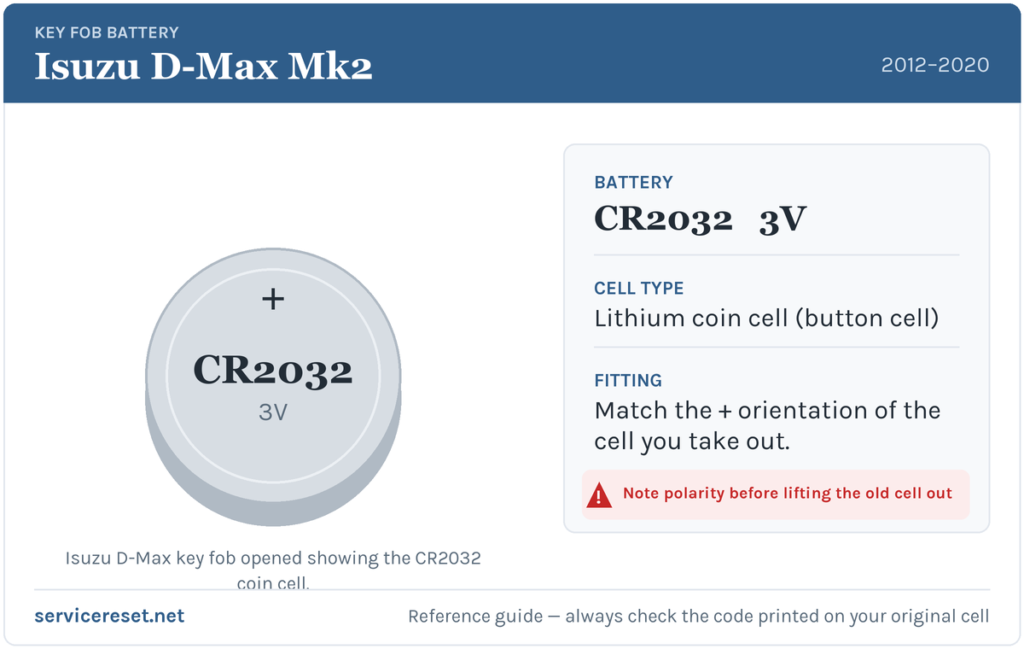
Both the folding remote and the smart keyless fob use a single CR2032 3-volt lithium coin cell — the same cell family used across the related Isuzu MU-X. It is the most common fob battery made, sold in any supermarket or hardware shop. Fit a fresh, good-quality branded cell: cheap or old-stock coin cells sag under the short burst of current the transmitter draws and can give poor range even straight out of the packet. If in doubt, open the key first and read the code stamped on the cell you remove — it will read CR2032.
Method 1 — Folding “Flip” Remote (lower grades)
- Fold the metal blade closed so the key is a compact block and easier to hold.
- Look at the back of the fob for a small retaining screw. If there is one, undo it with a fine cross-head (Phillips) screwdriver and lift the cover away. If there is no screw, the case splits along its seam instead: insert a flat plastic tool or a coin into the seam and gently twist to part the two halves, working around the joint rather than forcing one spot.
- Note which way the old cell faces — whether the printed “+” side is visible or hidden — then ease it out from under its retaining clip.
- Drop the new CR2032 in the same orientation you just noted, making sure it clicks fully under the clip against clean contacts.
- Refit the cover and screw (don’t overtighten — the housing is plastic) or press the halves back together until the clips snap, then test every button.
Method 2 — Smart Keyless Fob (passive entry / push-start grades)
- Release the emergency blade first. Slide the catch on the fob and pull the mechanical key blade straight out of the body. On a keyless D-Max this same blade unlocks the driver’s door if the truck is ever locked with a dead fob.
- Insert a flat-head screwdriver — wrap the tip in cloth or tape to avoid marking the case — into the slot the blade left behind, or into the seam around the fob edge.
- Gently prise the two halves apart. The case is designed to separate here; twist rather than lever hard so you don’t crack the plastic or disturb the circuit board.
- Take note of how the old cell sits, then lift it out. Fit the fresh CR2032 the same way round, seated firmly under its clip.
- Line the halves back up, making sure the rubber buttons and board sit flush, and press until the clips click. Slide the emergency blade back in until it latches.
⚠️ Match the polarity you removed. A coin cell fitted upside down makes poor contact, can quietly discharge and may leave the key dead — so always copy the exact orientation of the cell you took out rather than guessing. If you did not check before removing it, the printed “+” face almost always sits toward the side of the holder marked with a “+”.
Confirm It Worked
Stand back a few metres and lock, then unlock, the D-Max. Full range should return straight away. On a keyless truck, press the start button with your foot off the brake to confirm the fob is read cleanly; any low-key-battery message usually clears once the car has read a healthy fob, occasionally after one drive rather than instantly.
If a Fresh Cell Doesn’t Fix It
- Re-check the seating and polarity. A cell that is in the wrong way up, or not fully clipped down, is by far the most common reason a “new” battery seems not to help.
- Clean the contacts. A smear of finger grease or a little corrosion on the terminals is enough to cause dropouts — wipe them with a dry cloth before refitting.
- Try the other key. If your spare works normally with its own cell, the problem is inside the first fob, not the truck.
- Warning still showing? Rarely, a weak vehicle 12 V battery can mimic key faults if the truck is slow to wake. If the D-Max itself struggles to start or the electrics act up, the main battery is worth checking too.
New Key or Spare — Why It’s a Dealer Job
Changing the coin cell keeps the fob’s existing coding, so nothing needs reprogramming — the key works the moment the case clicks shut. Adding a new key is a different matter: a blank has to be cut to the D-Max’s mechanical pattern and then coded to the truck’s immobiliser with a diagnostic tool, matched against the vehicle’s VIN. That makes a spare or a lost-key replacement a job for an Isuzu dealer or an auto-locksmith, not the driveway. The cheap insurance is to keep the battery in your spare fresh too, so you are never down to one working key.
Frequently Asked Questions
What battery does an Isuzu D-Max (2012–2020) key take?
A single CR2032 3-volt lithium coin cell, and it is the same size whether you have the folding flip remote or the smart keyless fob. It is shared with the related Isuzu MU-X.
Which way up does the cell go?
Match the cell you removed — check its orientation before you lift it out. In most D-Max fobs the printed “+” face sits toward the “+” marked side of the holder. Fitting it the wrong way can flatten it and leave the key dead.
Do I need to reprogram the key after a battery change?
No. Swapping the coin cell does not touch the fob’s coding, so it keeps working straight away. Only a brand-new key needs cutting and programming.
How long should a D-Max key battery last?
A basic flip remote typically lasts two to four years. A smart keyless fob works harder because it is always listening for the truck, so expect nearer one to two years — less if it sits by a TV, router or charger that keeps it awake.
My key still won’t work after a new battery — is the truck broken?
Usually not. Re-check the cell’s orientation and seating, then wipe the contacts. If a known-good cell still won’t bring the remote back and the LED stays dark, the fob’s transmitter may have failed — but that is rare next to a flat or upside-down cell.
Can I drive the D-Max if the fob is completely dead?
Yes. Use the mechanical blade hidden in the fob to unlock the driver’s door. On keyless trucks the start system is designed to still recognise a fob with a flat battery when it is held against the marked spot or start button, so a dead cell won’t strand you.
If the remote stopped responding suddenly — right after the truck’s main battery was disconnected, say, rather than fading over weeks — the cause is more likely the pairing or a stored fault than the coin cell. You can look up any logged code and what it means on autodtcs.com.
Independent guide — not affiliated with Isuzu. Always follow your official service manual and safety precautions. Read our full disclaimer.