These instructions apply to the Honda Civic Mk9 (FK) 2012-2017.
For other models, please choose your vehicle here.
The Honda Civic (Mk9/FK, 2012–2017) hides a genuinely useful trick: its climate-control unit can run its own self-test and flash any heating/air-conditioning fault codes straight onto the panel — no scan tool, no garage. Most owners never know it exists because it is not printed in the handbook. This guide shows how to enter it, read the codes, and clear them on the Mk9 Civic.
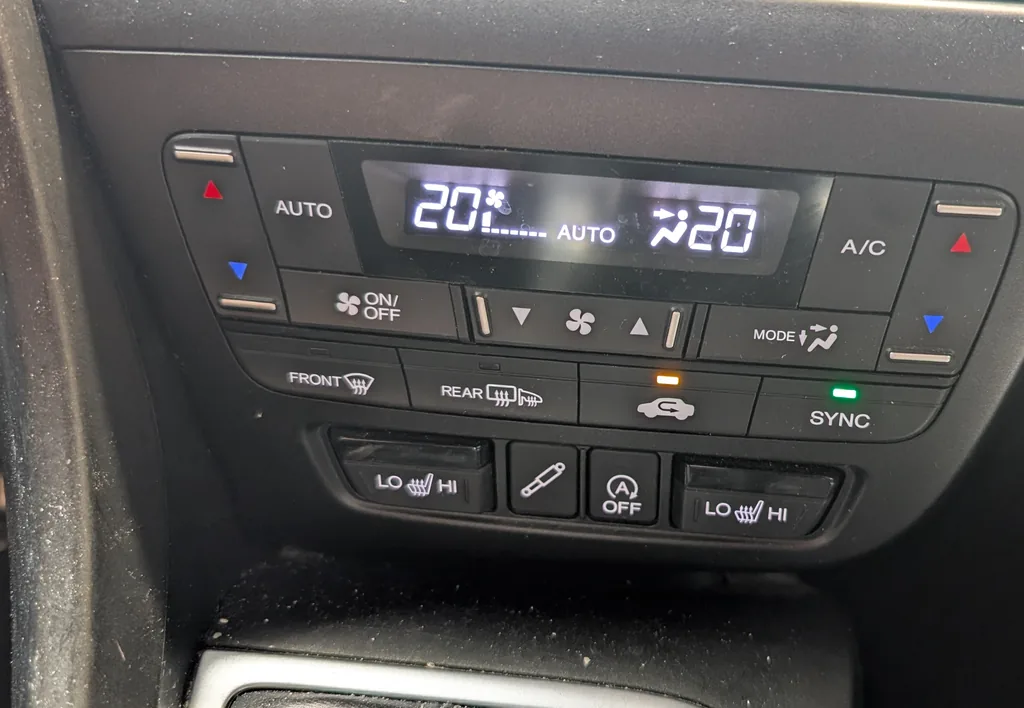
What the Self-Diagnostic Mode Does
The HVAC control unit constantly watches its own sensors and motors — the air-mix (temperature blend) motor, the mode (vent-direction) motor, the blower, the recirculation flap and the evaporator temperature sensor. When you trigger the self-test, it lights every segment on the display, cycles the motors, then blinks back any stored Diagnostic Trouble Codes (DTCs). It is a read-only health check: nothing is changed, nothing is at risk, and it works whether your Civic has the dial-type manual A/C or the upper-trim automatic climate control.
How to Enter Self-Diagnostic Mode (Automatic Climate Control)
- Sit in the car with the doors closed and the ignition OFF (LOCK / 0).
- Press and hold the AUTO button and the recirculation button together.
- Keeping both held, turn the ignition to ON (position II) — do not start the engine.
- The recirculation indicator lights for about 2 seconds, then the self-test begins. Release the buttons.
- The unit lights all display segments, runs the motors, then starts flashing.
On dial-type manual-A/C Civics the same test is reached by holding the recirculation and rear-window defogger buttons while you turn the ignition to ON.
How to Read the Codes
- No fault: the indicator does not blink — the system is healthy.
- A fault stored: the display alternates between “88” (all segments lit) and a number or lettered segment identifying the failed circuit.
- Typical meanings: 1–3 = air-mix motor circuit/linkage, 4–5 = mode motor circuit/linkage, 6 = blower motor, 7 = control-unit internal fault, 8–9 = evaporator temperature sensor.
- If several faults are stored, the unit blinks them in order from the lowest number first.
- Press the rear-window defogger button to step to the next sensor reading.
How to Exit and Clear the Codes
To leave the test, press AUTO or turn the ignition to LOCK (0). To clear stored DTCs on the Mk9: turn the ignition OFF, press and hold the AUTO and windshield (front) defroster buttons, then turn the ignition to ON; after about 5 seconds the defroster indicator blinks — release the buttons. Clearing only erases the memory — if the underlying fault is still present it will simply log again, so fix the cause first. Disconnecting the 12 V battery for a few minutes also wipes the codes.
Safety Note
This is a factory diagnostic routine, entered with the car stationary and the engine off. It moves the internal climate flaps and runs the blower, which is normal. It does not affect the airbags, ABS or engine management, and you cannot damage anything by running it. Always do it parked, not while driving.
Frequently Asked Questions
Does my Civic Mk9 need automatic climate control for this to work?
No. Cars with automatic climate use the AUTO + recirculation entry; manual dial-A/C cars use recirculation + rear-window defogger. Both reach the same HVAC self-test.
Why does the panel show “88”?
An “88” with every segment lit is the lamp-test stage — the unit alternates it with the actual fault code so you can see which segment is the genuine indicator.
My A/C blows warm but no code appears — is the test broken?
No. The self-test only sees electrical/sensor faults in the control unit. A low refrigerant charge or a failed compressor clutch often stores no HVAC DTC, so an empty result does not rule out an A/C problem.
Will running the test reset my temperature settings?
It may return the panel to default after you exit, but it does not affect anything permanent. Just set your preferred temperature and fan speed again afterwards.
What if a code comes straight back after I clear it?
That means the fault is live, not just a stale memory. Note the number, then look up what that HVAC code points to before replacing parts.
Because these flashing numbers are diagnostic trouble codes, you can look up what a specific HVAC or related code means on autodtcs.com.
Independent guide — not affiliated with Honda. Always follow your official service manual and safety precautions. Read our full disclaimer.