These instructions apply to the Honda Civic Mk9 (FK) 2012-2017.
For other models, please choose your vehicle here.
Disconnecting the 12 V battery on a Honda Civic Mk9 (FK, 2012–2017) is a routine job for a battery change or before electrical work, but the Civic is one of the cars where you really do need your radio and navigation security codes ready — the head unit locks after a power loss. This guide covers the safe order of work and what to reset once the leads are back on.
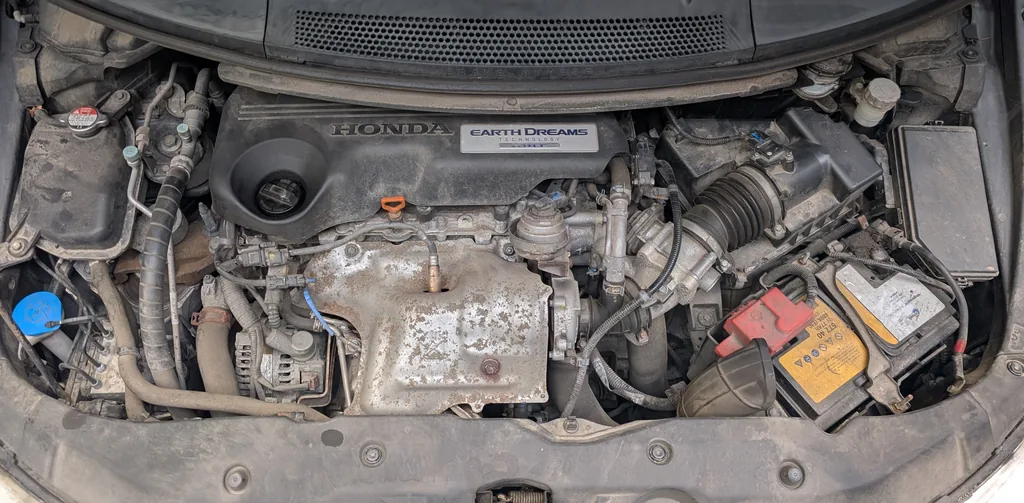
Where the Battery Is
The battery is in the engine compartment. Lift any cover to reach the two clamps. Fit a like-for-like replacement if you are renewing it.
Before You Disconnect
- Note your audio system security code and, on cars with built-in sat-nav, the navigation system code — both are needed after a power loss.
- Note your preset stations and user preferences.
- Turn the ignition off and remove the key (or keep the keyless fob away from the car).
- To keep settings alive, plug in a memory-saver. The steps below assume you are not using one.
- If working near airbags or seat-belt pretensioners, disconnect the battery and wait at least 3 minutes before handling those parts.
Disconnecting — Correct Order
- Turn the ignition off and remove the key.
- Open the bonnet and reach the battery.
- Slacken the negative (−, earth) terminal first and lift the lead clear, tucking it aside.
- Only undo the positive (+) terminal if you are removing the battery completely.
- If removing the battery, undo the base clamp and lift it out upright.
Reconnecting — Correct Order
- Refit the battery and secure the hold-down clamp.
- Connect the positive (+) lead first, then the negative (−) earth lead last. Tighten both firmly.
- Turn the ignition on for a few seconds before starting the engine.
What to Reset Afterwards
- Enter the radio code, and on sat-nav cars the navigation repair/security code, when prompted.
- Reset the date and time and re-enter your presets and user preferences.
- Re-initialise the tyre-pressure (Deflation Warning) system — once your pressures are correct, run the initialise routine from the i-MID menu (see our Civic TPMS reset guide).
- If the one-touch windows stop working, hold each switch fully up for a couple of seconds to re-teach the closed position.
If a Light Won’t Clear
One or two lights right after reconnecting is normal and should clear on a short drive. If the airbag, ABS or engine light remains, a fault code was logged during the power interruption. Reading it needs an OBD scanner — you can look up what a Civic code means on our sister site autodtcs.com.
Tools You Need
- 10 mm spanner/socket for the terminal clamps and hold-down.
- Optional memory-saver to preserve the radio/nav codes and settings.
- Your radio and navigation security codes.
Frequently Asked Questions
Will I lose my radio and sat-nav after disconnecting the battery?
The units lock and ask for their security codes after a power loss. Have the codes ready (from the owner’s wallet card, the unit serial, or a Honda dealer), or use a memory-saver to avoid it.
How long should I leave it disconnected to reset the electronics?
Around 15 minutes with the doors shut lets the modules power down fully, clearing most transient glitches.
Why does the tyre-pressure light come on after the battery change?
The Deflation Warning System loses its baseline; re-initialise it from the i-MID menu once your pressures are correct.
Do I need to register a new battery on a Civic Mk9?
The FK Civic is less fussy than some European cars, but fitting a like-for-like battery and entering the radio/nav codes afterwards is all most owners need.
To clear the service reminder after maintenance, see our Honda Civic service indicator reset guide.
Independent guide — not affiliated with Honda. Always follow your official service manual and safety precautions. Read our full disclaimer.