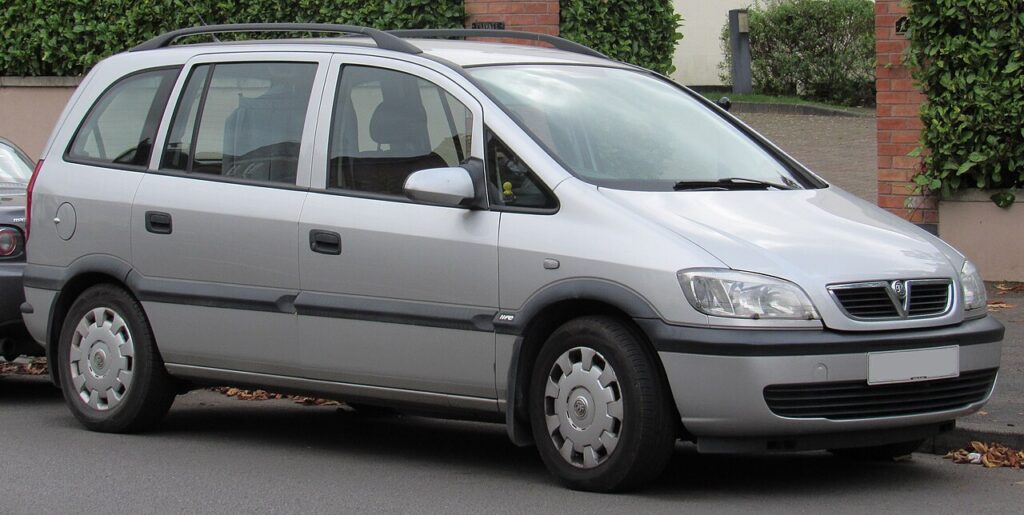
These instructions apply to the Opel Zafira Mk1 (T98) 1999-2005.
For other models, please choose your vehicle here.
The first-generation Opel Zafira A (T98 chassis, sold as Vauxhall Zafira A in the UK, 1999–2005) offered an electric tilt-and-slide sunroof on Elegance and higher trims. After a battery disconnection — usually for replacement, jump-starting, or a flat-battery recovery — the sunroof’s onboard controller loses its memory of the open and closed end-positions. The roof keeps working in manual hold-to-move mode but the one-touch slide and one-touch tilt stop functioning. Re-initializing takes a minute, requires no tools and no scan equipment, and is well within DIY territory.
Before you start
The Zafira A sunroof controller is mounted in the headliner above the rear-view mirror, integrated with the switch unit. There is no separate ECU — the motor, encoder and small embedded controller are all in the headliner module. This makes the initialization simple but also means the calibration is local: you cannot perform it through the diagnostic port.
- Battery state of charge. A weak battery causes the motor to slow at the seal, which the controller misinterprets as the closed end-stop. If the car has been stood for a week, charge the battery overnight before the procedure.
- Clean the rails. The Zafira A is now an older car and the front sunroof corners typically collect leaves and grit. Wipe the channels with a damp cloth and a soft brush before starting — debris causes spurious motor-load readings that abort the calibration.
- Park the car level. A slope can cause the heavy glass panel to lag slightly in motion, which feeds back to the encoder count.
- This procedure applies to 2001–2005 cars. Pre-2001 Zafira A models use a marginally different sequence and tend to be increasingly rare.
Tools required
None.
Initialization procedure
- Switch the ignition ON. Don’t start the engine.
- Press the sunroof switch in the “open” direction (rearward on the rotary switch) and hold it. The roof slides rearward.
- Keep the switch pressed until the sunroof is fully open and the motor has clearly stopped moving. Hold for an additional 2 seconds after the motor stops — this is the “open end-stop captured” trigger.
- Release the switch.
- Press the sunroof switch in the “close” direction (forward on the rotary switch) and hold it. The roof slides forward.
- Keep the switch pressed until the sunroof is fully closed. Hold for an additional 2 seconds after the motor stops. This is the “closed end-stop captured” trigger.
- Release the switch. The sunroof is now initialised.
- Verify by briefly pressing each direction: the roof should move all the way to the relevant end-stop on a single short press, in both slide and tilt modes.
How to verify it has worked
- One-touch slide open and one-touch slide close work from a brief press of the switch.
- One-touch tilt up — usually accessed by pressing the rotary switch upwards rather than rotating it — also works.
- The sunroof closes cleanly into the seal without overshooting (audible “thunk”) or undershooting (visible gap).
When It Won’t Cooperate
The roof moves only while you hold the switch, even after the procedure. The end-stops weren’t captured. Most likely cause on a 20-year-old car: a tired motor that varies in speed during the run. Run the procedure twice in a row, holding the switch for 5 extra seconds at each end-stop in the second attempt.
The roof closes but stops short of the seal, leaving a visible gap. The closed end-stop was captured before the glass actually reached the seal — usually because the seals are stiff with age and the motor’s protective current-limit kicked in early. Spray silicone lubricant onto the seal surface, work the roof open and closed three times to spread it, then re-run the procedure.
Water drips at the front corners on the inside. Not an initialization issue. The Zafira A sunroof has four drainage pipes — two front, two rear — that route water down the A and C pillars and out under the wheel arches. With age, all four become blocked. Use a thin garden-style cable tie down each drain from the corner of the sunroof aperture; you should hear water draining out below the car.
The roof works for a few weeks then loses calibration again. Either the battery is dipping below the controller’s brown-out threshold at start-up (likely on a car with an old battery), or there’s an intermittent connection in the headliner harness. The harness connector at the front-left of the headliner is a known failure point — unclip and re-seat it.
The procedure runs but the anti-pinch reverse no longer works. The Zafira A sunroof anti-pinch is calibrated as part of the same routine. If it doesn’t engage, the motor’s torque sensor is likely worn. The roof remains safe to use but you should be cautious about closing it on stray objects (or fingers).
Frequently asked questions
Will this procedure work on the Vauxhall Zafira A (UK)?
Yes — Opel Zafira A and Vauxhall Zafira A are mechanically and electrically identical. The procedure is the same regardless of badge.
Does it work on the Zafira B (T93)?
No, the Zafira B (2005–2014) uses a different sunroof controller integrated into the body computer. See the dedicated Zafira B guide for that generation’s procedure.
I have a panoramic glass roof rather than a tilt-and-slide. Same procedure?
No — the panoramic option on the Zafira A is a fixed-glass panel with no motor, so initialization does not apply.
Will the sunroof damage itself if I drive without initialization?
No. You lose one-touch and the anti-pinch sensitivity, but the manual hold-to-move function is unaffected. The car remains safe to drive indefinitely with an uncalibrated sunroof — it’s a convenience issue, not a safety one.
How can I tell if my Zafira A has the sunroof option without opening it?
Look at the headliner near the front: cars with the sunroof have a small rotary switch positioned just behind the dome lights. Cars without it have a plain headliner panel in that area. Some early Zafira A cars also had a glass-roof option which looks similar from outside but lacks any switch on the headliner.
For sunroof-related diagnostic trouble codes that don’t clear after the procedure, see autodtcs.com.
Independent guide — not affiliated with Opel. Always follow your official service manual and safety precautions. Read our full disclaimer.