These instructions apply to the Hyundai i20 Mk1 (PB) 2009-2014.
For other models, please choose your vehicle here.
If the 12-volt battery on your Hyundai i20 (PB, 2009-2014) is flat, you can jump-start it from another 12-volt vehicle using the battery in the engine bay. The key detail is where to clamp the last lead: connect it to a metal ground point, not to the flat battery’s own negative terminal.
How to jump-start a Hyundai i20 (2009-2014)
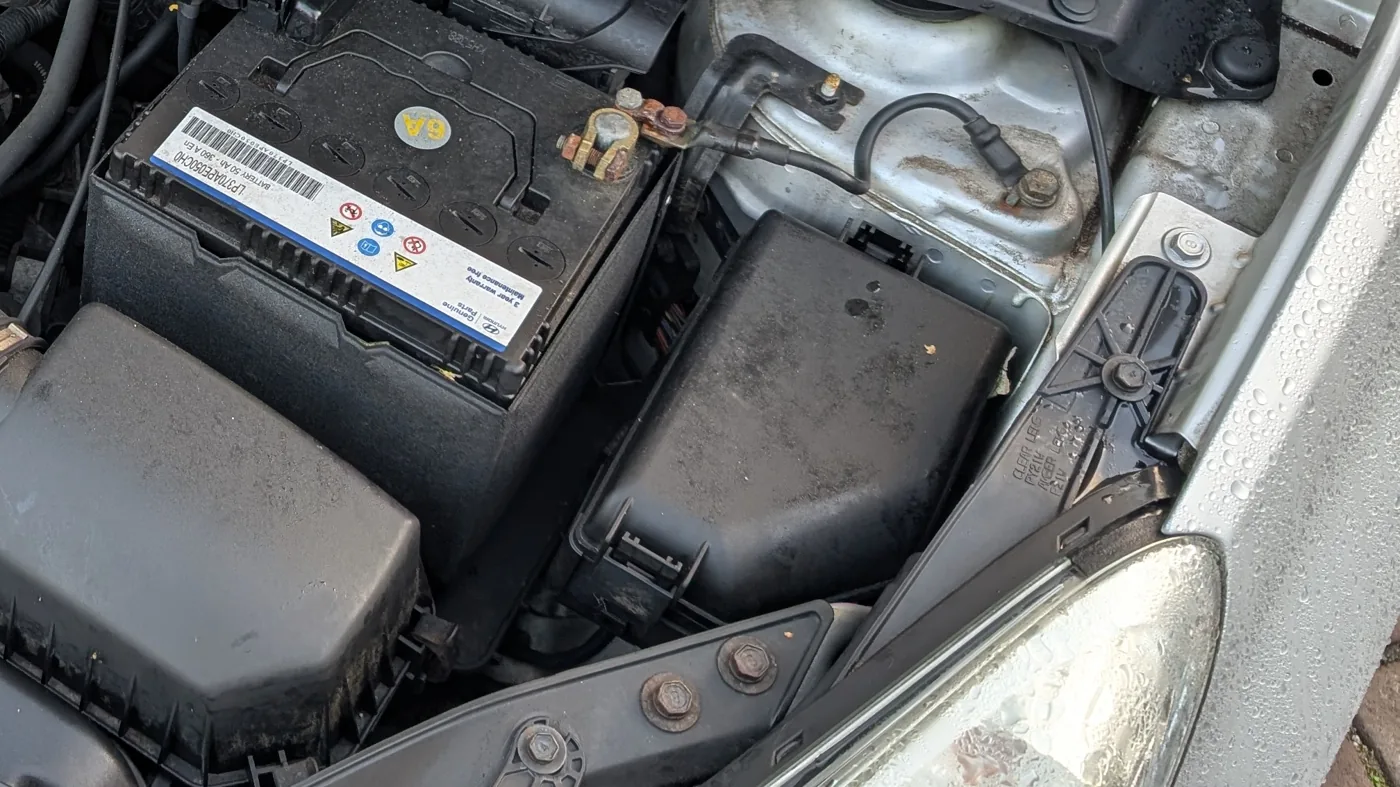
- Park the donor car close but not touching, switch both cars off, and make sure the booster battery is also 12 volt with its negative grounded.
- Connect one jumper lead to the positive (+) terminal of the flat i20 battery, then its other end to the positive (+) of the booster battery.
- Connect the second lead to the negative (−) of the booster battery, then its other end to a solid, unpainted metal point in the i20’s engine bay well away from the battery — the engine lifting bracket is ideal. Do not clamp it to the flat battery’s negative post.
- Start the donor car and let it run at about 2,000 rpm for a minute or two, then start the i20.
- Once the i20 is running, remove the leads in reverse order: the ground clamp first, then the booster negative, then both positives. Keep the clamps from touching each other or any metal.
Then drive or idle the i20 for a while to let the alternator recharge the battery. If it goes flat again soon after, the battery or charging system needs checking.
Frequently asked questions
Where do I connect the negative jump lead on an i20?
To a bare metal ground point in the engine bay — the engine lifting bracket works well — not to the flat battery’s negative terminal. Grounding away from the battery avoids igniting any gas it has given off.
Why connect to a ground point and not the battery?
A flat battery can release a little hydrogen gas. Making the final connection away from it means any small spark happens clear of the battery.
My i20 still won’t start after a jump — what now?
If it won’t turn over at all with good leads and a strong donor, the battery may be too far gone or the fault is elsewhere (starter or connections). If it starts but soon dies, suspect the battery or alternator.
Independent guide — not affiliated with Hyundai. Always follow your official service manual and safety precautions. Read our full disclaimer.