These instructions apply to the Hyundai i20 Mk2 (GB) 2014-2020.
For other models, please choose your vehicle here.
The Hyundai i20 has two fuse boxes: one in the cabin (driver’s-side end of the dashboard, behind a pull-off cover) and one in the engine bay (next to the battery). The fuse map is printed on the inside of each lid — match the symbol on your lid to the tables below to find any fuse and its rating.
Verified on this vehicle: Hyundai i20 (GB) 1.0 T-GDI, 2018, EU market, left-hand drive — both lids photographed on the car. (“GB” is Hyundai’s generation code for the 2014–2020 i20, not Great Britain.)
Cabin fuse box (driver’s side)
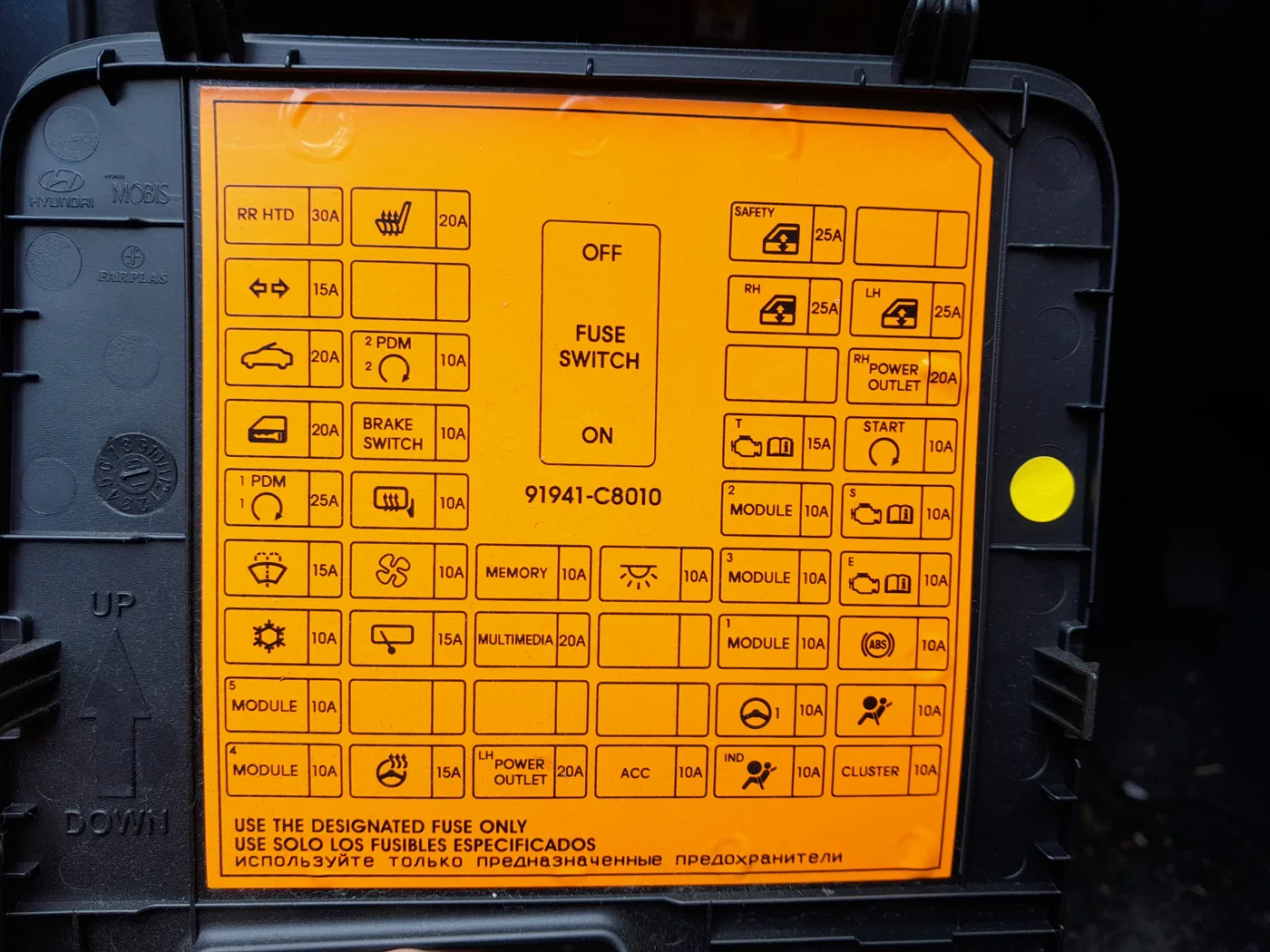
| Symbol | Fuse | Rating | Protects |
|---|---|---|---|
| RR HTD | 30 A | Heated rear window (defogger) | |
| Seat heater | 20 A | Front seat heating | |
| SAFETY P/W | 25 A | Driver power-window anti-pinch module | |
| Turn signals | 15 A | Turn signals / hazards (BCM) | |
| P/W RH | 25 A | Right power window | |
| P/W LH | 25 A | Left power window | |
| Sunroof | 20 A | Sunroof motor | |
| PDM 2 | 10 A | Smart-key module, Start/Stop button | |
| Power outlet RH | 20 A | 12 V power outlet (right) | |
| DR LOCK | 20 A | Central door locking | |
| — | Brake switch | 10 A | Brake-light switch, smart key |
| — | TCU | 15 A | Transmission control (selector, PCB) |
| START | 10 A | Start circuit | |
| PDM 1 | 25 A | Smart-key power supply | |
| HTD MIRR | 10 A | Heated door mirrors | |
| — | MODULE 2 | 10 A | Parking sensors, TPMS, lane-keep |
| — | SENSOR | 10 A | Oil-level, fuel-filter, glow-plug sensors |
| WASHER | 15 A | Windshield washer / wiper switch | |
| Blower | 10 A | Climate blower (auto A/C) | |
| — | MEMORY | 10 A | Clock, BCM, diagnostic socket, cluster, TPMS |
| Interior lamp | 10 A | Interior / luggage lights | |
| — | MODULE 3 | 10 A | Audio, climate, DC-DC, service plug |
| — | ECU | 10 A | ECM / PCM, smart key |
| A/CON | 10 A | Air conditioning module | |
| WIPER RR | 15 A | Rear wiper motor | |
| — | MULTIMEDIA | 20 A | Audio / infotainment |
| — | MODULE 1 | 10 A | BCM, sport mode, brake switch |
| ABS | 10 A | ABS / ESP module | |
| — | MODULE 5 | 10 A | Seat-heat switch, auto-dim mirror, headlamp level |
| MDPS | 10 A | Electric power steering | |
| A/BAG | 10 A | Airbag module | |
| — | MODULE 4 | 10 A | BCM, smart key |
| HTD STRG | 15 A | Heated steering wheel | |
| Power outlet LH | 20 A | 12 V power outlet (left) | |
| — | ACC | 10 A | Mirrors, clock, audio, DC-DC (accessory) |
| A/BAG IND | 10 A | Airbag warning indicator | |
| — | CLUSTER | 10 A | Instrument cluster |
The FUSE SWITCH (battery saver): the cabin box has a FUSE SWITCH that must stay in the ON position. If it is set to OFF — sometimes done to stop the battery draining during long storage — some systems need resetting and the remote or smart key may not work until it is switched back on.
Engine-bay fuse box

| Symbol | Fuse | Rating | Protects |
|---|---|---|---|
| ALT | 125/150 A | Alternator supply — 125 A petrol (no ISG) / 150 A ISG & diesel | |
| MDPS | 80 A | Electric power steering (MDPS) | |
| B+1 | 50 A | Smart junction block supply | |
| B+2 | 50 A | Smart junction block — power-window & connection relays | |
| B+3 | 30 A | Smart junction block (IPS 4/5) | |
| B+4 | 50 A | Smart junction block (IPS 1/2/3) | |
| B+5 | 40 A | Smart junction block supply | |
| — | IG1 | 40 A | Ignition switch / PDM IG1 & ACC relay |
| — | IG2 | 40 A | Start relay, ignition switch, PDM IG2 |
| ABS 1 | 40 A | ABS / ESP module & valves | |
| ABS 2 | 30 A | ABS / ESP control | |
| H/LAMP | 10 A | Headlight high-beam relay | |
| Blower | 50 A | Heater blower relay | |
| Cooling fan | 40/50 A | Cooling-fan relays — 40 A petrol / 50 A diesel | |
| F/PUMP | 20 A | Fuel-pump relay | |
| Horn | 15 A | Horn & alarm-horn relay | |
| Wiper | 25 A | Front wiper (low) relay | |
| ECU 1 | 30 A | Engine-control ECU relay | |
| ECU 2 | 15 A | ECM/PCM, injectors, cooling-fan | |
| ECU 3 | 15 A | ECM/PCM, immobiliser, fuel-pump, sensors | |
| ECU 4 | 15 A | ECM / PCM | |
| ECU 5 | 15 A | PCM (petrol) | |
| — | TCU | 15 A | Transmission control — petrol |
| Ign coil | 15 A | Ignition coils & capacitor — petrol | |
| — | B/UP lamp | 10 A | Reversing lamp / audio, auto-dim mirror |
| — | Diagnosis | — | Diagnostic relay block |
Engine variants: the table above is the petrol set. Diesel cars add a FUEL HEATER (30 A), ECU 6 (20 A) and ECU 7 (15 A), drop the TCU and ignition-coil fuses, run the cooling fan at 50 A, and have a separate connection block for the PTC-heater fuses. Always read your own lid — ratings vary by engine, trim and market.
How to change a fuse
- Switch off the ignition (key in LOCK/OFF) and the circuit that has failed.
- Find the fuse: match its symbol on the lid (or in the tables above) to its position in the box.
- Pull it with the plastic puller clipped inside the engine-bay box — never a screwdriver or metal tool, which can short the terminals.
- Hold it up to the light: a blown fuse has a broken metal strip.
- Fit a new fuse of the same amperage and check the circuit works.
A main-fuse or fusible-link failure (ALT, 80 A, 150 A), where nothing electrical works, needs a Hyundai dealer — don’t bridge it. If an electrical fault also triggered a dashboard warning light, you can read the code for free at autodtcs.com.
Independent guide — not affiliated with Hyundai. Always follow your official service manual and safety precautions. Read our full disclaimer.