These instructions apply to the Hyundai i30 Mk2 (GD) 2012-2017.
For other models, please choose your vehicle here.
The Hyundai i30 (GD) has two fuse boxes: one in the cabin (low on the driver’s side of the dash, behind the hinged “FUSE OBD” cover above the pedals) and one in the engine bay (beside the battery). The fuse map is printed on the inside of each lid — match the symbol on your lid to the tables below to find any fuse and its rating.
Verified on this vehicle: Hyundai i30 (GD), EU market, left-hand drive — both lids photographed on the car (cabin lid 91941-A6640, engine-bay lid 91950-A6720). “GD” is Hyundai’s generation code for the 2012–2017 i30.
Cabin fuse box (driver’s side)
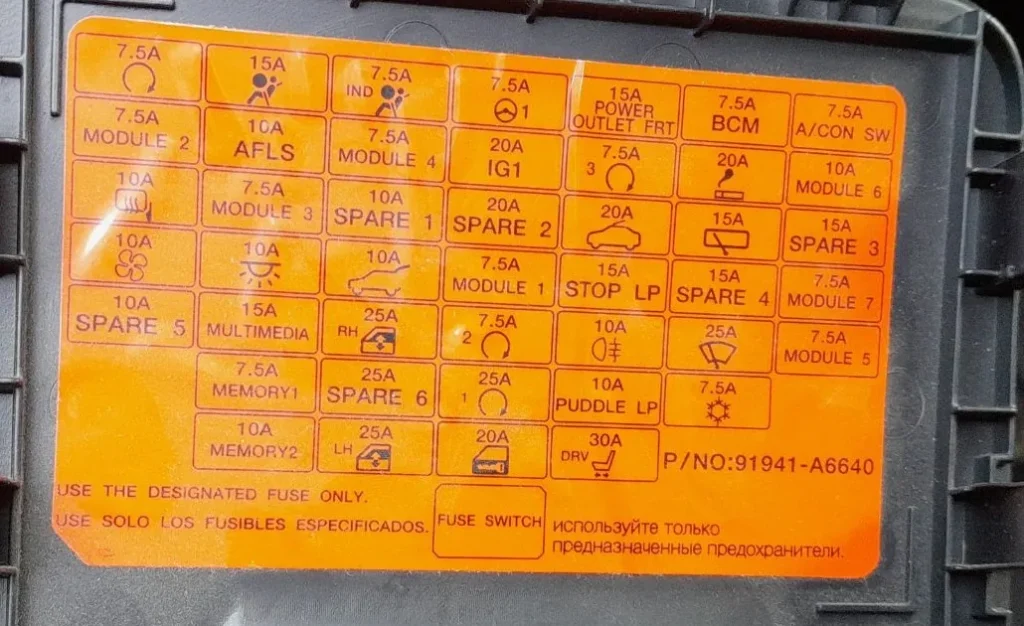
These are all small blade fuses and follow the standard color code (7.5 A brown, 10 A red, 15 A blue, 20 A yellow, 25 A clear, 30 A green).
| Symbol | Fuse | Rating | Protects |
|---|---|---|---|
| Cigarette lighter | 20 A | Console cigar lighter / rear 12 V socket | |
| Power outlet (front) | 15 A | Front 12 V accessory socket | |
| — | Multimedia | 15 A | Audio / head unit, navigation, DC-DC |
| — | Stop lamp | 15 A | Brake / stop-light switch |
| — | Tailgate | 10 A | Tailgate / boot release, reversing camera |
| Door lock | 20 A | Central door locking & alarm | |
| Sunroof | 20 A | Panoramic sunroof motor | |
| — | IG1 | 20 A | Ignition-on feed (junction box) |
| Front wiper | 25 A | Front wiper motor & rain sensor | |
| Power window LH | 25 A | Driver (left) window, anti-pinch module | |
| Power window RH | 25 A | Passenger (right) window module | |
| Driver power seat | 30 A | Driver electric seat | |
| Rear wiper | 15 A | Rear wiper motor | |
| — | Rear fog lamp | 10 A | Rear fog light |
| Heated mirrors | 10 A | Door-mirror defrost, mirror fold | |
| Blower | 10 A | Climate blower control | |
| AFLS | 10 A | Adaptive front-lighting / headlight leveling | |
| Puddle lamps | 10 A | Door courtesy / puddle lights | |
| Interior lamp | 10 A | Cabin, glovebox & luggage lights | |
| A/C | 7.5 A | Air-conditioning control module | |
| A/C switch | 7.5 A | A/C panel (A/CON SW) | |
| — | BCM | 7.5 A | Body control module |
| Airbag (A/BAG) | 15 A | SRS airbag control module | |
| Airbag indicator | 7.5 A | Airbag warning light (cluster) | |
| PDM 1 | 25 A | Smart-key power supply | |
| PDM 2 / 3 | 7.5 A | Smart-key module, Start/Stop button | |
| MDPS | 7.5 A | Electric power steering control | |
| Start | 7.5 A | Start / ignition-lock circuit | |
| — | MEMORY 2 | 10 A | Clock, cluster, TPMS, OBD socket, BCM |
| — | MODULE 1–7 | 10 A | Control-module feeds (7.5–10 A each) |
Engine-bay fuse box


| Symbol | Fuse | Rating | Protects |
|---|---|---|---|
| MDPS | 80 A | Electric power steering main supply | |
| B+2 (SJB) | 60 A | Smart junction block main supply | |
| — | PTC | 60 A | Diesel PTC cabin heater (diesel only) |
| B+1 (SJB) | 50 A | Smart junction block supply | |
| B+3 (SJB) | 50 A | Smart junction block supply | |
| Blower | 40/50 A | Heater blower relay — 40 A petrol / 50 A diesel | |
| — | IG1 | 40 A | Ignition-1 feed (junction box) |
| — | IG2 | 40 A | Ignition-2 / start feed |
| — | (P) 1 | 40 A | Junction-box power supply 1 |
| — | (P) 2 | 30 A | Junction-box power supply 2 |
| ABS 1 | 40 A | ABS / ESC pump motor | |
| ABS 2 | 20 A | ABS / ESC control | |
| RR HTD | 40 A | Heated rear window relay | |
| — | Front de-icer | 30 A | Windshield de-icer (if equipped) |
| IGN COIL | 20 A | Ignition coils & capacitor (petrol) | |
| ECU (main) | 20 A | Engine control (ECM / PCM) | |
| F/PUMP | 15 A | Fuel-pump relay | |
| Horn | 15 A | Horn & alarm horn relay | |
| — | TCU | 15 A | Transmission control (automatic) |
| Ignition / sensors | 15 A | ECM/PCM, ignition, sensors (petrol & diesel) | |
| Injector | 10 A | Fuel injectors | |
| Engine control feeds | 10 A | ECM/PCM, O₂ sensors, solenoids (10 A each) | |
| ABS / ESC sensors | 10 A | Stop-lamp switch, air-flow & ESC sensors | |
| — | Back-up lamp | 10 A | Reversing lamp, auto-dim mirror |
| — | Spares | — | Spare holders (7.5–25 A) |
How to check and change a fuse
- Turn the ignition off and switch off the circuit that isn’t working.
- Open the fuse-box cover and find the fuse using the symbol on the lid and the table above.
- Pull the fuse straight out with the plastic puller clipped inside the engine-bay box — never metal tweezers.
- Hold it to the light: a blown fuse has a broken metal strip inside.
- Fit a new fuse of the same rating (same color for blade fuses) and push it fully home.
If the new fuse blows again
A fuse that blows again right away means a fault in that circuit — a chafed wire, a failed component or a short. Do not fit a higher-rated fuse: the rating protects the wiring, and a bigger fuse can cause overheating or a fire. Have the circuit checked; any stored trouble code can be read on autodtcs.com.
Frequently Asked Questions
Where is the interior fuse box on a Hyundai i30 GD?
Low on the driver’s side of the dashboard, above the pedals, behind the hinged cover marked “FUSE OBD” — the same recess that holds the diagnostic socket.
Which fuse is the cigarette lighter / 12 V socket?
On this car the front accessory socket runs off a 20 A fuse and the front power outlet off a 15 A fuse in the cabin box. Confirm against the symbols on your own lid.
What is the FUSE SWITCH in the interior box?
It’s a battery-saver cut-off. If the car will sit unused for a long time, turning it OFF isolates some circuits to slow battery drain. Leave it ON for normal use.
Can I fit a higher-rated fuse if one keeps blowing?
No. The rating protects the wiring, not the fuse. A repeatedly blowing fuse is a fault to diagnose, and a stored code can be read on autodtcs.com.
Independent guide — not affiliated with Hyundai. Always follow your official service manual and safety precautions. Read our full disclaimer.