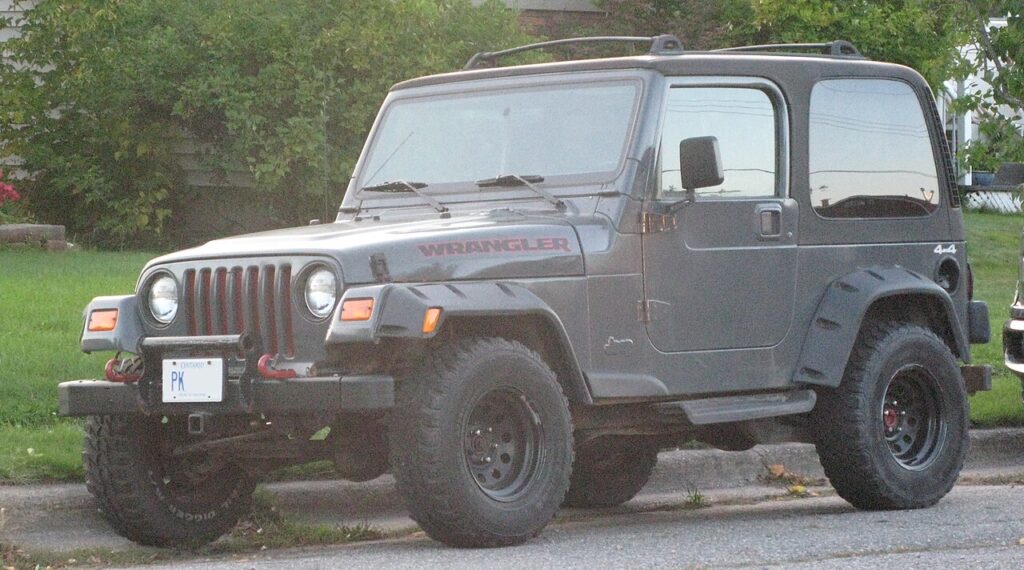
These instructions apply to the Jeep Wrangler Mk2 (TJ) 1997-2006.
For other models, please choose your vehicle here.
The Jeep Wrangler TJ (1997–2006) is old enough that keyless entry was never a given — base SE and early Sport trims often left the factory with nothing but a cut metal key and manual door locks. Where remote central locking was fitted, the TJ used a small separate clip-on three-button fob from the Chrysler/Jeep family of that era (FCC ID GQ43VT9T and its relatives) — not an integrated flip key. The transmitter and the ignition blade are two different objects on your keyring, which changes how you think about a dead battery: on a TJ a flat fob only stops the remote locking. The engine still starts on the mechanical key every time. Here is how to tell the cell is going, the exact batteries the TJ fob takes, and how to open it without cracking the case.
How to Tell the Fob Battery Is Dying
- Shrinking range. You find yourself standing right next to the Jeep — or almost touching the fob to the door — before it will lock or unlock. On a fob this old, fading range is the first and most reliable sign.
- The LED goes dim or dark. The GQ43VT9T-type fob has a small indicator light that flashes when you press a button. When it barely lights, or won’t light at all, the coin cells are nearly flat — a quick way to confirm the problem is the fob and not the car.
- No dash warning to rely on. The TJ predates “key battery low” cluster messages, so you won’t get a text prompt — the only feedback is range and the LED. Don’t wait for a warning that never comes.
- Cold-weather dropouts. A tired lithium cell sags in low temperatures, so buttons that work in a warm garage may quit on a frosty morning.
A pair of coin cells in a lightly used TJ remote typically lasts two to four years. If yours is older and showing any of the above, fit fresh cells before suspecting the receiver.
The Battery You Need
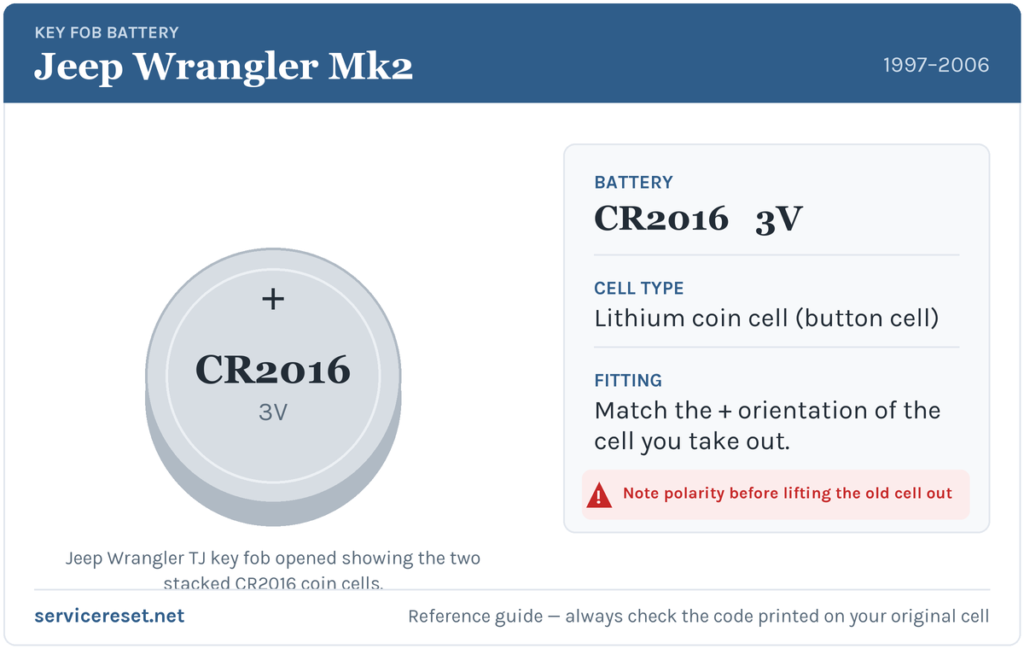
The TJ’s factory fob takes two CR2016 3-volt lithium coin cells — stacked one on top of the other, not a single thicker cell. This is the important part: do not reach for a CR2032 just because it is the “usual” fob battery and also reads 3 volts. A CR2016 is half the thickness of a CR2032; two of them stacked give the right total height to sit against the contacts, whereas one CR2032 will not seat correctly and can jam or crack the housing. Buy a good branded pair (Energizer, Duracell, Panasonic, Sony) — cheap cells sag under the brief high current the transmitter draws and give short range even when “new.” CR2016s are sold anywhere watch and hearing-aid batteries are.
Method — Opening the TJ Fob and Swapping the Cells
- Look along the edge of the fob for the seam where the two halves meet, and the small notch or lip meant for a tool. There is no screw on this fob — it is a pry-apart case.
- Insert a coin or a small flat-blade screwdriver into the notch and gently twist to pop the seam. Work around the edge easing each clip in turn rather than forcing one spot — the plastic is old and brittle, so patience beats pressure.
- Lift the halves apart to expose the two stacked coin cells. Note exactly how they sit before you touch them — both cells face the same way, and the orientation of the originals is your reference.
- Ease the old cells out. Fit the two fresh CR2016s the same way round as the ones you removed, stacked together, seated flat against the contacts. Handle them by the edges — finger grease on the faces can cause poor contact.
- Line the two halves up and press them together until every clip snaps home. A gap at the seam usually means a clip hasn’t engaged or a cell isn’t seated — open it and reseat rather than squeezing harder.
⚠️ Match the orientation of the cells you removed. Both CR2016s go in the same way up, matching the originals. A cell fitted the wrong way round bridges the contacts incorrectly and the fob simply won’t transmit — so copy what came out rather than guessing.
Make Sure It Took
Stand back a few metres and press lock, then unlock. Full range and a bright LED flash should return straight away. If the doors respond but the range still seems short, open the fob again and confirm both cells are seated firmly and both facing the correct way — a loose or slightly cocked cell in a stacked pair is the usual reason for a weak signal after a fresh battery.
If a Fresh Cell Doesn’t Fix It
- Re-check the stack. Two cells means two chances to get it wrong — both must face the same way and sit flat. This is the single most common mistake on a twin-cell fob.
- Clean the contacts. Wipe the metal terminals and the cell faces with a dry cloth; light corrosion or grease on a decades-old fob is enough to cause dropouts.
- Try the door lock manually. Because the TJ always locks and starts on the mechanical key, you can rule the car in or out easily — if the key works but the remote won’t after new cells, the fault is in the fob or its pairing, not the vehicle.
- Suspect the pairing if it died suddenly. A remote that stopped all at once — rather than fading — especially after the car battery was disconnected, has more likely lost its programming than run its cells flat.
New Fob or Spare — Why It’s Usually a Locksmith Job
Changing the cells keeps the fob’s existing coding, so a battery swap needs no programming — the remote works the moment it powers back up. A new or replacement fob is different: a blank GQ43VT9T-type remote has to be programmed to your Jeep before it will lock or unlock anything. On some Chrysler-family vehicles of this era that can be done through an on-board ignition-cycling routine when you already have working remotes to hand; otherwise it is a job for a Jeep dealer or an auto-locksmith with the right scan tool. Either way, keep the battery in your spare fob fresh too — the cheapest way to avoid a programming bill is to never be down to one working remote.
Frequently Asked Questions
What battery does a Jeep Wrangler TJ key fob take?
The factory clip-on remote uses two CR2016 3-volt lithium coin cells, stacked together — not a single CR2032. Two thin CR2016s make up the correct height; one CR2032 is too thick and won’t seat properly.
Does my TJ even have a key fob?
Not necessarily. Remote keyless entry was optional on the TJ, and many base SE and early Sport models were built without it. If you only ever had a plain cut key and manual locks, there is no fob to re-battery — that’s original to the vehicle, not a fault.
Which way up do the two cells go?
Both CR2016s face the same direction, matching the originals. Note the orientation before you remove the old pair and copy it exactly — a reversed cell stops the fob transmitting.
Do I need to reprogram the fob after changing the battery?
No. A battery swap doesn’t affect the coding, so the fob works straight away. Only a brand-new replacement remote needs programming to the vehicle.
Can I still drive the Wrangler if the fob is dead?
Yes, easily. The TJ locks and starts on its mechanical key regardless of the remote, so a flat fob only means you lock and unlock the doors by hand until you fit new cells. A dead fob never strands a TJ.
How long should the fob battery last?
Two to four years is typical for the twin CR2016 pack, depending on how often you use the remote. If your fob has been on the same batteries for years, replacing both cells is cheap insurance.
If the remote quit suddenly right after the Jeep’s battery was disconnected or ran flat — rather than fading over weeks — a lost pairing or a body-control fault is more likely than the coin cells, and the car may have logged a code worth reading on autodtcs.com.
Independent guide — not affiliated with Jeep. Always follow your official service manual and safety precautions. Read our full disclaimer.