These instructions apply to the Mitsubishi Outlander Mk3 PHEV (GG2W) 2014-2021.
For other models, please choose your vehicle here.
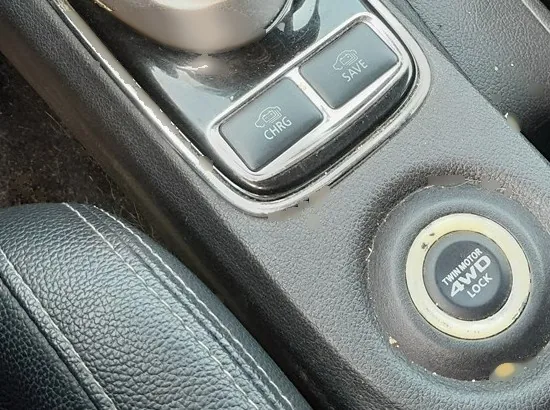
The Mitsubishi Outlander PHEV drives on electricity by default whenever there is charge and conditions allow; the petrol engine steps in automatically — as a generator or to help drive the wheels — only when needed. Three buttons, plus the B setting on the selector, let you save charge, make more, or recover more energy on the move. Here is what each one does.
EV mode: the default electric drive
With charge in the drive battery the Outlander PHEV pulls away and drives on its electric motors alone, using no fuel. You do not select this — it is the normal state whenever there is battery charge and conditions allow. The car quietly switches the engine in (as a generator or, at higher speeds, to help drive the wheels) when it needs to, then returns to electric running on its own.
SAVE: hold on to the charge you have
Press the battery save switch and the car stops running the drive battery down, using the engine in series or parallel hybrid mode to hold the current charge instead. Use it on a motorway run so you arrive with battery left for quiet, zero-emission driving in town or at your destination. Press it again to cancel; a display in the instrument cluster confirms when SAVE is active.
CHARGE: top the battery up with the engine
Press the battery charge switch and the engine runs to charge the drive battery back up to roughly 80% while you drive. It is worth doing before a long, steep climb so you have full electric assistance in reserve. Press it again to cancel. Because the engine is working harder, CHARGE increases fuel use — and, as it runs the engine, never use it in a closed garage or other enclosed space.
B mode: stronger regenerative braking
Move the selector across to B (you can select B only from the D position) to increase how strongly the car slows and recovers energy when you lift off. From there the steering-wheel paddles fine-tune it: pull the − paddle to step the regenerative braking up a level at a time, and hold the + paddle for about two seconds to return to normal D. It gives a one-pedal feel on descents while sending energy back to the battery — but it is not a substitute for the brakes, so keep your foot ready for the brake pedal. For how the selector itself works, see the Outlander PHEV gear-selector guide.
Twin Motor 4WD LOCK
The Outlander PHEV drives all four wheels with a motor at each axle (Mitsubishi’s S-AWC system). Pressing the 4WD LOCK button biases the system for maximum grip on wet or snowy surfaces; press it again to return to NORMAL. It improves stability and traction but does not change the laws of physics — keep speeds sensible for the conditions.
Why the engine sometimes starts on its own
Even in electric driving, the engine may start automatically to protect the car or meet demand — for example under hard acceleration, on a long climb, when the drive battery is low, in very hot or very cold weather, when the cabin heater or air conditioning needs it, or simply because the car has not been run or refuelled for a long time. This is normal hybrid behaviour, not a fault. If instead the car is completely dead and will not start at all, that is usually the 12-volt battery — see how to jump-start the Outlander PHEV.
Which mode, when
- Around town / short trips: leave it in normal EV driving — quiet, fuel-free running.
- Motorway before a town stop: press SAVE to arrive with battery for electric driving where it matters.
- Before a long, steep climb: press CHARGE for a few minutes first so you have full electric assistance in reserve.
- Long descents: use B and the paddles to recover more energy and hold your speed.
- Wet or snowy roads: press 4WD LOCK for maximum grip, then return to NORMAL.
Frequently asked questions
What is the difference between SAVE and CHARGE?
SAVE holds the battery at its current level so you don’t use it up; CHARGE actively runs the engine to put charge back in, up to about 80%. Use SAVE to ration what you have for later, and CHARGE to build a reserve before you need electric assistance.
Does using CHARGE cost more fuel?
Yes. CHARGE makes the petrol engine work as a generator, so it burns more fuel than letting the car manage itself. It is best kept for specific situations, such as before a long mountain climb, rather than used all the time.
Can I get one-pedal driving in the Outlander PHEV?
Close to it. Select B and pull the − paddle to raise the regenerative braking to its strongest level; the car then slows firmly as you lift off and feeds energy back to the battery. It still is not a full stop-and-hold, so keep your foot ready for the brake.
If a warning light appears alongside any of these modes, you can check what the specific dashboard symbol or fault code means on autodtcs.com.
Independent guide — not affiliated with Mitsubishi. Always follow your official service manual and safety precautions. Read our full disclaimer.