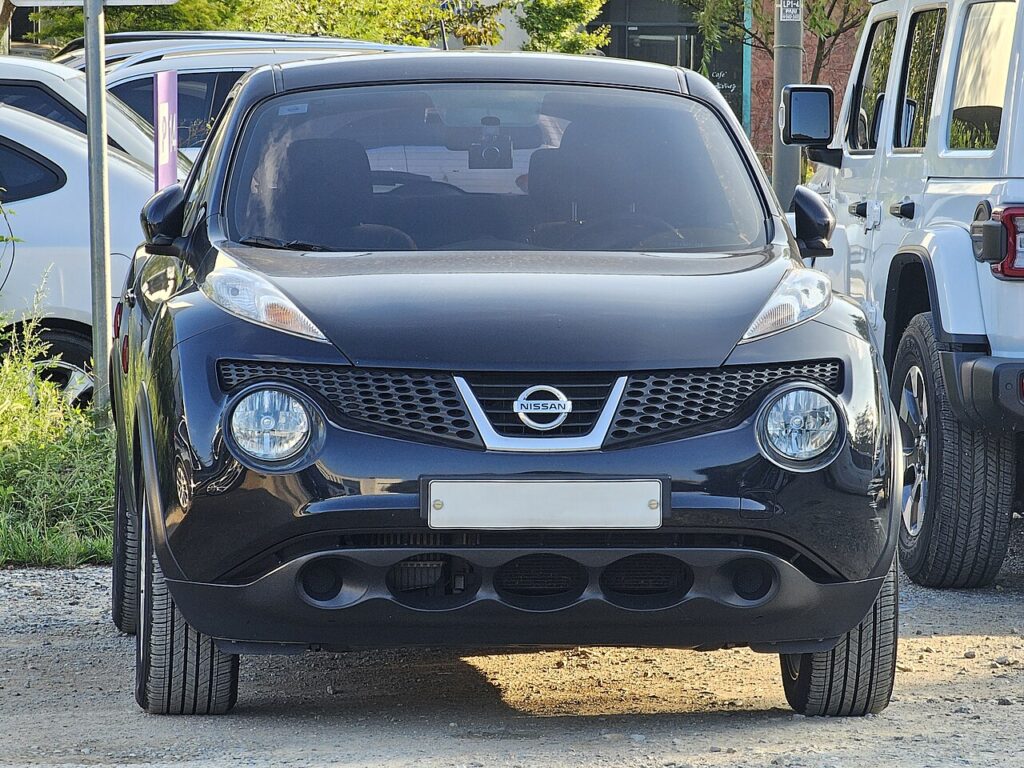
These instructions apply to the Nissan Juke Mk1 (F15) 2010-2019.
For other models, please choose your vehicle here.
On the Nissan Juke (F15, 2010–2019), a flat key-fob battery does not strand you. Juke models fitted with the Nissan Intelligent Key and a push-button START/STOP ignition can still be started by holding the fob against the button, while base trims with a bladed turn-key simply start as normal. This guide walks through both, plus unlocking with the hidden mechanical key and swapping the coin cell.
Start a push-button Juke with a dead fob battery
The START/STOP button on the Juke houses a backup antenna that reads the Intelligent Key’s transponder chip directly, with no fob battery needed.
- Sit in the driver’s seat with the doors closed and press the brake pedal fully.
- Hold the Intelligent Key so the Nissan badge side touches the START/STOP button.
- Keep the fob pressed against the button and push the button at the same time.
- The car detects the chip and the engine cranks. Once running, you can set the fob aside, but do not switch off until you have fitted a fresh battery.
If your Juke has a conventional key blade and ignition barrel instead of a button, just insert the key and turn it — the fob battery plays no part in starting that variant.
Unlock the doors with the mechanical key
A dead fob also means the remote buttons will not unlock the car, so use the emergency blade hidden inside the Intelligent Key.
- Slide the small release catch on the back of the fob and pull the metal blade free.
- Insert the blade into the lock on the driver’s door and turn to unlock.
- Open the door. The alarm may sound briefly until you start the car with the key recognised inside.
Immobiliser note
The Juke’s immobiliser reads a passive transponder built into the Intelligent Key. Because that chip is powered by the radio field from the start button (not the coin cell), the engine will still recognise an authorised key with a completely dead fob battery. A flat battery only disables the remote locking and the proximity (walk-up) features.
Replace the key-fob battery
The first-generation Juke Intelligent Key uses a CR2025 3 V coin cell (a CR2032 is the same diameter and voltage and is widely used as a longer-life substitute).
- Slide out the mechanical blade first, then prise the fob halves apart at the seam with a coin or small flat screwdriver.
- Lift out the old cell and fit the new one with the same side facing up (usually the positive + face).
- Click the case back together and reinsert the blade. Test the lock/unlock buttons.
Frequently Asked Questions
Why won’t my Nissan Juke detect the key? The most common cause is a flat fob battery. Touch the fob to the START/STOP button to start, then replace the CR2025 cell.
Does the touch-to-start trick work on every Juke? It works on Juke trims with the push-button ignition. Lower-spec cars with a turn-key barrel are unaffected by a dead fob and start normally.
Will a dead fob battery damage anything? No. It only disables remote locking and walk-up detection. The immobiliser transponder is passive and keeps working.
Can I use a CR2032 instead of a CR2025? Yes. It is the same diameter and 3 V output, just slightly thicker, and many owners prefer it for the longer life. It fits the Juke fob.
The car started but the key warning stays on — is that normal? Yes, the dash will keep warning of a weak key until you fit a new battery. Replace the cell and the message clears.
For dashboard warning lights or fault codes that appear alongside a key-detection problem, our sister site autodtcs.com explains what each OBD-II trouble code means.
Independent guide — not affiliated with Nissan. Always follow your official service manual and safety precautions. Read our full disclaimer.