These instructions apply to the Peugeot 5008 Mk2 (P87) 2017-Present.
For other models, please choose your vehicle here.
The Peugeot 5008 Mk2 (P87, 2017–present) learns a reference set of tyre pressures, so after you inflate or change a tyre you re-initialise it from the i-Cockpit menu. Here’s how to clear the warning. The tyre alert is a monitoring message rather than a mechanical fault — it means a pressure has moved away from the stored reference, and once you set the tyres correctly and store a fresh baseline it goes out.
What the Warning Means on the 5008
The amber tyre symbol is a low-pressure alert, not a sign that something has broken. It usually points to a slow puncture, a nail or screw picked up on the road, a cold spell that has pulled every pressure down, or simply a recent top-up or wheel change that shifted the readings. As a seven-seat family SUV the 5008 often carries a full load, which changes the recommended pressures, so it is worth setting the tyres to the right figure for how the car is loaded before you clear the light.
How the System Works
The 5008 uses an indirect system: instead of a sensor inside each wheel, it watches how fast each wheel is turning through the ABS. A softer tyre has a slightly smaller rolling radius and spins marginally faster, and the car spots that difference. This is why there is a menu step rather than a button — after you set the pressures you must store the current values as the new reference, so the system knows what “correct” looks like.
Set the Pressures First
Inflate all four tyres cold to the figure on the driver’s door-pillar label, then store the new reference.
Before You Start
- Check the tyres cold, before driving or after the car has stood for a couple of hours — warm tyres read high.
- Use the exact figure from the driver’s door-pillar label, and pick the fully-laden value if the car is loaded with passengers and luggage.
- Set all four tyres correctly — the reference is only as good as the pressures you store.
- Do the initialisation with the car stationary and the ignition on, not while driving.
How to Reset the 5008 TPMS
- Park the car and turn the ignition on.
- Press the ‘MENU’ button and select ‘Driving’ (driving assistance).
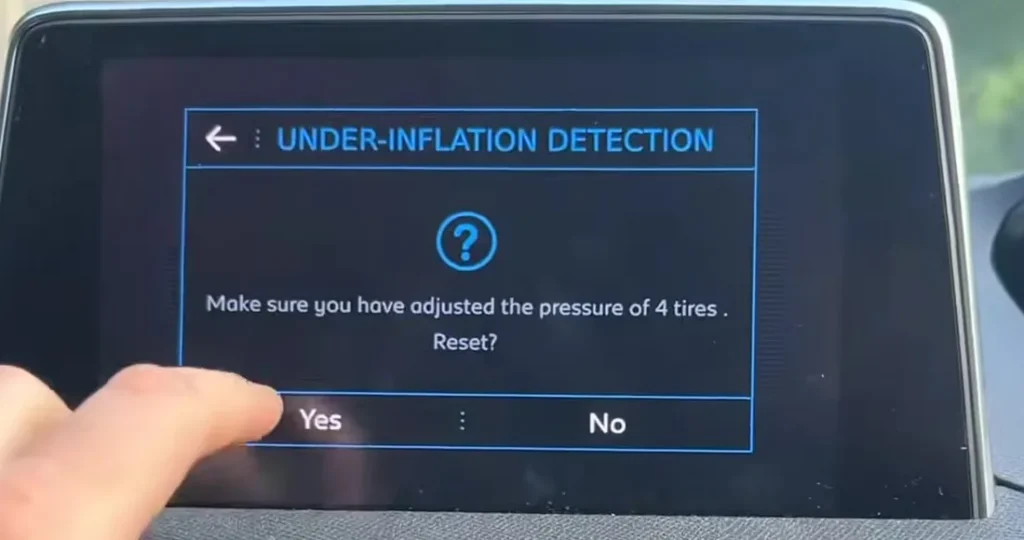
- Select ‘Under-inflation initialisation’, then ‘YES’.
- The system stores the current pressures as the reference — the warning clears.
If the Light Stays On
- Re-check every tyre — one low corner keeps the warning on even after initialisation.
- Always re-initialise after inflating or a wheel change — the system needs the new baseline stored.
- Look for a slow puncture — if a tyre keeps dropping, storing a new reference won’t help; find the leak.
- Set the pressures accurately — storing a reference while a tyre is a few psi low simply teaches the car the wrong baseline.
- Cold weather can re-trigger the alert; top up to the label figure and re-initialise on a cold morning.
- If the warning returns quickly every time, a stored fault may be involved — check any code on autodtcs.com.
What to Expect After
Once you confirm the initialisation, the car takes the current pressures as its new “correct” point and the amber tyre symbol goes out. It should stay off for the rest of the journey and beyond, provided the tyres hold their pressure. Because the system is indirect, it settles over the first few minutes of driving; if you swap wheels or adjust pressures again later, just repeat the same menu step.
Frequently Asked Questions
How do I reset the tyre pressure light on a Peugeot 5008?
Set all four tyres to the label pressures cold, then with the ignition on press MENU → Driving → Under-inflation initialisation → YES. The car stores the current pressures as its new reference and the warning clears.
Do I need a tool?
No. The 5008 stores the reference from its own menu, so no diagnostic tool or in-wheel sensor programming is involved. Getting the pressures right before you initialise is the only thing that matters — the menu step does the rest.
Why does the light come on in cold weather?
Pressures fall by roughly 1 to 2 psi for every 10 °C drop, so a cold night can push a tyre below the stored reference. Top every tyre up to the label figure and re-initialise, and the alert should stay off once the pressures are back to spec.
It came on after a wheel change — why?
The reference moved. Fitting different wheels or resetting the pressures changes what the system reads, so the old baseline no longer matches. Re-run the initialisation so the new pressures become the reference and the warning clears.
Do I need higher pressures with seven aboard?
Often yes. The door-pillar label usually lists a higher fully-laden figure for a full car with luggage. Set the tyres to that value when you travel loaded, then re-initialise, so the system’s reference matches how the 5008 is actually being used.
The warning came back a day later — is a tyre leaking?
Possibly. If the alert returns soon after a correct initialisation, one tyre is likely losing air through a slow puncture, a porous valve, or a poor rim seal. Re-check all four cold; if the same corner is always down, have it inspected rather than repeatedly resetting.
If a fault code is stored, look it up on autodtcs.com. To clear a service reminder, see our 5008 Mk2 service reset.
Independent guide — not affiliated with Peugeot. Always follow your official service manual and safety precautions. Read our full disclaimer.